Silence and Solitude: Tools of the Soul

For the past three days I’ve been attending a work-related conference on health communication, marketing and media. As you might expect, almost every session refers to the “new media” tools used to communicate in today’s digital world.  “Facebook and Twitter” is spoken as a single word, and it’s invariably followed by other social media tools used both to communicate and measure that communication. Topics such as “engagement,” “reach,” “influencing,” and being “connected” with one’s target audience are pervasive.

A monarch butterfly enjoys the garden at Thomas Jefferson’s Monticello.

I get that this is the world in which we live. I also understand that these tools are just that — tools in a larger toolbox that has been around since the first humans realized that they were not alone, that there were others like them, and that they wanted to reach out to others, interact with others, and be connected. The need and desire for human connectedness is even more self-evident than the truths penned by Thomas Jefferson; we are social beings, and we want to know one another, to interact with one another, to touch one another.

Yet, in the midst of all the talk of connectedness, I’ve found myself these past days seeking and relishing moments of quiet and solitude. And by that I don’t mean time simply alone.  As a single man I have lots of that! I am by myself more than I am with others, and so the need I’ve been experiencing went beyond that. I’ve been experiencing a need to be “disconnected” from all the texts and tweets and emails and surfing and simple “noise” that at times can be so very overwhelming.  Perhaps that’s why I find myself now — in the middle of the night — sitting in the silence of a darkened hotel room, relishing the silence and the opportunity to be alone in a deeper, more profound way.

A large bird — is it a vulture? — flies overhead at Monticello.

Silence and solitude are tools, too. They are not the tools of social engagement, but are the tools of the soul. Without our occasional (dare I say regular?!) forays into silence and solitude, our souls in shyness can become bewildered. When we are so utterly “connected” and so constantly engaged with an outward gaze, we can lose the necessary perspective that an inward gaze provides. We can lose touch with the deepest part of who we are, or even forget that there is a part of who we are that doesn’t need our gadgets and technologies.  What I’m speaking of is not so much the need to be disconnected from that which is outside of us, but rather the need to be equally connected with that which is within us. Deeper connection with myself, and with the Other Whom I find in the quiet depths of my soul forms and informs and blesses my connections with others.

Even more than FB and Twitter, Silence and Solitude are tools everyone can use (and there’s no username of password required!).


Reconciliation, Forgiveness, and “Letting go”

Yesterday, in reflecting on some particular aspects of my life over the past few years, I found myself meditating on the difference between Reconciliation and Forgiveness.

Fr Rohr’s daily meditation is timely:

“The religious word for this letting go is forgiveness. You see the imperfect moment for what it is, and you hand it over to God. You refuse to let any negative storyline or self-serving agenda define your life.”

To let go isn’t always easy, especially when there is the need for forgiveness without the possibility of reconciliation. Reconciliation with another means both must be involved; both must actively be seeking to mend that which has been injured or broken. Forgiveness, on the other hand, is something I can (and often must) do on my own. When we find ourselves in situations where, for whatever reasons, the cooperative work of reconciliation isn’t possible, we must still work to find the ability to forgive, lest we allow some past hurt or injury to keep us from being who we are called to be.

And, as Fr. Rohr points out, letting go of something doesn’t mean simply ignoring it, denying it, or tossing it away with the morning trash. It means handing it over to God, trusting that God will do with it whatever is best to bring about full healing in ways we can’t even imagine.

Fidelity Oaths Revisited – part 1

Last week I wrote briefly about the rise in so-called “fidelity oaths” in which Church workers are being asked by local bishops to pledge their belief in and support of positions put forth
by Church office-holders.

As I concluded my comments I wrote this: “Anyone who fully understands and values the breadth and depth of Catholic Christianity must be appalled by this trend, especially when such oaths appear to be written in ways that clearly are contrary to Catholic teaching.”

I realize that this broad declaration needs further clarification, not only for those who may be less familiar with the “breadth and depth of Catholic Christianity,” but also for those who may be wondering why, precisely, might such oaths be “contrary to Catholic teaching.”

Here are three reasons:

  1. First, they offend the principle which respects the primacy of the well-formed conscience in moral decision-making.
  2. Second, they can exemplify a type of creeping infallibility that seems to be a growing trend in some quarters of the Church.
  3. Third, and most important, they seem to usurp the fidelity oath that we already have as Catholic Christians, i.e. the Creed or Profession of Faith we profess at every Sunday liturgy.

I’ll write about each of these over the next week or so. But in order to understand the first point in particular, as well as to set this in a specific context, it would be helpful to look specifically at an example of what one such “fidelity oath” states and demands. As referenced in the Washington Post article, the former bishop of the Diocese of Baker (Washington) included the following in that diocese’s 201-page Pastoral Guidelines from 2006 (full text here). (These Guidelines, by the way, go so far as to include the Archdiocese’s of Los Angeles’ list the vintages and vineyards of wines – California produced, of course – that are “approved to sacramental use.”).

Lest I be accused of taking something out of context, here are three relevant sections:

25. The Affirmation of Personal Faith asks candidates for ministry to state unequivocally: “I believe and profess all that the Holy Catholic Church teaches, believes and proclaims to be revealed by God.” This carries with it the affirmation of specific teachings of the Catholic Church. A non-exhaustive list of these is provided in the form of individual affirmations. They include statements on the inviolability of human life, the sinfulness of contraception, the evil of extra-marital sexual relationships, the unacceptability of homosexual relationships, the wrongness of cohabitation before marriage, the significance of the Real Presence of Christ in the Eucharist, the legitimacy of Marian devotions, the existence of hell and purgatory, the uniqueness of the Catholic Church, the legitimacy of the Holy Father’s claim to infallibility and the moral teaching authority of the Catholic Church.

26. It is hoped that no one who presently serves will be excluded from future ministry as a result of this insistence on a clearer Affirmation of Personal Faith but if anyone is unable in good faith to make the Affirmation then this indicates a need to study and understand the Faith more thoroughly before seeking approval for public ministry. In the event that someone indicates that they cannot make the required Affirmation no public announcement will be made about the reasons for their end of service. An inability to make this Affirmation does not necessarily exclude someone from the possibility of receiving Holy Communion but it would indicate a need to look at his or her own life more carefully and consider, before God, the acceptability of his or her moral status.

27. While there is a possibility that someone may object that such a policy is an unjust infringement on an individual’s right and duty to follow their own conscience such an objection is invalid. Conscience is not something which exists in a vacuum. No one can claim a legitimate right to follow a conscience which is clearly not formed in a fashion consistent with the very clear teachings of the Catholic Church. The following of one’s own conscience is a strict moral obligation but that obligation is preceded by the obligation to assure that the conscience one is following is properly formed. When that conscience leads to judgments which are diametrically opposed to the clear and consistent teachings of the Catholic Church then the conscience has established itself as a new and individual, infallible personal magisterium which far exceeds the definition of conscience. Furthermore, it is one thing to claim a right to follow one’s conscience, even if it is erroneously formed, it is quite another to insist that one be afforded certain privileges, to which one has no right, while following that manifestly ill-formed conscience.

to be continued…

Morning Prayer

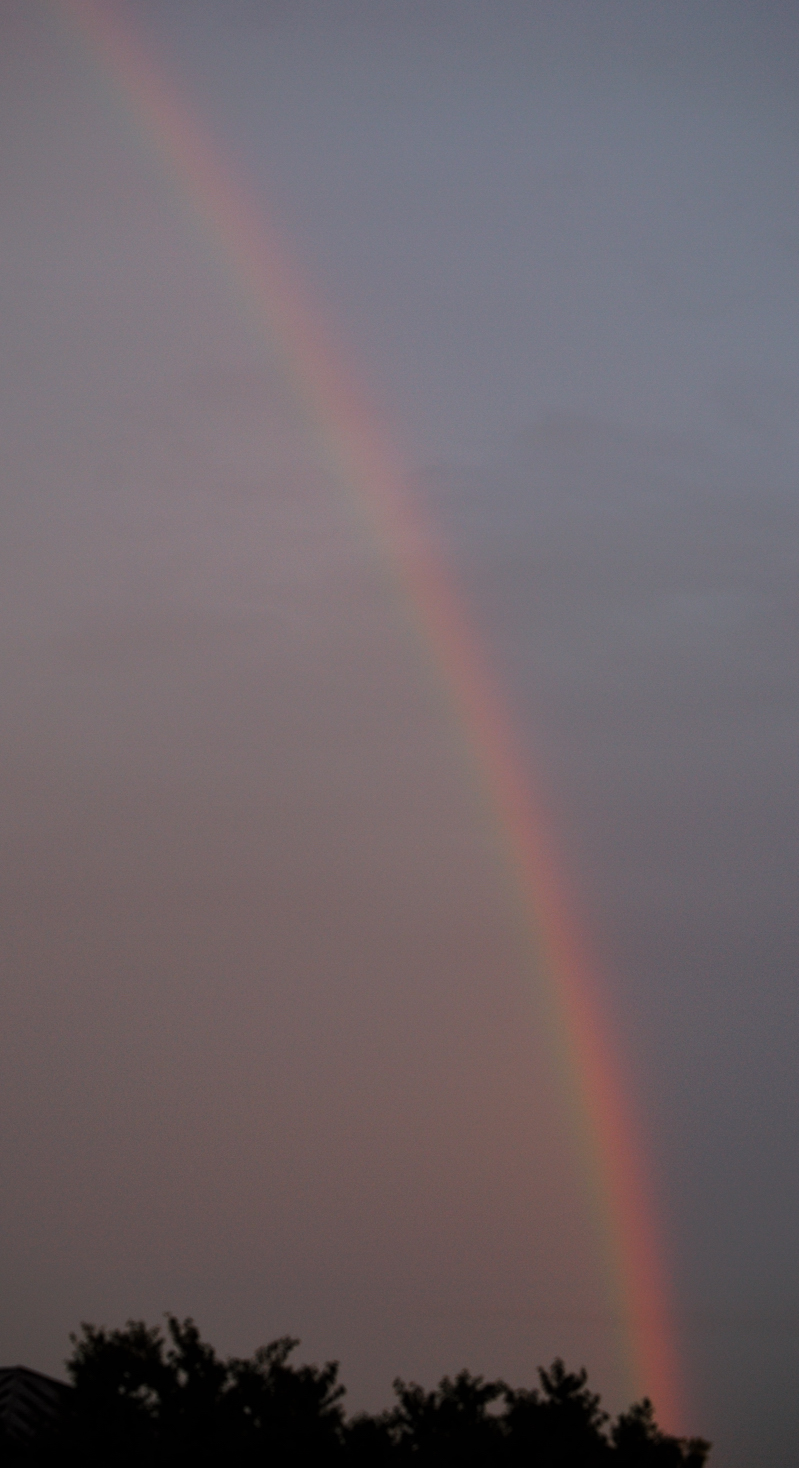
This rainbow — the perennial reminder of God’s promise — appeared in the Eastern sky after a brief rain on the ride back from a few days at the beach.

Lord, here and now I open my heart, my mind, my soul, my very self to the lessons of this day and all that You desire for me.

Bless at this dawn all people in my life — family, friends, co-workers, neighbors and even strangers.

Bless especially those whom I love and who have touched my heart, whether they know it or not.

Free me from all anxiety and sadness and doubt and fear.

Give me eyes to see and ears to hear all that is wondrous and beautiful in the world.

Help me to do some good — however great or small — so that this world and the world yet to come may be more closely united in the timeless Oneness of All.

Amen.

May the Prophets’ Voice be heard

“And whether they heed or resist–for they are a rebellious house–they shall know that a prophet has been among them.”

I was struck by this line from the first reading of today’s Liturgy. Ezekiel is forewarned that his words may or may not be heard, they may or may not be heeded.

What prophetic voices do I need to hear and heed? Who in today’s world is speaking Divine words to the obstinate of heart?

Twenty-five Years Ago Today ….

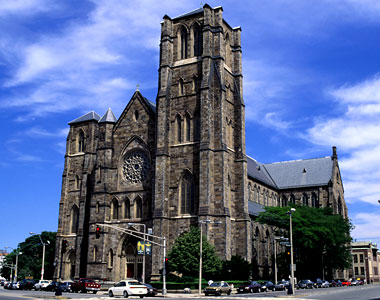
In part, this is how the Boston Globe reported (on June 21, 1987) what took place at the Cathedral of the Holy Cross twenty-five years ago today:

Fourteen seminarians were ordained to the priesthood by Cardinal Bernard F. Law yesterday in a ceremony at the Cathedral of the Holy Cross in Boston’s South End.

Of those ordained, 11 completed their studies at St. John’s Seminary in Brighton, two at Pope John Seminary for Delayed Vocations in Weston and one at North American College, Rome.

The ordained from St. John’s Seminary are Rev. Michael A. Alfano, Stoughton; Rev. Robert J. Bowers, Needham; Rev. David P. Callahan, Lawrence; Rev. Robert E. Casey, Dorchester; Rev. Thomas F. Coronite, Hingham; Rev. James A. Flavin Jr., Billerica; Rev. John W. Gentleman, Lynn; Rev. William M. Kennedy, West Roxbury; Rev. Timothy MacGeorge, Holliston; Rev. Paul G. McManus, Lynn and Rev. Paul F. Russell, Alpena, Mich., and formerly of Lynn.

The two seminarians from Pope John Seminary are Rev. Richard W. Fitzgerald, Boston, and Rev. Ronald A. Gomes, Cambridge.

Rev. Robert Congdon, of Millis, is completing his studies in Rome.

June 20, 1987 was unusually hot and humid in Boston, so you can imagine what it was like to be dressed not only in black, but also to be further garbed in the vestments of priestly ordination. Nonetheless, I still remember that day with great joy and happiness — despite being told by Cardinal Law just moments before the Liturgy of Ordination was to begin that we wouldn’t be sure we had vocations to the priesthood until the moment in the Liturgy when he, the archbishop, accepted the recommendation of the seminary rector and formally called us to ordination!

The past quarter of a century has lead the 14 of us ordained that day along different paths, down different roads.  Some are still active in priestly ministry, others (myself included) have felt called elsewhere. Catholic sacramental theology holds that ordination is irrevocable — once a priest, always a priest. And so while I could never have imagined then that I would be in life where I am now, I try as best as I can to bear the fruits of that special day in everything I do.

To my classmates, my brothers, my friends — you are in my thoughts and prayers this day and always.  Ad multos annos!

Is there room in our lives for another?

This is a question I’ve been meditating on in recent weeks, perhaps even longer. In his daily meditation continuing his reflections on Eucharist, Richard Rohr puts it this way:

Somehow we have to make sure that each day we are hungry, that there’s room inside of us for another presence [emphasis added]. If you are filled with your own opinions, ideas, righteousness, superiority, or sufficiency, you are a world unto yourself and there is no room for “another.”

As a gay man “of a certain age” who is also single and would prefer not to be, I wonder if the history of my own life sometimes gets in the way of having youth’s openness to possibility, to new experiences, and especially to new people whom God may bring my way?  I ask this of myself, but also wonder if it might be true for others who have also lived for some time, perhaps many years, establishing their own daily routines, interests, and ways of spending time? Are our lives so utterly fulfilling that there is no longer any room for “another”? How do my/your “independence” fit with our “interdependence” as neighbors, acquaintances, friends, dates or partners? As Fr. Rohr says, if there is no emptiness or hunger, then what is there to be satisfied? To be sure, only God can fulfill that ultimate emptiness and hunger so eloquently stated by Augustine — “My heart will not rest until it rests in Thee” — but are there not hungers at the level of human relationship and intimacy that we are called to fulfill for one another?

Just as there is possibility within every springtime bud, is there not great possibility within every human heart and soul?

The Gift of Birthdays

Yesterday was my birthday.

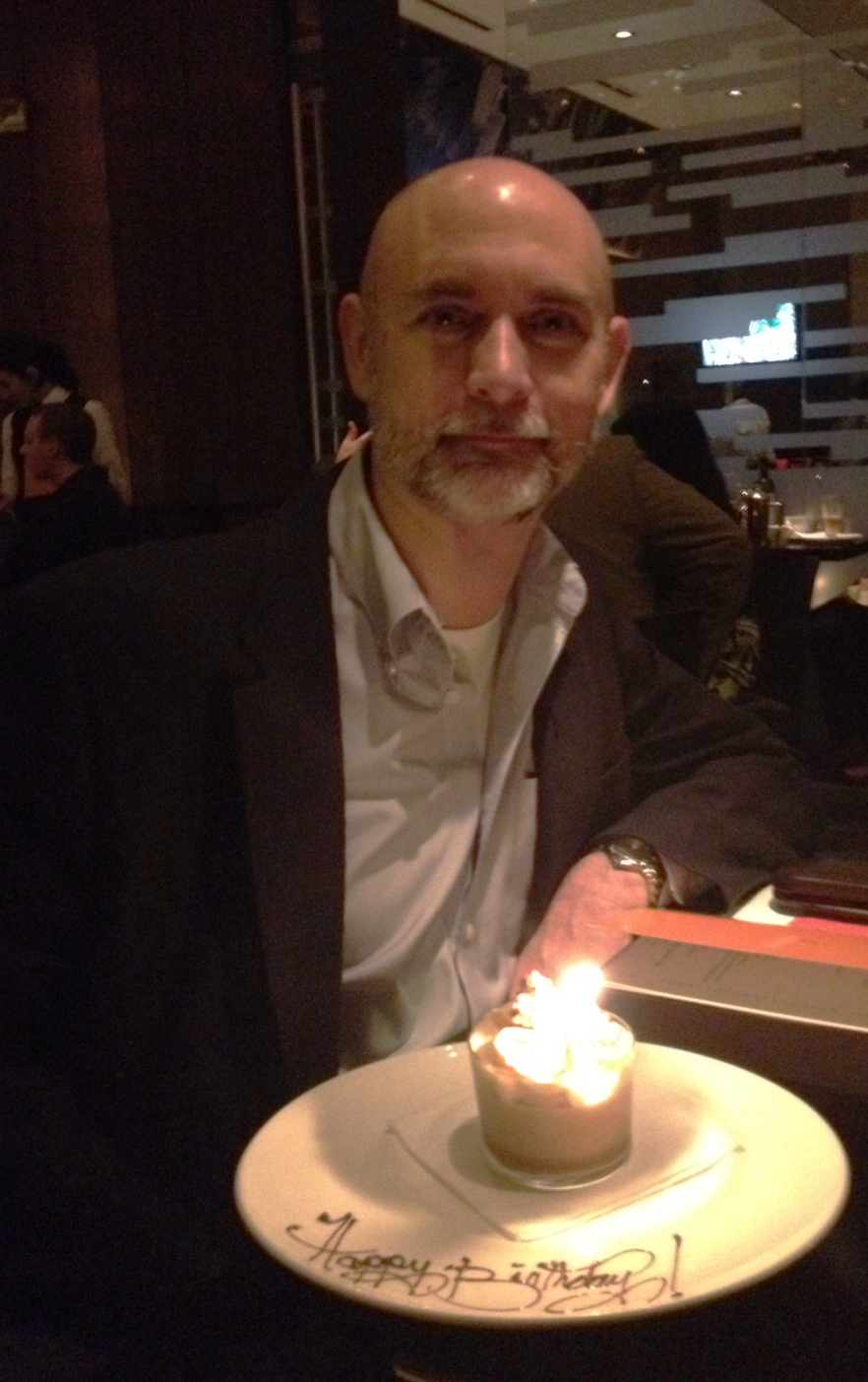
There really was just a single candle in my panna cotta, even though it looks like the fire department might be on its way!

I usually observe that day each year by taking off from work and going for a long walk here in DC.  Invariably I stop in to the National Gallery of Art (NGA) to enjoy the beauty of its architecture, sculptures, and other artwork from across the centuries.

Sometimes I just relax in the rotunda of the Gallery’s west wing, sitting back and taking in all the activity of visitors from around the country and around the world enjoying this national treasure.

While I wasn’t able to get away from work for the entire day, nor was I able to make it to the NGA, I did leave early and enjoyed a wonderful dinner with some special friends. Throughout the day I continued to be periodically delighted as more and more Facebook friends and acquaintances offered best wishes and congratulations. It felt good to be remembered.

Birthdays are gifts; they are snippets of time out of Time that encourage us to pause for a moment on our life’s journey —

remembering what was,

pondering what might be, and

most especially being grateful for what is.

Dignity/NoVA Celebrates 20th Anniversary

Dignity/NoVA recently celebrated its 20th Anniversary of serving the community of LGBT Catholics in the Northern Virginia area. On Saturday evening (May 12, 2012) an intrepid crew of about 30 members set sail for a three-hour tour on the Potomac, past the iconic monuments of DC and beyond the Georgetown harbor.

This slideshow requires JavaScript.

“Connected, but alone?” — Sherry Turkle’s TED Talk

If you’re not familiar with the TED Talks, you should be.  A “non profit devoted to ideas worth spreading,” TED (Technology, Entertainment, Design) engages in a number of activities that fulfill its mission:  Spreading ideas.

This TED Talk by psychologist Sherry Turkle looks at technology and texting and the many devices to which we have tied our ourselves, and wonders if expecting more from technology means we expect less of one another?

It’s a question that probably resonates with all of us.  I have a friend who, while no luddite, is definitely not infatuated with technology. I used to get slightly annoyed when I would call his cell phone and I’d get voicemail.  “Why doesn’t he answer?” I’d quietly wonder, thinking “I know he’s not at work, doesn’t he have his phone in his pocket, close at hand?”  When I was in his physical, real time company, however, I realized that his phone was not on, not accessible, and that if someone were trying to reach him, they’d get voicemail too.  You see, my friend had made choices about the importance of presence. He knew intuitively that “divided attention” is really “no attention,” and that when he is with he, he is truly with me. He knows that to be with another person, to enjoy his company, to engage her in conversation, all this means saying “Yes” to the “you” I’m with right now, and “No” — or at least, “Not right now” — to all others.

But it wasn’t this idea of presence that first jumped out at me. It was Turkle’s statement that our infatuation with technology and all our devices are getting in the way of people’s capacity for self-reflection. Time by oneself is necessary for healthy development, yet increasingly we hear of studies measuring the increased anxiety that comes with being “unconnected” to the virtual world.

Turkle is a psychologist and she speaks from that discipline. But it’s no great leap to hear her words from a spiritual perspective. The Hebrew and Christian scriptures are filled with examples bespeaking both the importance of true presence to one another, and the need for occasional trips into the desert, alone.

What richer lives we might lead if we can appreciate just a little more the real value of the present moment, including those moments of solitude which invite us more deeply into ourselves.  After all, it’s only by knowing ourselves as deeply as we can that we are able to share our true selves with one another.