
It was great to gather earlier this evening with students from CUAllies, the gay/straight alliance at The Catholic University of America. CUAllies is not yet formally recognized by CUA, as other student groups are. This gathering — not of protest but of prayer — bore witness on the grounds of this most Catholic of universities, praying that God’s LGBT children might enjoy at CUA the same rights and respect that as their straight brothers and sisters. Drawing upon our rich Catholic heritage, we heard passages from Vatican II’s Gaudium et Spes and the US Bishops’ Always Our Children. Prayers were offered on behalf of LGBT youth throughout the world — especially those who feel isolated and alone — that they might know there are people who love and care for and accept them just as God created them to be.
Category Archives: Commentaries
Where there is pain and suffering, there is God

“Jesus forever tells us that God is found wherever the pain is, which leaves God on both sides of every war, in sympathy with both the pain of the perpetrator and the pain of the victim, with the excluded, the tortured, the abandoned, and the oppressed since the beginning of time. I wonder if we even like that. There are no games of moral superiority left. Yet this is exactly the kind of Lover and the universal Love that humanity needs.
What else could possibly give us a cosmic and final hope? This is exactly how Jesus redeemed the world “by the blood of the cross.” It was not some kind of heavenly transaction, or “paying a price” to God, as much as a cosmic communion with all that humanity has ever loved and ever suffered. If he was paying any price it was for the hard and resistant skin around our souls.”
From Richard Rohr’s Holy Week/Good Friday meditation.
The Cycle of Life
I live in a relatively small space. For mostly sentimental reasons, I’ve kept a few pieces of furniture that used to belong to my grandmother, Eileen “Nana” MacGeorge. Nana passed away January 21, 2005, just one week shy of her 99th birthday. Today I gave away one of those pieces of furniture, an old worn wooden desk that actually had been a vanity at its birth many decades ago.

The Eileen Desk
I wanted to give it away rather than sell it, and so posted it on the DC Freecycle group. Just a short while ago, a young woman named Ali came by to pick it up. She and her husband and two children have recently moved from the city to the suburbs and they’re working on filling their larger living quarters as inexpensively as possible. As we were taking the desk down in the elevator and I told her of its history, she asked what Nana’s name was. “Well, she said, it’ll be the Eileen desk!” After putting it in her vehicle and shaking hands, she said with a smile, “Thank you Tim; it’ll be well-loved.”
Recently the father of a good friend of mine passed away. Although I didn’t know my friend’s dad, I know that he raised at least one wonderful son in my friend, who is a genuinely good, loving, and kind-hearted man.
These two unrelated events — the giving away of a desk that evokes my grandmother’s memory and the passing away of a friend’s father — seem so relevant as we enter this week we Christians call “Holy.” Beginning with the fanfare of Palm/Passion Sunday, Holy Week culminates in the celebration of the Sacred Three Days — the Triduum — as we liturgically live once again through the deepest mysteries of Christian faith, the Passion, Death, and Resurrection of Jesus.
As Catholics, we believe that our liturgical rites are note merely commemorations of those events from two thousand years ago. They are not simply a re-telling of what has been told and re-told over the centuries. No, Liturgy in the Catholic world (as well as other traditions) transcends time and place and pulls us in once again to what Life is really all about. If we have eyes to see and ears to hear and hands to touch and hearts to love, then this cycle of life invites us deeper and deeper into the Mystery that is God.
May Eileen and “Bud” rest in peace, and may this Holy Week be for us, our communities and our world and time of blessing, joy and peace.
Kennedy Townsend and “Image and Likeness”
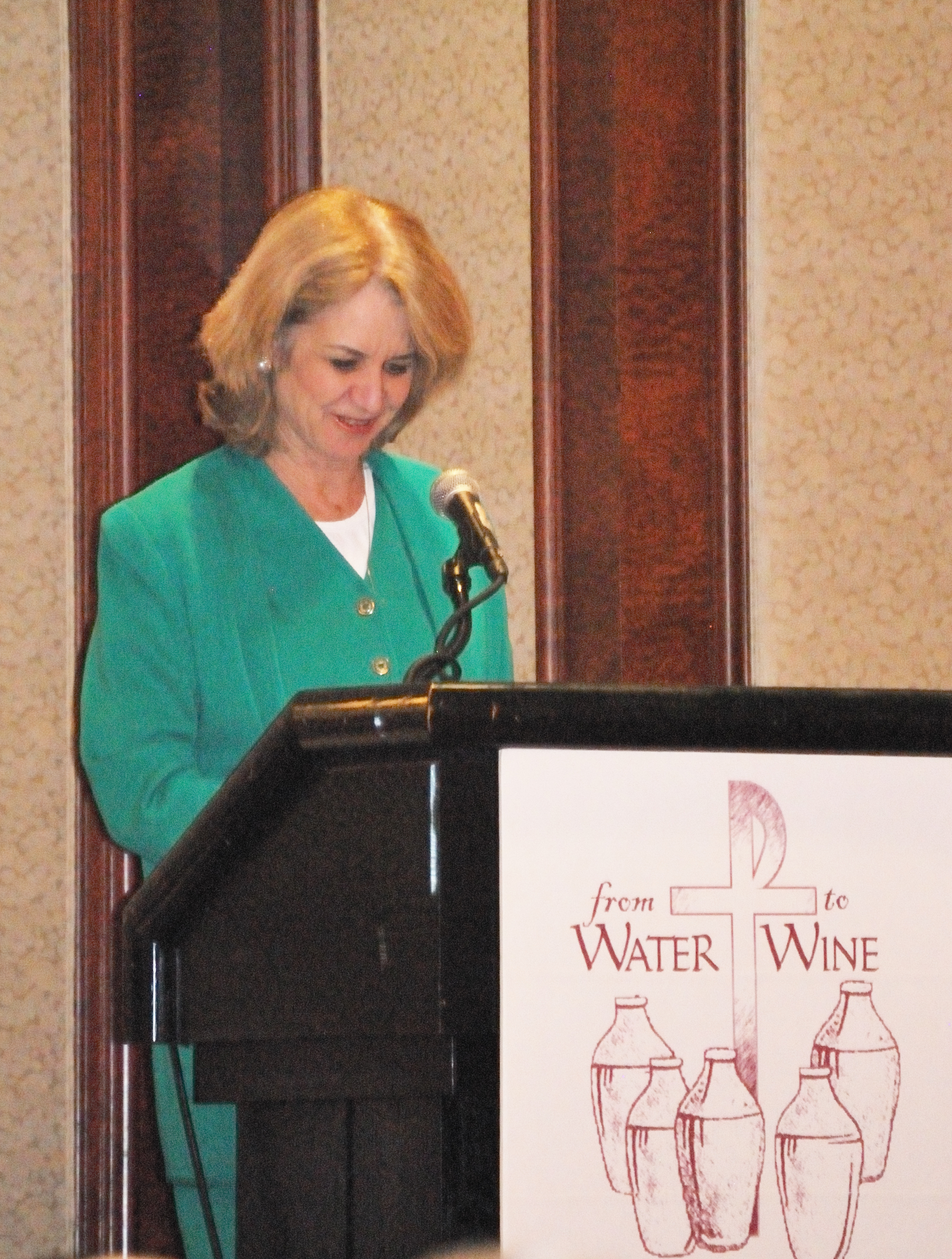
Kathleen Kennedy Townsend speaks at New Ways Ministry Symposium,. March 17, 2012
In her recent commentary in The Atlantic (The Case for Gay Acceptance in the Catholic Church), I’m flattered that Kathleen Kennedy Townsend would use the name of this blog in her closing summation about whey God’s LGBT children should — and in time, will — be unequivocably accepted in the Roman Catholic Church.
At this time, when the hierarchy does not want to recognize that we are all made in the image and likeness of God [emphasis added], and that the one of the two most critical commandments is to love one another, it is critical to assert that God loves the LGBT community equally. Sometimes the Church moves slowly, sometimes quickly. The point is to make sure the voices of dissent are not quiet and the Holy Spirit can be heard.
Ok, so perhaps she didn’t actually know she was referring to the title of this blog, but the Spririt works in mysterious ways, right? In any event, I had the privilege of hearing the former lieutenant governor of Maryland speak on the last day of the recent New Ways Ministry Symposium in Baltimore. She is an engaging speaker — as one would expect from a politician with the last name Kennedy — and had an instant rapport with the Catholic audience, perhaps many of Irish ancestry, on St. Patrick’s Day no less. When asked if she would lead the crowed in singing, “When Irish Eyes are Smiling,” she politely demurred — that is until a woman (a parish musician, no doubt) sat down at the piano and began to play that quintessential Irish tune. The entire gathering then erupted into song.
Kennedy Townsend’s presentation was markedly more conversational than the several plenary sessions earlier in the symposium. Author Richard Rodriguez, Bishop Geoffrey Robinson, and theologians Luke Timothy Johnson and Patti Jung all gave extremely substantive, thought-provoking presentations from their own areas of expertise. While much less academic, Kennedy Townsend’s presence and presentation was a reminder of the important role public Catholic public figures can and should play in at least raising the profile of the issues affecting gay Catholics. Such heightened profile provides greater success that our Church’s bishops — even if behind closed doors — will be willing to engage in dialogue with the Catholic LGBT community.
Catholics need more understanding of Catholicism
There are lots of elements to the on-going story about the denial of communion to a Maryland woman, Barbara Johnson, by Fr. Marcel Guarnizo at her mother’s funeral. One element that will never get any headlines is the low level of understanding even regular Church-going Catholics have about our faith. I remember hearing years ago a religious education professional lamenting the fact that while her parish was filled with many accomplished and well-educated people, when it came to their “religious education,” they stopped progressing at about a 4th grade level.
I’ve been reminded of that time and again as I read comments posted by supposedly informed and practicing Catholics who’ve been sharing their thoughts about what happened in Gaithersburg: who was right and who was wrong? what should official Church leaders do in response? etc.
Today’s “On Religion” section of the Washington Post (p. B2) prints just two comments that demonstrate exactly what I mean:
joestrong701: The priest should be commended for faithfully following the Catholic Church teachings. If you want to be a lesbian, you can’t claim to be being a Roman Catholic. I love basketball, but at 6-2, I can’t sue the Knicks for not picking me to be their center.
And…
Ivegstsyo: The priest denied her Communion because her lifestyle is considered immoral by the Catholic Church. As a priest, he is supposed to deny communion to those who don’t listen or follow Church teachings/doctrine. He was just doing his job. It was nothing personal. Just because you choose to live a sinful life doesn’t mean that the Churchhas to accept who you are.
I don’t know if either of these commenters is Catholic, but if they are, they should consider going back to their CCD/religious education program and take some more classes. “Church teachings” implies much, much more than what one may remember from a catechism class and certainly much more than what can be found through a Google search. It includes areas of study such as fundamental theology, sacred scripture, systematic theology, sacramental theology, ecclesiology, christology, pastoral theology, liturgy and canon law. Perhaps some in depth understanding of these various disciplines and how they fit into the teaching and practice of the Church might better equip them to offer comments about what might have been appropriate actions in the situation now receiving such attention.
It’s true that Church teaching says that we as Catholics should be properly disposed to receive the Eucharist, and that those who are “…obstinately persevering in manifest grave sin are not to be admitted to holy communion,” (cf. Code of Canon Law, #915). It is equally true, however, that the primary assessment for such disposition rests with the individual, and no one else. Only I (and God) can judge my conscience, and only I — taking responsibility for ensuring my conscience is well-formed — can judge my suitability for receiving Eucharist, remembering especially the words we pray immediately before Communion: “Lord, I am not worthy to receive you…”
For those who look to the “obstinately persevering in manifest grave sin” standard, it would be almost impossible in almost any real-life situation for a minister of the Eucharist to be able to make such a judgment with any certainy. Even if a pastor or priest knew well the spiritual lives of his parishioners, how would this judgment be expressed at a Eucharistic liturgy where so many others are often distributing communion? Perhaps pastors should provide lists to all the Ordinary and Extraordinary Ministers of the Eucharist assigned to each Mass with categories of those “Known to be unfit for communion”? Clearly, such an idea is preposterous, as are attempts by ministers of the Eucharist to judge the worthiness of those who come to share in the Lord’s table. After all, who is to say that even the most notorious mass murderer in history who approaches to receive communion has not — at that moment — made a “perfect act of contrition” and committed to receiving sacramental reconciliation as soon as possible, thus being properly disposed to receive Communion?
Every word in that phrase — “obstinately persevering in manifest grave sin” — is important. Every word is there for a reason, and every word demands that those who may even consider not admitting someone to communion be absolutely certain and have no doubt whatsoever before taking the potentially scandalous action of denying communion to anyone.
Perhaps, however, the most compelling argument is this: If we really believe that the Eucharist is the real presence of Jesus, why would we want to get in the way of a sinner encountering the Lord? After all, isn’t He more likely a candidate than any of us to change the heart and mind of the worst sinner in our midst?
“We are called by name, not by category”
That is the closing line in theologian James Alison’s response to a question about same-sex marriage. A gay man, priest and former Dominican who describes his current canonical status as “anomalous,” Alison responds to questions about his thoughts on a variety of issues about the hierarchy’s teaching about homosexuality. The Commonweal magazine interview is definitely worth a read, but requires some distraction-free time to take it in fully.
There’s a lot to take away; here are a few things that jumped out at me:
On forms of idolatry:
Spending time, as I do, with people on both sides of the Reformation divide, I find strict parallels between the temptations to which either side is prone. Protestantism is tempted to bibliolatry, and Catholicism is tempted to ecclesiolatry. Both are forms of idolatry that involve some sort of grasping of security where it is not to be found. This grasping ends up by evacuating the object grasped (whether the Bible or the church) of meaning, turning it instead into a projection of the one grasping. The nonidolatrous approach is when we allow ourselves to be reached and held by a living act of communication from One who is not on the same level as either Bible or church, but of whose self-disclosure those realities can most certainly become signs.
In response to the question: “Are there things that Catholics who support your view on homosexuality do that drive you crazy?”
Such things [many kinds of protests and demonstrations] feed ecclesiastical delusions of holy victimhood. They effectively give church leaders an excuse to put off the slow, humble task of beginning to imagine forms of truthfulness of speech.
From my experience, I would add to this the casual, frequent, and not apparently thought-through attempts at re-defining core elements of Catholic faith and practice that occur in some circles. In particular, the areas of sacrament and liturgical practice — largely because it’s what most of us DO as Catholics — seems sadly subject to this.
On the distinction between the institutional Church’s condemnation of homosexual acts as “disordered,” but not the condemnation of homosexual persons as persons:
This does seem to me somewhat of a Ptolemaic discussion in a Copernican universe. Of course there is a notional distinction between talking about what someone is, and talking about what someone does. The question is not “Does the notional distinction exist?” but “What use is being made of the fact that such a distinction can be formulated?” When the distinction is made in the discussion of gay people to which you refer, it is subservient to a conviction brought in from elsewhere—that of the objectively disordered nature of the inclination….
…it seems to me quite patent that here we have an unwieldy bid to fit a reality into an acceptable framework, rather than learning from reality how to adjust a now unreliable framework…
And finally, as a closing thought to where things currently stand in the institutional Catholic Church and where we might be headed in the years again, given what we have:
Until all this is resolved, people like me find ourselves, I guess, muddling along in this messy transitional period in the life of the church, resting in Our Lord’s good cheer!
“He was an angel, a balm on our hearts”
Even as we struggle with how to respond to the abusive action of Fr. Marcel Guarnizo in denying the Eucharist to Barbara Johnson at her mother’s funeral, and even as we look forward to further action from the Archdiocese of Washington in response, let’s be thankful for priests like Fr. Peter Sweeney of Silver Spring, MD. According to the coverage in the National Catholic Reporter, Barbara Johnson described Fr. Sweeney this way:
“He was an angel, a balm on our hearts,” she said. “He was everything I knew the Catholic church to be.”
Amen!
A Third Grade Spirituality ?
If I had settled for the mostly one-line answers to everything from my Fr. McGuire’s Baltimore Catechism, my spiritual journey would have been over in the third grade. [from Richard Rohr OFM, Daily Meditation for Sat., Feb. 25, 2012]
- How many of us have stopped our spiritual journey at some point along the way?
- How many religious “leaders” try to pass off as nourishment for the adult soul what might satisfy a third-grader, but which leaves the mature soul even more unsatisfied than before?
And I love Fr. Rohr’s definition of the Bible. In what ways today, right now, am I allowing the light of my own life and experience to be engaged by the beautiful Mystery we call God?
The Bible is an honest conversation with humanity about where power really is. All spiritual texts, including the Bible, are books whose primary focus lies outside of themselves, in the Holy Mystery. The Bible is to illuminate your human experience through struggling with it. It is not a substitute for human experience. It is an invitation into the struggle itself—you are supposed to be bothered by some of the texts.
Gay, by the Grace of God
The headline of today’s Washington Post was expected, though no less wonderful! It announces the approval of legislation in Maryland to recognize same-sex marriage (Gay marriage bill approved by Md. Senate). What’s not so wonderful is the accompanying story, For black clergy, issue is not a civil rights one.
As I read the article and its direct quotations from the story’s central character, Rev. Nathaniel Thomas, I couldn’t help but be reminded of something I had read just an hour earlier. In his daily mediation, Rev. Richard Rohr writes this:
I would like to say that the goal in general is to be serious about the word of God, serious about the scriptures. We have often substituted being literal with being serious and they are not the same! (Read that a second time, please.) I would like to make the point that in fact literalism is to not take the text seriously at all! Pure literalism in fact avoids the real impact, the real message. Literalism is the lowest and least level of meaning in a spiritual text.
The problem with Rev. Thomas’s position, and the position of so many other religious leaders — including Catholic bishops and other clergy — who oppose same-sex marriage and other civil (and religious!!!) rights for gay people on religious or biblical grounds is that they are reading the Scriptures at the lowest and least level of meaning. Notwithstanding the fact that even at this lowest level of literal meaning they misunderstand what the text is saying, they fail to see the issue of homosexuality within the context of the entire Christian message, instead of the very few scriptural passages which they repeatedly cite and take out of context.
According to the Post,
Not long ago, Thomas says, a young gay man came to him and said, “Look, I can’t help being how I am.” The minister embraced the man.
“We are all sinners,” Thomas says. “Christ never turned anyone away. People come to us all the time with issues, some with a stealing demon, some with urges and desires. But love doesn’t mean you go along to get along. I counsel them by showing them God’s word; some receive the word, and some reject it.”
Despite his attempts to “soften” his rhetoric and appear less condemning that many fellow preachers, Thomas’s words are no less offensive and off the mark. I suspect that back in 1865, many white preachers said this or something similar in response to the desires of enslaved people to be free: “But the Word of God (see Ephesians 6:5) clearly says that slaves should obey their earthy masters. So while I embrace you for who you are, I must reject your sin of wanting freedom in direct contradiction to God’s Word.” Even today’s biblical literalist would see that such a position is not only morally untenable, but that it is an abuse of Scripture to claim it supports maintaining an institution which subjugates one group of people to another and which denies them their fundamental human dignity.
I’m thankful that my own Church recognizes that one does not choose one’s sexuality. The Church teaches that homosexuality is not a choice, but is indeed part of the spectrum of human experience. (Yes, I know that recent decades have seen a shift to the righ’ on this, but declarations that homosexuality is “intrinsically disordered” are on theologically shaky ground when seen from a more complete Christian anthropology). This teaching is supported by theology, the life sciences, social science, and most especially the lived experience of LGBT people.
Put simply, those whom God has created gay — or straight, or blue-eyed, or left-handed, or black, or [insert any immutable human quality or trait] — are such by the Grace of God. For societies and churches and religious bodies to deny this and its implications is to put themselves above God and the wonder of His creation — a creation revealed in the beauty and mystery of every human person, even gay ones.
Where are the kids?
Today’s Ask Amy column gives five tips distilled from a project at Cornell University (The Legacy Project) about what makes a successful, long, and happy marriage. Despite the fact that opponents of same-sex marriage always mention that gay people shouldn’t be allowed to marry because they don’t procreate (at least in the same way opposite-sex couple do), I find it curious that not one these tips mentions children at all!
Here’s my favorite tip (which, those who know me, will completely understand):
4. Talk to each other: Marriage to the strong, silent type can be deadly to a relationship. Long-term married partners are talkers (at least to one another, and about things that count).
Happy Valentines Day!
 Image and Likeness