“Connected, but alone?” — Sherry Turkle’s TED Talk

If you’re not familiar with the TED Talks, you should be.  A “non profit devoted to ideas worth spreading,” TED (Technology, Entertainment, Design) engages in a number of activities that fulfill its mission:  Spreading ideas.

This TED Talk by psychologist Sherry Turkle looks at technology and texting and the many devices to which we have tied our ourselves, and wonders if expecting more from technology means we expect less of one another?

It’s a question that probably resonates with all of us.  I have a friend who, while no luddite, is definitely not infatuated with technology. I used to get slightly annoyed when I would call his cell phone and I’d get voicemail.  “Why doesn’t he answer?” I’d quietly wonder, thinking “I know he’s not at work, doesn’t he have his phone in his pocket, close at hand?”  When I was in his physical, real time company, however, I realized that his phone was not on, not accessible, and that if someone were trying to reach him, they’d get voicemail too.  You see, my friend had made choices about the importance of presence. He knew intuitively that “divided attention” is really “no attention,” and that when he is with he, he is truly with me. He knows that to be with another person, to enjoy his company, to engage her in conversation, all this means saying “Yes” to the “you” I’m with right now, and “No” — or at least, “Not right now” — to all others.

But it wasn’t this idea of presence that first jumped out at me. It was Turkle’s statement that our infatuation with technology and all our devices are getting in the way of people’s capacity for self-reflection. Time by oneself is necessary for healthy development, yet increasingly we hear of studies measuring the increased anxiety that comes with being “unconnected” to the virtual world.

Turkle is a psychologist and she speaks from that discipline. But it’s no great leap to hear her words from a spiritual perspective. The Hebrew and Christian scriptures are filled with examples bespeaking both the importance of true presence to one another, and the need for occasional trips into the desert, alone.

What richer lives we might lead if we can appreciate just a little more the real value of the present moment, including those moments of solitude which invite us more deeply into ourselves.  After all, it’s only by knowing ourselves as deeply as we can that we are able to share our true selves with one another.
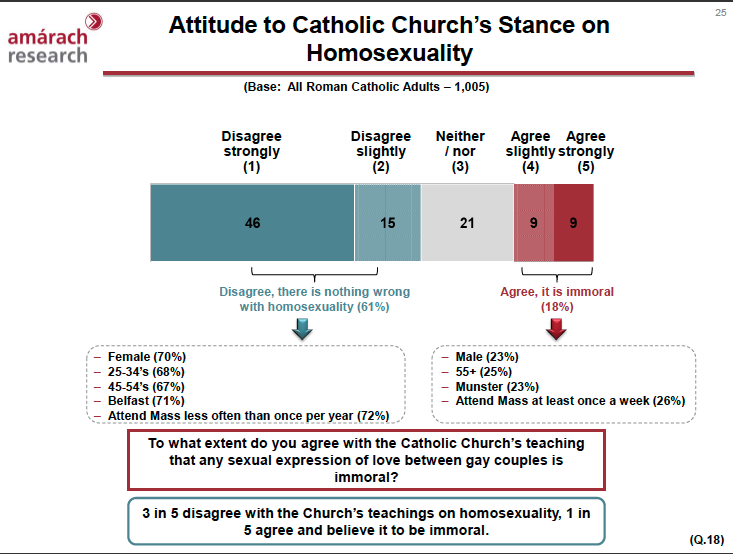

61% of Irish Catholics Disagree with Bishops on Homosexuality

Irish people are often reported in the popular media to be “socially conservative,” the deep roots of Catholicism on that island nation often cited as the reason. Like most generalizations, such characterizations are not only overly simplistic, they’re often wrong. New findings from research conducted by Amárach Research for Ireland’s Association of Catholic Priests paints a very different, though not surprising, picture of the state of Irish Catholicism as seen from the perspective of the ones who really matter — Irish Catholics themselves.

Take homosexuality, for instance. When asked specifically, “To what extent do you agree with the Catholic Church’s teaching that any sexual expression of love between gay couples is immoral?” only 18% agreed. A full 61% disagreed!

Views of Irish Catholics on "official" Church teaching about homosexuality (Amarach Research conducted for the Association of Catholic Priests)

The report covers a wide range of issues affecting Irish Catholicism today and is worth a look. See the full report here (pdf).

“Addiction doesn’t work”

Richard Rohr writes (On the Threshold of Transformation: Daily Meditations for Men, Day 110):

Addiction happens when we no longer want to feel our feelings. Addiction happens when we don’t want to know our own thoughts or feel our own pain. But you know what? Addiction doesn’t work. In the long run, addiction brings ten times more pain than you would experience by accepting the legitimate pain of being a human being. Religion needs to be teaching this up front and without apology.

And by “addiction,” Fr. Rohr refers not only to alcohol, street drugs, or the abuse of other substances that those in treatment facilities and halfway houses are addicted to. He’s also talking about the unfettered consumerism and materialism of our culture. To this list, I would add the addiction to self-righteousness which, in the extreme, is expressed as hate. It’s the view heard so frequently on talk radio, seen often in the comments of “anonymous,”and even heard preached from pulpits. It’s the view that says, “I’m right, you’re wrong; I possess truth, and you are filled with lies.”

There are treatment options and 12-step programs for those struggling with alcoholism or drug addiction. But where’s the 12-step program for consumerism and the addiction to hate? Where’s the treatment plan for the addiction that never has enough “stuff” or that so quickly judges others who are “different” by equating “different” with evil?

Where there is pain and suffering, there is God

“Jesus forever tells us that God is found wherever the pain is, which leaves God on both sides of every war, in sympathy with both the pain of the perpetrator and the pain of the victim, with the excluded, the tortured, the abandoned, and the oppressed since the beginning of time. I wonder if we even like that. There are no games of moral superiority left. Yet this is exactly the kind of Lover and the universal Love that humanity needs.

What else could possibly give us a cosmic and final hope? This is exactly how Jesus redeemed the world “by the blood of the cross.” It was not some kind of heavenly transaction, or “paying a price” to God, as much as a cosmic communion with all that humanity has ever loved and ever suffered. If he was paying any price it was for the hard and resistant skin around our souls.”

From Richard Rohr’s Holy Week/Good Friday meditation.

“We are called by name, not by category”

That is the closing line in theologian James Alison’s response to a question about same-sex marriage. A gay man, priest and former Dominican who describes his current canonical status as “anomalous,” Alison responds to questions about his thoughts on a variety of issues about the hierarchy’s teaching about homosexuality. The Commonweal magazine interview is definitely worth a read, but requires some distraction-free time to take it in fully.

There’s a lot to take away; here are a few things that jumped out at me:

On forms of idolatry:

Spending time, as I do, with people on both sides of the Reformation divide, I find strict parallels between the temptations to which either side is prone. Protestantism is tempted to bibliolatry, and Catholicism is tempted to ecclesiolatry. Both are forms of idolatry that involve some sort of grasping of security where it is not to be found. This grasping ends up by evacuating the object grasped (whether the Bible or the church) of meaning, turning it instead into a projection of the one grasping. The nonidolatrous approach is when we allow ourselves to be reached and held by a living act of communication from One who is not on the same level as either Bible or church, but of whose self-disclosure those realities can most certainly become signs.

In response to the question: “Are there things that Catholics who support your view on homosexuality do that drive you crazy?

Such things [many kinds of protests and demonstrations] feed ecclesiastical delusions of holy victimhood. They effectively give church leaders an excuse to put off the slow, humble task of beginning to imagine forms of truthfulness of speech.

From my experience, I would add to this the casual, frequent, and not apparently thought-through attempts at re-defining core elements of Catholic faith and practice that occur in some circles. In particular, the areas of sacrament and liturgical practice — largely because it’s what most of us DO as Catholics — seems sadly subject to this.

On the distinction between the institutional Church’s condemnation of homosexual acts as “disordered,” but not the condemnation of homosexual persons as persons:

This does seem to me somewhat of a Ptolemaic discussion in a Copernican universe. Of course there is a notional distinction between talking about what someone is, and talking about what someone does. The question is not “Does the notional distinction exist?” but “What use is being made of the fact that such a distinction can be formulated?” When the distinction is made in the discussion of gay people to which you refer, it is subservient to a conviction brought in from elsewhere—that of the objectively disordered nature of the inclination….

…it seems to me quite patent that here we have an unwieldy bid to fit a reality into an acceptable framework, rather than learning from reality how to adjust a now unreliable framework…

And finally, as a closing thought to where things currently stand in the institutional Catholic Church and where we might be headed in the years again, given what we have:

Until all this is resolved, people like me find ourselves, I guess, muddling along in this messy transitional period in the life of the church, resting in Our Lord’s good cheer!

A Third Grade Spirituality ?

If I had settled for the mostly one-line answers to everything from my Fr. McGuire’s Baltimore Catechism, my spiritual journey would have been over in the third grade. [from Richard Rohr OFM, Daily Meditation for Sat., Feb. 25, 2012]

  • How many of us have stopped our spiritual journey at some point along the way?
  • How many religious “leaders” try to pass off as nourishment for the adult soul what might satisfy a third-grader, but which leaves the mature soul even more unsatisfied than before?

And I love Fr. Rohr’s definition of the Bible. In what ways today, right now, am I allowing the light of my own life and experience to be engaged by the beautiful Mystery we call God?

The Bible is an honest conversation with humanity about where power really is. All spiritual texts, including the Bible, are books whose primary focus lies outside of themselves, in the Holy Mystery. The Bible is to illuminate your human experience through struggling with it. It is not a substitute for human experience. It is an invitation into the struggle itself—you are supposed to be bothered by some of the texts.

Where are the kids?

Today’s Ask Amy column gives five tips distilled from a project at Cornell University (The Legacy Project) about what makes a successful, long, and happy marriage.  Despite the fact that opponents of same-sex marriage always mention that gay people shouldn’t be allowed to marry because they don’t procreate (at least in the same way opposite-sex couple do), I find it curious that not one these tips mentions children at all!

Here’s my favorite tip (which, those who know me, will completely understand):

4. Talk to each other: Marriage to the strong, silent type can be deadly to a relationship. Long-term married partners are talkers (at least to one another, and about things that count).

Happy Valentines Day!

Commonweal Article on Economic Justice

I’m always struck how Catholics who would readily identify themselves as “conservative” or “traditional” tend to be guilty of the same sin they ascribe to their more “liberal” brothers and sisters, namely that of a cafeteria approach to religion.  The offering that conservative Catholics tend to pass over is the one that deals with such things as social and economic justice, despite the fact that every Pope of recent history, including Benedict XVI, loudly proclaim such teachings, included the dreaded “redistribution of wealth” so that the God-given fruits of this world are not denied to the least among us. I wonder what the most currently well-known Catholics in the US — Newt Gingrich and Rick Santorum — would have to say if the Pope himself were to call them out on the relevant planks of their platforms?

There’s a good article at Commonweal (Plutocracy or Democracy? How Bad Policies Brought Us a New Gilded Age) that takes on some of this stuff. As always, some of the comments are just as telling as the article itself. My own comment, in response to another’s condemnation of homosexuality as among the factors that has wrought “devastation” on so much of family and society, is also there:

Tim MacGeorge subscriber 01/31/2012 – 11:06pm

@Patricia McCarron: I find your naming “the spread of homosexuality” as one of the causes for a societal decline you lament to be offensive, uncharitable, and patently untrue. With a broad brush you so blithely denigrate the millions of loving, committed relationships that God’s gay and lesbian sons and daughters have formed for centuries; relationships which only recently are beginning to receive the societal recognition and support they deserve. All of us — including those of us whom God created gay or lesbian — are created in the image and likeness of God.  Yet, instead of recognizing this fundamental truth of theological anthropology, American bishops fight with every fiber of their being legislative efforts to recognize the loving, stable and committed relationships LGBT people form.

Where, one might ask, are the episcopal voices raised to proclaim the principles of Catholic economic and social justice Mr. Cochran identifies? They are too busy saying that gay people can’t adopt children in need of a loving home, or that gay people are “intrinsically disordered” and therefore society shouldn’t be surprised when violence is perpetrated upon them. Such rubbish would be funny if it weren’t so dangerous.

No straight, married couple has ever had their marriage harmed by the loving, committed relationship of a gay couple. To lay the blame of the decline of the “traditional family” or a high divorce rate of straight couples at the feet of gay people is preposterous.  And, as far children being a requirement for marriage, if two straight people who are beyond the age of bearing children are allowed to get married (for, in the language of Catholic theology, “the good of the spouses”), why can a gay couple not enjoy the same rights and blessings of marriage?

Believe what you will, Ms. McCarron, but please keep your hate-filled lies to yourself and let God’s LGBT children live the lives God’ created us to live.

The Big Business of Prisons

The Caging of America is a thoughtful and very disturbing look at the American prison system.  As Americans we tend to think of ourselves as civilized and even quite religious. Christianity itself embraces not only justice, but justice tempered by mercy and forgiveness.  Yet one has to wonder if mercy and forgiveness have any role in the big business of the American “correctional” system?  One has to wonder what is wrong with a society that seems not only to mete out harsh punishments such as long sentences disproportionate to the crime and the isolation of solitary confinement, but also to do so in such numbers and with such frequency.

Of the many, many troubling issues Adam Gopnik’s commentary addresses, what jumped out at me most is the link between private, for-profit enterprise and US prisons. I’d always thought of prisons as a necessary function of government, something undertaken for the common good and safety of society, whose purpose was not only to punish but also to rehabilitate. I’d thought of prisons as something we would willingly do without if the lesser nature of humanity were diminished in the ongoing creation of a more just, peaceful, and humane society.  Oh, how naive I am! This quotation form the article says it all:

No more chilling document exists in recent American life than the 2005 annual report of the biggest of these firms, the Corrections Corporation of America. Here the company (which spends millions lobbying legislators) is obliged to caution its investors about the risk that somehow, somewhere, someone might turn off the spigot of convicted men:

‘Our growth is generally dependent upon our ability to obtain new contracts to develop and manage new correctional and detention facilities. . . . The demand for our facilities and services could be adversely affected by the relaxation of enforcement efforts, leniency in conviction and sentencing practices or through the decriminalization of certain activities that are currently proscribed by our criminal laws. For instance, any changes with respect to drugs and controlled substances or illegal immigration could affect the number of persons arrested, convicted, and sentenced, thereby potentially reducing demand for correctional facilities to house them.’

Brecht could hardly have imagined such a document: a capitalist enterprise that feeds on the misery of man trying as hard as it can to be sure that nothing is done to decrease that misery.

Could there be any greater affront to Justice itself than a business whose success is linked to crime and a system that seeks to keep as many people locked up for as long as possible, as cheaply as possible??

Now what, Mr. Mutty?

New Ways Ministry’s blog, Bondings 2.0, has an interesting post today about the leader of the Maine Catholic Conference. Apparently Marc Mutty has had some second thoughts about the ways in which he characterized the impact legalization of same-sex marriage might have in The Pine Tree State. In Catholicism, of course, we’re all about changing hearts and moving more and more toward the greater good.

My comment to the post is below:

Yes, Frank, thank you for sharing this story. And while I share the respect expressed by others who are able to admire someone who now sees the “error of his ways,” the question then becomes, Now what?

At the time of the Maine initiative against same-sex marriage, I took the time to write to Mr. Mutty’s boss, Portland Bishop Richard Malone. Bishop (then Father) Malone had been a professor and advisor of mine at St. John’s Seminary College in Boston. “Dick” Malone — whose doctorate came from a secular, not Catholic, institution, Boston University — was well-like and admired as a careful thinker, a good teacher, and someone who challenged students with high academic standards. I reminded Bishop Malone of this in my letter, challenging him to see that from the perspective of reason, opposition to same-sex marriage (especially in the civil context) is on very flimsy footing. Needless to say, I never heard back from him.

So, I come back to my initial point, which I hope Mr. Mutty would consider. In our theology of Reconciliation, when we recognize we have done wrong, we are called upon to embrace a firm “purpose of amendment” through which we commit to changing past ways. So, Mr. Mutty …. Now what??