Note: As I was heading out the door last night to church, I was moved almost to tears by the words of a young father, Robbie Parker, whose daughter Emilie was killed in Friday’s horrible event in Newtown. He began by extending his own family’s condolences to the many families who lost loved ones — including the shooter’s family!
December 15, 2012
For the communities of Dignity/NoVA at Emmanuel Church-on-the-Hill in Arlington, VA and Dignity/Washington at St. Margaret’s Episcopal Church, Washington, DC.
I’ve been thinking and praying this past week about what words I might offer on this, the third Sunday of Advent. As you know, I sometimes like to begin with a little levity, a little humor… and so thought about coming up with something humorous to say about the unique Liturgical color we have for today and our gathering as a community of LGBT Christians, because there’s no doubt something “gay” could be said in that regard! Some clergy, by the way, go to great lengths to make the point that the color is rose and not pink!
I also thought about pointing out that we have a unique Liturgical color because today, this Third Sunday of Advent, is also known in the Liturgical Calendar as “Gaudete” Sunday … Gaudete being the first word of the opening prayer of the Latin mass: “Gaudete in Domino semper – Rejoice in the Lord always!” “Iterum dico, gaudete! – I say it again, Rejoice!”
But then … yesterday happened. I had taken the day off from work on Friday, and I was proud of myself for not sleeping in too late and for going to the gym in the morning. But then, on the way home, I heard the first coverage of the horrible tragedy that had only just occurred in Newtown, Connecticut. I heard first on the radio, and then I turned on CNN as soon as I got inside. I spent much of the day absorbed by the media coverage of that awful tragedy. I also watched and even participated in various conversations online as people expressed their outrage, their anger, and their thoughts about the issues related to inadequate gun control laws and the insufficiencies of our fragmented mental health system.
And so, as I thought further about the liturgy for this evening, it didn’t seem like the appropriate time to be making light of things or trying to be humorous. And, it seemed even less appropriate to be speaking about “Rejoicing” when there was clearly no rejoicing, but in fact just the opposite – such incomparable sadness and grief and a whole host of “non-rejoicing” emotions – unfolding in that small New England town, and dare I say, around the country and beyond.
The sudden and tragic deaths of twenty-eight people – most of whom were little children less then ten years old – have caught the world’s attention, as the emerging news of this sad event continues to do so even now.
And so I found myself – appropriately – focusing even more closely on the scriptures. The one line that I kept returning to over and over again is in that opening exchange in the Gospel of Luke where Luke has the crowd put this question to John the Baptist: “What should we do?” It’s a question that was spoken by many seeking to find some way to respond to yesterday’s sad event.
In the passage immediately preceding the Gospel passage we just listened to, followers of John the Baptist heard him speak forcefully his message of Repentance. They heard him minimize the significance of their claim to being “children of Abraham” – as if being “children of Abraham” would be enough to bring them to salvation. But John tells them that God can raise up out of the very desert stones countless “children of Abraham,” so there’s really nothing special in that! They also heard him say that the ax is at the ready – ready to cut down those trees that do not produce good fruit – knowing full well that they were the trees about which he spoke.
And so they ask, “What should we do?” They come asking not what we should believe, or what we should think. They come not with a question about what is in the mind or even in the heart … but wanting to know what action they should pursue in order to come to know the salvation that the Baptizer proclaims.
John does not disappoint. And though it is certainly not meant to be exhaustive, he gives a list of things to do, actions to take, in order to be the true “children of Abraham.” These actions are ones that many – even many Christians – would reject out of hand.
- Got two cloaks? Give one to someone who has none.
- Got more food than you need? Give it to someone who has none.
- Even to the tax collectors and soldiers who also ask what to do, he admonishes them not to abuse their power, but to use their authority with restraint, with honesty, and to be content with what wages they earn.
In short, John tells all to be attentive to the needs of the less fortunate, to be content with what we have so that others might not go without; and to use power and authority with restraint, free from abuse, and never use it to meet selfish or self-serving interests. John’s “to do list” is rooted in a biblical sense of what is right and what is just, understanding that ultimately we can claim nothing as our own, that all is from God. To use language of a later theology, John reminds us that all is grace, and that if we are to live grace-filled lives, we must never forget the graciousness and justice of God.
I’m sure that this time of year – and even all year long – most of us try to support those in need and to be attentive to helping the less fortunate. But the crowd’s question asked of John is one that we also ask, especially when faced with situations of confusion, of hurt, of anger, of rejection, or even of violence: What should we do, how should we respond as people of faith and children of God?
Specific answers to that question each of us must find for ourselves. But, regardless of what struggle we face, what tragedy we encounter … we should remember this: It is a fundamental truth of Christianity that no matter what has happened in the past, what might happen in the future, or even what is happening however horribly in the present, the Jesus of Nazareth, who is the Christ, the Incarnate Son of God, this very Jesus is in our midst right here and right now. It’s a Truth we proclaim so loudly every time we gather to break open the Word and to share in the Eucharist. This belief in the ever-presence of Jesus whom we call Lord should guide us in whatever we choose to do and in every action we choose to pursue. As Americans, we know that greed, selfishness, and abuse of power and position are still with us – and all-too-often with us in abundance. Where, we may ask, in our day is there a voice crying in the wilderness? Perhaps what we should really ask is a question of ourselves: What am I doing and what choices am I making to live a life of grace, turned always toward God by looking squarely in the eyes of my brothers and sisters, trying each and every day to live as fully as I can the Good News that John and Jesus proclaim?
(c) Copyright 2012 – Timothy J MacGeorge


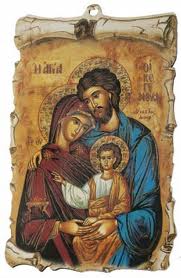 In the Catholic liturgical calendar, today is the Feast of the Holy Family of Jesus, Mary and Joseph. Ironic, isn’t it, that this feast — in which Catholics hold up for reverence a three-person family where a man marries a woman and raises a child not his own — is used by religious leaders to condemn the dire, unforeseen consequences of allowing God’s LGBT sons and daughters the right to form their own loving, committed relationships and families. A
 “….is precisely the repositioning of God in the material world once and forever. Continual top-down religion often creates very passive, and even passive-dependent and passive-aggressive Christians. I know this as a Catholic priest for over 40 years. Bottom-up, or incarnational religion, offers a God we can experience for ourselves. We have nothing to fight or prove, just something to know for ourselves. This is what we are about to celebrate at Christmas.”
 Image and Likeness