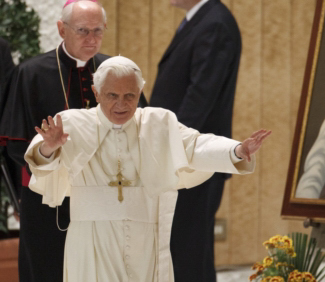
Benedict, Nuns, Christians…and “freedom” to proclaim the Gospel

In his daily meditation for today (April 24, 2012), Franciscan Fr. Richar Rohr writes:

I am not denying that Jesus could and undoubtedly did physical healing. It still happens, and I have seen it, but the healings and exorcisms in Mark’s Gospel are primarily to make statements about power, abuse, relationships, class, addiction, money, the state of women and the poor, and the connections between soul and body—the exact same issues that we face today. [emphasis added]

Just as Jesus’ actions made statements about those parts of the world in need of healing, so have the actions of many of his followers. In the United States, religious women — sisters and nuns (there is a difference, by the way!) — for more than two centuries have been at the heart and forefront of two of the most important activities of any society:  Education and Healthcare.  Communities of religious women have founded hospitals and clinics and hospices; they have opened schools and colleges and universities. And while they have ministered to people across the social spectrum, they typically would be willing to serve where others would dare not tread.

Even Pope Benedict XVI has praised the historic role of women in building the Church in America.  Just yesterday, the pope noted that two women from this continent will be canonized later this year — Blessed Kateri Tekakwitha and Blessed Mother Marianne Cope.

While recalling the historic role of women in the Church in the United States, the pope notably did not praise the current role played by so many tens of thousands of women religious in the daily lives of hospitals, schools, parishes and communities across this land.  Instead, he gave voice to that growing canard that the bishops of the US have latched on to, i.e. the notion that the “freedom” of religion is somehow under attack.  In concluding his speech to some visiting Americans, Benedict stated:

In these days I ask your continued prayers for the needs of the universal Church and in particular for the freedom of Christians to proclaim the Gospel and bring its light to the urgent moral issues of our time.

I don’t know where the Pope gets his information, though given the Vatican’s recent actions regarding congregations of women religious in the US (see coverage in US Catholic for one perspective), I suspect it’s not from very good sources. Concerning religious freedom, however, I’ve yet to see any roadblocks put forth hindering the proclamation of the Gospel or the light it sheds on the “moral issues of our time.”  What the Pope fails to understand is that his voice and the voices of his brother bishops are not the only voices empowered to proclaim the Gospel. The voices of religious women and men, of priests and lay people, all the Baptized together have a right and responsibility to proclaim the Gospel in both word and — like Jesus in Mark’s Gospel — in action. At times, those voices will differ as we collectively discern “the signs of the times” and struggle to understand where and how God’s Spirit might be leading us here and now.

Benedict rightly notes that “Christians” (he didn’t limit this to the hierarchy!) have the freedom to proclaim the Gospel.  I pray that he and his brother bishops will listen to the voices of Christians doing just that, even when what they have to say might not be what Benedict wants to hear!


“Addiction doesn’t work”

Richard Rohr writes (On the Threshold of Transformation: Daily Meditations for Men, Day 110):

Addiction happens when we no longer want to feel our feelings. Addiction happens when we don’t want to know our own thoughts or feel our own pain. But you know what? Addiction doesn’t work. In the long run, addiction brings ten times more pain than you would experience by accepting the legitimate pain of being a human being. Religion needs to be teaching this up front and without apology.

And by “addiction,” Fr. Rohr refers not only to alcohol, street drugs, or the abuse of other substances that those in treatment facilities and halfway houses are addicted to. He’s also talking about the unfettered consumerism and materialism of our culture. To this list, I would add the addiction to self-righteousness which, in the extreme, is expressed as hate. It’s the view heard so frequently on talk radio, seen often in the comments of “anonymous,”and even heard preached from pulpits. It’s the view that says, “I’m right, you’re wrong; I possess truth, and you are filled with lies.”

There are treatment options and 12-step programs for those struggling with alcoholism or drug addiction. But where’s the 12-step program for consumerism and the addiction to hate? Where’s the treatment plan for the addiction that never has enough “stuff” or that so quickly judges others who are “different” by equating “different” with evil?

The Divine and Religion

I’ve become mesmerized by the words, wisdom, and captivating brogue of the late John O’Donohue.  He died too young, but has left a lifetime’s worth of insight into life, humanity, beauty, the Divine, and the spiritual dimension we call soul so often ignored in our dizzyingly fast world.

Here’s a snippet from Wisdom from the Celtic World:

Everyone hungers and longs for the home that we call the Divine. And what’s really sad is that very often peoples’ ability to come into the Divine presence is most damaged by religion.

Religion has filled so many holy and lovely people with such a sense of fear and sense of guilt. And this fear and guild have often been used by religion to control people.

And you should never let any religious power or institution take away from you that intimacy and depth of belonging that you have to the Divine, because the Divine is your secret name.

The Cycle of Life

I live in a relatively small space. For mostly sentimental reasons, I’ve kept a few pieces of furniture that used to belong to my grandmother, Eileen “Nana” MacGeorge. Nana passed away January 21, 2005, just one week shy of her 99th birthday. Today I gave away one of those pieces of furniture, an old worn wooden desk that actually had been a vanity at its birth many decades ago.

The Eileen Desk

I wanted to give it away rather than sell it, and so posted it on the DC Freecycle group. Just a short while ago, a young woman named Ali came by to pick it up. She and her husband and two children have recently moved from the city to the suburbs and they’re working on filling their larger living quarters as inexpensively as possible. As we were taking the desk down in the elevator and I told her of its history, she asked what Nana’s name was.  “Well, she said, it’ll be the Eileen desk!” After putting it in her vehicle and shaking hands, she said with a smile, “Thank you Tim; it’ll be well-loved.”

Recently the father of a good friend of mine passed away. Although I didn’t know my friend’s dad, I know that he raised at least one wonderful son in my friend, who is a genuinely good, loving, and kind-hearted man.

These two unrelated events — the giving away of a desk that evokes my grandmother’s memory and the passing away of a friend’s father — seem so relevant as we enter this week we Christians call “Holy.” Beginning with the fanfare of Palm/Passion Sunday, Holy Week culminates in the celebration of the Sacred Three Days — the Triduum — as we liturgically live once again through the deepest mysteries of Christian faith, the Passion, Death, and Resurrection of Jesus.

As Catholics, we believe that our liturgical rites are note merely commemorations of those events from two thousand years ago.  They are not simply a re-telling of what has been told and re-told over the centuries.  No, Liturgy in the Catholic world (as well as other traditions) transcends time and place and pulls us in once again to what Life is really all about.  If we have eyes to see and ears to hear and hands to touch and hearts to love, then this cycle of life invites us deeper and deeper into the Mystery that is God.

May Eileen and “Bud” rest in peace, and may this Holy Week be for us, our communities and our world and time of blessing, joy and peace.

Catholics need more understanding of Catholicism

There are lots of elements to the on-going story about the denial of communion to a Maryland woman, Barbara Johnson, by Fr. Marcel Guarnizo at her mother’s funeral. One element that will never get any headlines is the low level of understanding even regular Church-going Catholics have about our faith. I remember hearing years ago a religious education professional lamenting the fact that while her parish was filled with many accomplished and well-educated people, when it came to their “religious education,” they stopped progressing at about a 4th grade level.

I’ve been reminded of that time and again as I read comments posted by supposedly informed and practicing Catholics who’ve been sharing their thoughts about what happened in Gaithersburg: who was right and who was wrong? what should official Church leaders do in response? etc.

Today’s “On Religion” section of the Washington Post (p. B2) prints just two comments that demonstrate exactly what I mean:

joestrong701: The priest should be commended for faithfully following the Catholic Church teachings. If you want to be a lesbian, you can’t claim to be being a Roman Catholic. I love basketball, but at 6-2, I can’t sue the Knicks for not picking me to be their center.

And…

Ivegstsyo: The priest denied her Communion because her lifestyle is considered immoral by the Catholic Church. As a priest, he is supposed to deny communion to those who don’t listen or follow Church teachings/doctrine. He was just doing his job. It was nothing personal. Just because you choose to live a sinful life doesn’t mean that the Churchhas to accept who you are.

I don’t know if either of these commenters is Catholic, but if they are, they should consider going back to their CCD/religious education program and take some more classes. “Church teachings” implies much, much more than what one may remember from a catechism class and certainly much more than what can be found through a Google search. It includes areas of study such as fundamental theology, sacred scripture, systematic theology, sacramental theology, ecclesiology, christology, pastoral theology, liturgy and canon law. Perhaps some in depth understanding of these various disciplines and how they fit into the teaching and practice of the Church might better equip them to offer comments about what might have been appropriate actions in the situation now receiving such attention.

It’s true that Church teaching says that we as Catholics should be properly disposed to receive the Eucharist, and that those who are “…obstinately persevering in manifest grave sin are not to be admitted to holy communion,” (cf. Code of Canon Law, #915). It is equally true, however, that the primary assessment for such disposition rests with the individual, and no one else. Only I (and God) can judge my conscience, and only I — taking responsibility for ensuring my conscience is well-formed — can judge my suitability for receiving Eucharist, remembering especially the words we pray immediately before Communion: “Lord, I am not worthy to receive you…”

For those who look to the “obstinately persevering in manifest grave sin” standard, it would be almost impossible in almost any real-life situation for a minister of the Eucharist to be able to make such a judgment with any certainy. Even if a pastor or priest knew well the spiritual lives of his parishioners, how would this judgment be expressed at a Eucharistic liturgy where so many others are often distributing communion? Perhaps pastors should provide lists to all the Ordinary and Extraordinary Ministers of the Eucharist assigned to each Mass with categories of those “Known to be unfit for communion”? Clearly, such an idea is preposterous, as are attempts by ministers of the Eucharist to judge the worthiness of those who come to share in the Lord’s table. After all, who is to say that even the most notorious mass murderer in history who approaches to receive communion has not — at that moment — made a “perfect act of contrition” and committed to receiving sacramental reconciliation as soon as possible, thus being properly disposed to receive Communion?

Every word in that phrase — “obstinately persevering in manifest grave sin” — is important. Every word is there for a reason, and every word demands that those who may even consider not admitting someone to communion be absolutely certain and have no doubt whatsoever before taking the potentially scandalous action of denying communion to anyone.

Perhaps, however, the most compelling argument is this: If we really believe that the Eucharist is the real presence of Jesus, why would we want to get in the way of a sinner encountering the Lord? After all, isn’t He more likely a candidate than any of us to change the heart and mind of the worst sinner in our midst?

A Third Grade Spirituality ?

If I had settled for the mostly one-line answers to everything from my Fr. McGuire’s Baltimore Catechism, my spiritual journey would have been over in the third grade. [from Richard Rohr OFM, Daily Meditation for Sat., Feb. 25, 2012]

  • How many of us have stopped our spiritual journey at some point along the way?
  • How many religious “leaders” try to pass off as nourishment for the adult soul what might satisfy a third-grader, but which leaves the mature soul even more unsatisfied than before?

And I love Fr. Rohr’s definition of the Bible. In what ways today, right now, am I allowing the light of my own life and experience to be engaged by the beautiful Mystery we call God?

The Bible is an honest conversation with humanity about where power really is. All spiritual texts, including the Bible, are books whose primary focus lies outside of themselves, in the Holy Mystery. The Bible is to illuminate your human experience through struggling with it. It is not a substitute for human experience. It is an invitation into the struggle itself—you are supposed to be bothered by some of the texts.

Gay, by the Grace of God

The headline of today’s Washington Post was expected, though no less wonderful! It announces the approval of legislation in Maryland to recognize same-sex marriage (Gay marriage bill approved by Md. Senate). What’s not so wonderful is the accompanying story, For black clergy, issue is not a civil rights one.

As I read the article and its direct quotations from the story’s central character, Rev. Nathaniel Thomas, I couldn’t help but be reminded of something I had read just an hour earlier. In his daily mediation, Rev. Richard Rohr writes this:

I would like to say that the goal in general is to be serious about the word of God, serious about the scriptures. We have often substituted being literal with being serious and they are not the same! (Read that a second time, please.) I would like to make the point that in fact literalism is to not take the text seriously at all! Pure literalism in fact avoids the real impact, the real message. Literalism is the lowest and least level of meaning in a spiritual text.

The problem with Rev. Thomas’s position, and the position of so many other religious leaders — including Catholic bishops and other clergy — who oppose same-sex marriage and other civil (and religious!!!) rights for gay people on religious or biblical grounds is that they are reading the Scriptures at the lowest and least level of meaning. Notwithstanding the fact that even at this lowest level of literal meaning they misunderstand what the text is saying, they fail to see the issue of homosexuality within the context of the entire Christian message, instead of the very few scriptural passages which they repeatedly cite and take out of context.

According to the Post,

Not long ago, Thomas says, a young gay man came to him and said, “Look, I can’t help being how I am.” The minister embraced the man.

“We are all sinners,” Thomas says. “Christ never turned anyone away. People come to us all the time with issues, some with a stealing demon, some with urges and desires. But love doesn’t mean you go along to get along. I counsel them by showing them God’s word; some receive the word, and some reject it.”

Despite his attempts to “soften” his rhetoric and appear less condemning that many fellow preachers, Thomas’s words are no less offensive and off the mark. I suspect that back in 1865, many white preachers said this or something similar in response to the desires of enslaved people to be free: “But the Word of God (see Ephesians 6:5) clearly says that slaves should obey their earthy masters. So while I embrace you for who you are, I must reject your sin of wanting freedom in direct contradiction to God’s Word.” Even today’s biblical literalist would see that such a position is not only morally untenable, but that it is an abuse of Scripture to claim it supports maintaining an institution which subjugates one group of people to another and which denies them their fundamental human dignity.

I’m thankful that my own Church recognizes that one does not choose one’s sexuality. The Church teaches that homosexuality is not a choice, but is indeed part of the spectrum of human experience. (Yes, I know that recent decades have seen a shift to the righ’ on this, but declarations that homosexuality is “intrinsically disordered” are on theologically shaky ground when seen from a more complete Christian anthropology). This teaching is supported by theology, the life sciences, social science, and most especially the lived experience of LGBT people.

Put simply, those whom God has created gay — or straight, or blue-eyed, or left-handed, or black, or [insert any immutable human quality or trait] — are such by the Grace of God. For societies and churches and religious bodies to deny this and its implications is to put themselves above God and the wonder of His creation — a creation revealed in the beauty and mystery of every human person, even gay ones.

TFTD: Forgiveness and Reclaiming our Human Dignity

Almost by definition, forgiveness is a mutual act. There is both the one who forgives, and the one who is forgiven. Forgiveness is one piece of the more full and all-encompassing act of reconciliation, by which not only is a wound healed, but a broken relationship is restored.

In my own experience, there are two lessons about forgiveness that have been hard for me to learn.  The first is that giving forgiveness — at least forgiveness that’s worth giving — is not a singular act. No, it is something that must happen over and over until my own heart is healed and the need to forgive no longer exists. This is the lesson of the so-called Parable of the Unforgiving Servant in the Gospel of Matthew (18:21-22):

Then Peter approaching asked him, “Lord, if my brother sins against me, how often must I forgive him? As many as seven times?” Jesus answered, “I say to you, not seven times but seventy-seven times.

The second lesson about forgiveness may be even more of a challenge.  It’s the challenge to forgive even when the other person does want, request, or even acknowledge the need to be forgiven. In some sense, this is almost like a second injury. It’s one thing to be hurt deeply by another person; it’s another thing to have that injury ignored, minimized, or otherwise unseen and unacknowledged. And yet … even in such situations as this, forgive we must. As Henri Nouwen writes,

But if our condition for giving forgiveness is that it will be received, we seldom will forgive! Forgiving the other is first and foremost an inner movement. It is an act that removes anger, bitterness, and the desire for revenge from our hearts and to reclaim our human dignity...The only people we can really change are ourselves. Forgiving others is first and foremost healing our own hearts. (Bread for the Journey, January 27, emphasis added)

Forgiveness is first and foremost something we do for ourselves, and we do so because failing to forgive means we are carrying around a weight and burden we don’t need. Failure to forgive is an act of self-injury.

Is there someone I need to forgive today, whether or not he/she knows it? Let today be the dawn of a new day — the day I take one step along the path of forgiveness, a path that leads me to reclaim the fullness of my human dignity and healing my injured heart.

All images © 2012 Timothy MacGeorge

Opposing the death penalty: “common ground” for conservative and liberal Catholics

The idea of “common ground” seems to have become a victim of the extremism all around us these days.  In the worlds of politics and religion, we hear regularly about the lack of civility, the dearth of bipartisanship, and the recalcitrant conflicts between those who have different perspectives on almost every issue.

Instead of focusing on what separates, the concept of common ground asks us to look for those areas in which we agree in order to make some progress and do some good. The fact that such common ground must be searched for in the first place means we already know, and likely know all too well, the areas in which we disagree.  It recognizes that progress on those issues of conflict may not be possible right now … but surely there is something we can do, some common ground we can find, in order to make this world a better place.

In the Catholic world where conservatives and liberals have conflicts no less strident than those on Capitol Hill, why can we not come together on the issue of our collective opposition to the death penalty as a place to start?

Recently, Pope Benedict XVI praised the advocacy efforts of some Americans from Chicago representing a group whose name needs no explanation: Illinois Coalition to Abolish the Death Penalty.

If American Catholics from cathedra to pew could find this common ground, at least two benefits could ensue. First, we might be able to help our fellow citizens see that our words about human dignity and the value of human life are words with meaning. We would put into practice what we preach when we say our faith calls us to respect the dignity and value of every person. Second, achieving a goal with someone typically seen as “the other” would surely open our eyes even more, helping us see the humanity in “the other” whom we can sometimes readily dismiss. Perhaps  we might understand more fully why they cling to what they cling, even when we cling to something different.  Common ground forces us to see one another not from a distance, but up close.

Perhaps that’s not such a bad thing to do, especially during this Advent Season when we celebrate our belief not in a distant and disinterested god, but in a God who took on the common ground of our own humanity and invites us daily to do the same.

Your thoughts? Would love to know.