Loves Urgent Longings …

“Love’s urgent longings …” — this phrase from The Dark Night by St. John of the Cross has been echoing in my mind and resounding in my heart today. Would that every human heart knew the love of which the Spanish saint writes, and that laying our face on our beloved, we might leave our cares among the lilies!

Stanzas Of The Soul

One dark night,
fired with love’s urgent longings
– ah, the sheer grace! –
I went out unseen,
my house being now all stilled.

In darkness, and secure,
by the secret ladder, disguised,
– ah, the sheer grace! –
in darkness and concealment,
my house being now all stilled.

On that glad night,
in secret, for no one saw me,
nor did I look at anything,
with no other light or guide
than the one that burned in my heart.

This guided me
more surely than the light of noon
to where he was awaiting me
– him I knew so well –
there in a place where no one appeared.

O guiding night!
O night more lovely than the dawn!
O night that has united
the Lover with his beloved,
transforming the beloved in her Lover.

Upon my flowering breast
which I kept wholly for him alone,
there he lay sleeping,
and I caressing him
there in a breeze from the fanning cedars.

When the breeze blew from the turret,
as I parted his hair,
it wounded my neck
with its gentle hand,
suspending all my senses.

I abandoned and forgot myself,
laying my face on my Beloved;
all things ceased; I went out from myself,
leaving my cares
forgotten among the lilies.

Silence and Solitude: Tools of the Soul

For the past three days I’ve been attending a work-related conference on health communication, marketing and media. As you might expect, almost every session refers to the “new media” tools used to communicate in today’s digital world.  “Facebook and Twitter” is spoken as a single word, and it’s invariably followed by other social media tools used both to communicate and measure that communication. Topics such as “engagement,” “reach,” “influencing,” and being “connected” with one’s target audience are pervasive.

A monarch butterfly enjoys the garden at Thomas Jefferson’s Monticello.

I get that this is the world in which we live. I also understand that these tools are just that — tools in a larger toolbox that has been around since the first humans realized that they were not alone, that there were others like them, and that they wanted to reach out to others, interact with others, and be connected. The need and desire for human connectedness is even more self-evident than the truths penned by Thomas Jefferson; we are social beings, and we want to know one another, to interact with one another, to touch one another.

Yet, in the midst of all the talk of connectedness, I’ve found myself these past days seeking and relishing moments of quiet and solitude. And by that I don’t mean time simply alone.  As a single man I have lots of that! I am by myself more than I am with others, and so the need I’ve been experiencing went beyond that. I’ve been experiencing a need to be “disconnected” from all the texts and tweets and emails and surfing and simple “noise” that at times can be so very overwhelming.  Perhaps that’s why I find myself now — in the middle of the night — sitting in the silence of a darkened hotel room, relishing the silence and the opportunity to be alone in a deeper, more profound way.

A large bird — is it a vulture? — flies overhead at Monticello.

Silence and solitude are tools, too. They are not the tools of social engagement, but are the tools of the soul. Without our occasional (dare I say regular?!) forays into silence and solitude, our souls in shyness can become bewildered. When we are so utterly “connected” and so constantly engaged with an outward gaze, we can lose the necessary perspective that an inward gaze provides. We can lose touch with the deepest part of who we are, or even forget that there is a part of who we are that doesn’t need our gadgets and technologies.  What I’m speaking of is not so much the need to be disconnected from that which is outside of us, but rather the need to be equally connected with that which is within us. Deeper connection with myself, and with the Other Whom I find in the quiet depths of my soul forms and informs and blesses my connections with others.

Even more than FB and Twitter, Silence and Solitude are tools everyone can use (and there’s no username of password required!).

Reconciliation, Forgiveness, and “Letting go”

Yesterday, in reflecting on some particular aspects of my life over the past few years, I found myself meditating on the difference between Reconciliation and Forgiveness.

Fr Rohr’s daily meditation is timely:

“The religious word for this letting go is forgiveness. You see the imperfect moment for what it is, and you hand it over to God. You refuse to let any negative storyline or self-serving agenda define your life.”

To let go isn’t always easy, especially when there is the need for forgiveness without the possibility of reconciliation. Reconciliation with another means both must be involved; both must actively be seeking to mend that which has been injured or broken. Forgiveness, on the other hand, is something I can (and often must) do on my own. When we find ourselves in situations where, for whatever reasons, the cooperative work of reconciliation isn’t possible, we must still work to find the ability to forgive, lest we allow some past hurt or injury to keep us from being who we are called to be.

And, as Fr. Rohr points out, letting go of something doesn’t mean simply ignoring it, denying it, or tossing it away with the morning trash. It means handing it over to God, trusting that God will do with it whatever is best to bring about full healing in ways we can’t even imagine.

Fidelity Oaths Revisited – part 1

Last week I wrote briefly about the rise in so-called “fidelity oaths” in which Church workers are being asked by local bishops to pledge their belief in and support of positions put forth
by Church office-holders.

As I concluded my comments I wrote this: “Anyone who fully understands and values the breadth and depth of Catholic Christianity must be appalled by this trend, especially when such oaths appear to be written in ways that clearly are contrary to Catholic teaching.”

I realize that this broad declaration needs further clarification, not only for those who may be less familiar with the “breadth and depth of Catholic Christianity,” but also for those who may be wondering why, precisely, might such oaths be “contrary to Catholic teaching.”

Here are three reasons:

  1. First, they offend the principle which respects the primacy of the well-formed conscience in moral decision-making.
  2. Second, they can exemplify a type of creeping infallibility that seems to be a growing trend in some quarters of the Church.
  3. Third, and most important, they seem to usurp the fidelity oath that we already have as Catholic Christians, i.e. the Creed or Profession of Faith we profess at every Sunday liturgy.

I’ll write about each of these over the next week or so. But in order to understand the first point in particular, as well as to set this in a specific context, it would be helpful to look specifically at an example of what one such “fidelity oath” states and demands. As referenced in the Washington Post article, the former bishop of the Diocese of Baker (Washington) included the following in that diocese’s 201-page Pastoral Guidelines from 2006 (full text here). (These Guidelines, by the way, go so far as to include the Archdiocese’s of Los Angeles’ list the vintages and vineyards of wines – California produced, of course – that are “approved to sacramental use.”).

Lest I be accused of taking something out of context, here are three relevant sections:

25. The Affirmation of Personal Faith asks candidates for ministry to state unequivocally: “I believe and profess all that the Holy Catholic Church teaches, believes and proclaims to be revealed by God.” This carries with it the affirmation of specific teachings of the Catholic Church. A non-exhaustive list of these is provided in the form of individual affirmations. They include statements on the inviolability of human life, the sinfulness of contraception, the evil of extra-marital sexual relationships, the unacceptability of homosexual relationships, the wrongness of cohabitation before marriage, the significance of the Real Presence of Christ in the Eucharist, the legitimacy of Marian devotions, the existence of hell and purgatory, the uniqueness of the Catholic Church, the legitimacy of the Holy Father’s claim to infallibility and the moral teaching authority of the Catholic Church.

26. It is hoped that no one who presently serves will be excluded from future ministry as a result of this insistence on a clearer Affirmation of Personal Faith but if anyone is unable in good faith to make the Affirmation then this indicates a need to study and understand the Faith more thoroughly before seeking approval for public ministry. In the event that someone indicates that they cannot make the required Affirmation no public announcement will be made about the reasons for their end of service. An inability to make this Affirmation does not necessarily exclude someone from the possibility of receiving Holy Communion but it would indicate a need to look at his or her own life more carefully and consider, before God, the acceptability of his or her moral status.

27. While there is a possibility that someone may object that such a policy is an unjust infringement on an individual’s right and duty to follow their own conscience such an objection is invalid. Conscience is not something which exists in a vacuum. No one can claim a legitimate right to follow a conscience which is clearly not formed in a fashion consistent with the very clear teachings of the Catholic Church. The following of one’s own conscience is a strict moral obligation but that obligation is preceded by the obligation to assure that the conscience one is following is properly formed. When that conscience leads to judgments which are diametrically opposed to the clear and consistent teachings of the Catholic Church then the conscience has established itself as a new and individual, infallible personal magisterium which far exceeds the definition of conscience. Furthermore, it is one thing to claim a right to follow one’s conscience, even if it is erroneously formed, it is quite another to insist that one be afforded certain privileges, to which one has no right, while following that manifestly ill-formed conscience.

to be continued…

Bishops, Oaths, and Conscience

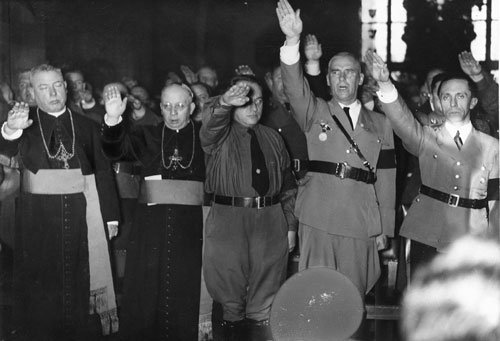
Catholic bishops joining in the Nazi salute.

Today’s Washington Post reports on a highly troubling story (Arlington Diocese parishioners question need for fidelity oath) about a rising trend in Catholic dioceses to require workers — including volunteers who teach religious education — to affirm some sort of “fidelity oath” in order to continue their work or ministry. The story ends with this:

The Rev. Ronald Nuzzi, who heads the leadership program for Catholic educators at the University of Notre Dame, said many bishops “are in a pickle.” They want Catholic institutions to be staffed by people who not only teach what the church teaches but whose “whole life will bear witness.”

Nuzzi said he keeps a photo on his desk from the 1940s that shows all the German bishops in their garb, doing the Nazi salute.

“I keep it there to remind people who say to do everything the Church says, that their wisdom has limitations, too.”

Anyone who fully understands and values the breadth and depth of Catholic Christianity must be appalled by this trend, especially when such oaths appear to be written in ways that clearly are contrary to Catholic teaching. What is more troubling, however, is the perspective expressed by some — both clergy and laity — who see no problem with such a practice.

Morning Prayer

This rainbow — the perennial reminder of God’s promise — appeared in the Eastern sky after a brief rain on the ride back from a few days at the beach.

Lord, here and now I open my heart, my mind, my soul, my very self to the lessons of this day and all that You desire for me.

Bless at this dawn all people in my life — family, friends, co-workers, neighbors and even strangers.

Bless especially those whom I love and who have touched my heart, whether they know it or not.

Free me from all anxiety and sadness and doubt and fear.

Give me eyes to see and ears to hear all that is wondrous and beautiful in the world.

Help me to do some good — however great or small — so that this world and the world yet to come may be more closely united in the timeless Oneness of All.

Amen.

May the Prophets’ Voice be heard

“And whether they heed or resist–for they are a rebellious house–they shall know that a prophet has been among them.”

I was struck by this line from the first reading of today’s Liturgy. Ezekiel is forewarned that his words may or may not be heard, they may or may not be heeded.

What prophetic voices do I need to hear and heed? Who in today’s world is speaking Divine words to the obstinate of heart?

Twenty-five Years Ago Today ….

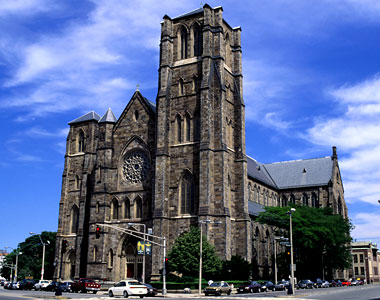
In part, this is how the Boston Globe reported (on June 21, 1987) what took place at the Cathedral of the Holy Cross twenty-five years ago today:

Fourteen seminarians were ordained to the priesthood by Cardinal Bernard F. Law yesterday in a ceremony at the Cathedral of the Holy Cross in Boston’s South End.

Of those ordained, 11 completed their studies at St. John’s Seminary in Brighton, two at Pope John Seminary for Delayed Vocations in Weston and one at North American College, Rome.

The ordained from St. John’s Seminary are Rev. Michael A. Alfano, Stoughton; Rev. Robert J. Bowers, Needham; Rev. David P. Callahan, Lawrence; Rev. Robert E. Casey, Dorchester; Rev. Thomas F. Coronite, Hingham; Rev. James A. Flavin Jr., Billerica; Rev. John W. Gentleman, Lynn; Rev. William M. Kennedy, West Roxbury; Rev. Timothy MacGeorge, Holliston; Rev. Paul G. McManus, Lynn and Rev. Paul F. Russell, Alpena, Mich., and formerly of Lynn.

The two seminarians from Pope John Seminary are Rev. Richard W. Fitzgerald, Boston, and Rev. Ronald A. Gomes, Cambridge.

Rev. Robert Congdon, of Millis, is completing his studies in Rome.

June 20, 1987 was unusually hot and humid in Boston, so you can imagine what it was like to be dressed not only in black, but also to be further garbed in the vestments of priestly ordination. Nonetheless, I still remember that day with great joy and happiness — despite being told by Cardinal Law just moments before the Liturgy of Ordination was to begin that we wouldn’t be sure we had vocations to the priesthood until the moment in the Liturgy when he, the archbishop, accepted the recommendation of the seminary rector and formally called us to ordination!

The past quarter of a century has lead the 14 of us ordained that day along different paths, down different roads.  Some are still active in priestly ministry, others (myself included) have felt called elsewhere. Catholic sacramental theology holds that ordination is irrevocable — once a priest, always a priest. And so while I could never have imagined then that I would be in life where I am now, I try as best as I can to bear the fruits of that special day in everything I do.

To my classmates, my brothers, my friends — you are in my thoughts and prayers this day and always.  Ad multos annos!