
Some images from the J.N. Ding Darling National Wildlife Refuge on Sanibel Island, FL; and along the beach in Naples, FL. (Click on any image to see the slideshow.)
Author Archives: Tim MacGeorge
Benedict XVI’s Final Tweet
Grazie per il vostro amore e il vostro sostegno. Possiate sperimentare sempre la gioia di mettere Cristo al centro della vostra vita.
— Benedetto XVI (@Pontifex_it) February 28, 2013
Thank you for your love and your support. May you always experience the joy of putting Christ at the center of your life.
Blessed Fra Angelico
I hadn’t realized that the great artist Fra Angelico (aka Giovanni di Fiesole) was beatified in 1982 and so is known now as Blessed Fra Angelico. This video of his fresco, The Annunciation, in the Convent of San Marco in Florence brings back memories of my own 2010 visit to Tuscany and to this historically important 15th century convent (where Girolamo Savonarola also lived). Fra Angelico died on this date (February 18) in 1455. Ironically, this is also the anniversary of the death of Michelangelo Buonarroti who died over a century later in 1564.
Resignation of Benedict XVI: First Impressions
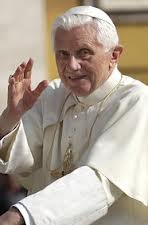
Pope Benedict XVI
It will never be an understatement that the announced resignation of Pope Benedict XVI has shocked the world. Already the media and internet are abuzz with discussion, commentary, and speculation about what will follow.
I have two initial reactions: first, a sense of trepidation. Moving into the unknown, especially when it comes so quickly and with apparently so little notice, can leave us with a sense of anxiety. Regardless of what one thinks of Benedict and his legacy, he is a known entity. What will happen after February 28, 2013, the day his resignation becomes official, is yet to be seen.
Second, a sense of hopeful expectation. The fact that a conservative pope would do what most conservative Catholics would consider to be unthinkable is a sign to me that God’s Spirit is still at work in the Church. Sometimes an unexpected shock — and this news is a shock — is what the Church needs in order to move forward. Doing what some would have considered an impossibility is a stark reminder of what is and is not a core belief or practice in Catholicism. The concept of creeping infallibility is just the extreme version of a more broad notion that says “this position” or “that practice” is from God, when in fact it is limited by time or place or culture. The resignation of a conservative pope reminds us that the Church can and does change — and change is a sign of life!
May God bless Benedict in whatever lies ahead for him, and may God bless all God’s Holy People as a new Successor to St. Peter is chosen to lead the Church!
“Into deep water” — Homily for the 5th Sunday in Ordinary Time
February 9/10, 2013
For the communities of Dignity/NoVA at Emmanuel Church-on-the-Hill in Arlington, VA and Dignity/Washington at St. Margaret’s Episcopal Church, Washington, DC.
 Most of us are familiar with the word “vocation.” When we hear that word, many of us might think of it in its limited notion of a “vocation to religious life or the priesthood” or other ministerial vocation. That’s certainly a very legitimate use of the word, and it’s understandable that our own idea of “vocation” might be so limited because that’s how we’ve heard the word used. How many of us have heard in various parishes frequent prayers for “an increase in vocations to the priesthood and religious life”? How many of us might even have been asked by a friendly religious sister, brother, or priest when we were younger, “have you ever thought you might have a vocation”? And, of course, there are a fair number of us here in our own gathering who either explored or lived that type of “religious vocation” for a significant part of our lives, and so it’s very understandable that this legitimate, but more narrow concept is what comes to mind when we hear that word.
Today’s scriptures, however, speak to us very poignantly about a much more fundamental and basic understanding of vocation. The word itself comes from the Latin word, “vocare” – meaning to name, to summon, to call, or to invite. All of those ideas are wrapped up in the biblical calls that we hear today from all three readings — from Isaiah, First Corinthians, and the Gospel of Luke.
Although the calls of Isaiah, Paul, and Peter are different, they each have some common elements that can help us understand our own calls, our own vocations. What are some of those elements? Well, to begin, the person called usually has a sense of unworthiness; a sense of “Oh no, not me! You’ve got the wrong guy, Lord. I don’t have what it takes!” We hear that reaction from Isaiah who says, “I am a man of unclean lips, living among a people of unclean lips.” Paul describes himself as “one not fit to be an apostle,” and perhaps most dramatically, Peter falls at Jesus’ feet and says, “Depart from me, Lord, for I am a sinful man.”
This sense of unfitness, sinfulness, and unworthiness is not some sense of pathological self-hatred. It’s not an expression from people whose self-esteem and self-worth have been so damaged by life that they don’t see in themselves any goodness at all. No, this reaction is honest and real. It’s rooted in a deep and utterly honest understanding of who they are. As I was reflecting on the scriptures for today, one of the phrases that I kept returning to was Jesus’ command to Peter and his fellow fishermen, “Put out into deep water.” To know ourselves, we need to go deeply into our hearts and souls. Knowing one’s self as fully as Isaiah, Paul, and Peter surely knew themselves certainly required self-awareness at their core. And so, when they find themselves in the presence of something much greater than themselves, in the presence of what is Good and True and Holy, a humility that comes from having looked at themselves honestly and deeply causes them, at first, to turn away and to feel deeply their own unworthiness. Humility is not a virtue that I don’t think is in very high regard in our day and age — and perhaps that’s especially true for this city if Washington, DC. Humility is a virtue that reminds us we are limited, imperfect, and that we cannot save ourselves; that we cannot have and do it all. And yet, such true humility in knowing oneself seems to be a requirement for discerning the call of God in our lives.
Fortunately for Isaiah, Paul, and Peter however, what they see of themselves, though accurate, is not complete. For them — and for all of us if we have the courage to listen and to hear God’s calls in our lives — that sense of unworthiness is not where the story ends. What happens next is that God or Jesus responds in a way that heals or removes that sense of unworthiness… what was lacking has been provided, what was limited has now been made whole. Isaiah speaks of the burning ember that touched his lips, but Jesus simply says to Peter, “Do not be afraid.” It’s almost is if Jesus is saying, “Yes, I know you are a sinful man. I know your shortcomings, your weaknesses, your limitations. I know you more deeply than you know yourself because I see beyond those shortcomings, weaknesses and limitations and see the great possibility that lies in the depths of your soul.”
Because they did not get stuck in seeing only their limitations, but were able to let go of that limited vision of self and begin to see themselves as God sees them – each of these: Isaiah, Paul, and Peter – was able to respond almost immediately with a response that embraced that divine call. Isaiah responds in words: “Here I am; send me!” while Peter and his companions respond in action: Luke tells us that they simply brought their boats to the shore, left everything, and followed Jesus.
I suspect that very few of us have ever had such a dramatic encounter with the Divine as those we hear today. And because God’s presence in our lives is rarely made known in such grand epiphanies, it might be a bit more challenging to experience God’s call in our lives. Some of us might even wonder what our call is, or whether we are called at all? Although the specifics differ from each of us one to the other – surely our common call to follow Jesus is the same. At its core, that call is a call to Love. It is a call to live each day with kindness and compassion and understanding – especially for those in our world who are most in need. Right now, God is calling each of us in one way or another to live the Gospel more fully, more faithfully, with greater humility, and with greater love. What that call sounds like, only you can tell. The only question is, how you will respond?
(c) Copyright 2013 – Timothy J MacGeorge
Priest-Mayor and Gay Marriage in France
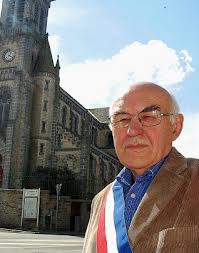
Elie Geffray, priest and mayor of the village of Eréac in Brittany
What a great story from the French countryside! This evening’s All Things Considered tells the story of a Catholic priest who supports same-sex marriage in France and — when that becomes law — will officiate at civil weddings in his capacity as mayor.
French Catholic Priest Plans To Marry Same-Sex Couples In New Job As Mayor
Which Catholic parish will be first to welcome Gay Scouts?
 Apparently the Boy Scouts of America may soon revise their long-standing ban on allowing gay people — as either scouts or volunteer leaders — into the organization. (See today’s story in the Washington Post.) The revision may be that local organizations that sponsor troops — typically civic or religious groups — will be able to make their own call on this matter.
If that comes about, I pray that there will be one Catholic parish somewhere in these United States that will have the faith, the courage, and the decency to do the right thing. I pray that there will be one courageous pastor who will lead his parish in making a decision that puts them “on the right side of history,” and allows the scout troop under their auspices to accept openly gay scouts and leaders.
Today’s story in the Washington Post includes this comment:
“Said Sister Mary Ann Walsh, a spokeswoman for the U.S. Conference of Catholic Bishops, “The bishops hope the Boy Scouts will continue to work under the Judeo-Christian principles upon which they were founded and under which they have served youth well.”
Hopefully Sister Mary Ann and the bishops for whom she works will one day learn that exclusion of people because of who they are as God made them to be is not really a “Judeo-Christian principle.”
Homily for the 3rd Sunday in Ordinary Time (Year C)
January 26/27, 2013
For the communities of Dignity/NoVA at Emmanuel Church-on-the-Hill in Arlington, VA and Dignity/Washington at St. Margaret’s Episcopal Church, Washington, DC.
Before I say anything about the scriptures we just listened to and what they might mean for us today, I think I would be remiss if I failed to acknowledge that – as Americans – we are gathering today as a different people than we did one week ago. While many people who listened to the President’s Inauguration speech on Monday may have had to look up what his references to Seneca Falls and Selma and Stonewall meant, no one could misconstrue the meaning of his words when he went on to say this: “Our journey is not complete until our gay brothers and sisters are treated like anyone else under the law – for if we are truly created equal, then surely the love we commit to one another must be equal as well.” Regardless of whether we voted for Mr. Obama or not, or whether we agree or disagree with his stance on this or that political issue, there can be no doubt that – for us as gay and lesbian Americans – a page of history turned last Monday. There can be no doubt that his speech marked the dawn of a new era and the beginning of a new chapter in the long road of LGBT Americans to see our full acceptance and inclusion in American society. For this, I’m sure you join me in being very thankful to God.

View from Whiteface Mountain, New York
Sadly, the corresponding chapter in the history of our Church has yet to see the full light of day. But let me suggest that the pages of that chapter are being written right here and right now, week in and week out, as we gather to celebrate in Word and in Sacrament the faith of our ancestors – a faith that, as today’s scriptures remind us, brings healing and liberation to those who both listen to and live God’s Word in daily life.
By now you all know that last fall marked the 50th anniversary of the opening of the Second Vatican Council. One of often repeated beliefs frequently heard after Vatican II is that the Church is most fully itself when it gathers for Liturgy. Today we have 3 scripture readings that remind us of this – two of them call to mind the Liturgy of the Word, and one of them reminds us of the Liturgy of the Eucharist. Ezra the priest reads to the people who have recently returned to Jerusalem form their long captivity in Babylon. Jesus of Nazareth, “as was his custom,” entered the local synagogue, reads to a gathering of people who surely knew him well, and tells them, “Today this scripture has been fulfilled in your hearing.”
And finally Paul, in that unusually long passage from his first letter to the Corinthians, reminds a somewhat troubled and fractured community that they are, indeed the very Body of the Christ in whose name they have been baptized. When you hear those words, “Body of Christ,” I suspect that for many of us the first thing that comes to mind is the Eucharist – the bread which we will soon bless and break and share among us. Those are, after all, the words to which we say “Amen!” when the minister of the Eucharist offers us the Communion. Using the image of the human body, however, Paul provides us with a related and dare I say deeper meaning of what “Body of Christ” means.
Paul is writing to a group of Christians in about the year 55 – some 25 years or so after Jesus’ death and resurrection. This small group of people – perhaps 50, but probably not much more – had embraced Paul’s message when he had traveled to the Greek city of Corinth the year before. They had heard him preach, been baptized in Jesus’ name, and had made an initial commitment to what we today would call Christian discipleship. In the year since Paul had gone to preach elsewhere, Paul has learned that things aren’t so good in Corinth. He’s heard that there is tension and division and jealousy; that some people are straying from the message he had taught, that others are living what we can euphemistically call “less than virtuous” lives, and that they were neglecting the poor in their midst.
It is to this small group, this Church, that Paul writes. He probably knew all the people at least by face if not by name, just as we know one another gathered here. He also knew that this was quite a diverse group of people – men and women; Jews and Gentiles; young and old; married and single and widowed; rich and poor; some free and sound bound in servitude and slavery – each with their own gifts and shortcomings, their own weaknesses and strengths. Knowing all this, Paul goes on great length comparing this community, this local Church, to a body. Just like any human body has different parts that all must work together for the good of the whole, so must every member of this body work with all other members for the good of the whole. And just like every part of a human body as its own unique purpose and function, so too does each member of this body have his or her own unique talents and skills and blessings to contribute to the greater good of the whole. And so for Paul, the Body of Christ refers to you and me, gathered as we are in the name of Christ. His words are clear: “… you are Christ’s body, and individually parts of it.”
Even though the Church today is very different than it was in Paul’s day – much larger and even more diverse than two thousand years ago – Paul’s message remains unchanged: Through Baptism into his death and resurrection and through the sharing the One Bread and the One Cup, we are all members of the One Body of Christ.
As LGBT Catholics, we’ve often heard quite a different message from many quarters within our Church, haven’t we? We’ve been told in subtle and not-so-subtle ways that we either are somehow de-formed parts of the Body of Christ, or that we aren’t even a part of that Body at all. You and I know in our hearts that such claims are patently false. We reject positions that would disparage our full humanity or our full Christianity – positions that would seek to exclude us from the Body of Christ. And yet, hearing such claims as we sometimes do, we can feel like the hand or the foot or the eye that says to those other parts, “I do not need you.” In our anger at being rejected, we can reject in turn those who dismiss us … especially those who wield great power within the Church and who … unlike the President in his speech … would never even speak the word “gay” let alone engage in fruitful dialogue with God’s LGBT sons and daughters.
And so for us, if God’s Word is to be fulfilled in our hearing, then there is a new challenge. Like our Corinthian ancestors, we are called to see fellow members of the Body of Christ not only in the faces of one another gathered here – people whom we know and care for and even call friend – but also we are challenged to see as members of the Body of Christ those who may still be blinded by prejudice and bound by ignorance. And … if our blindnesses are healed … we may even have cause to see some signs of hope for our Church.
Some gay Catholics were pleased, for example, to see seeds of hope in this week’s statement from the Bishops of France where, as you probably know, the issue of same-sex marriage is being hotly debated. While their statement would hardly be endorsed by gay rights groups, the French bishops’ statement at least: Recognizes that homosexuality has always existed; Rejects homophobia in any and all forms; Recognizes that there can be value in loving, committed same-sex relationships; and Recognizes that the concerns and needs of gay people themselves must be listened to directly.
The passage of Scripture that Luke tells us Jesus declared “fulfilled in their hearing” was from the prophet Isaiah.
The Spirit of the Lord is upon me, because he has anointed me to bring glad tidings to the poor. He has sent me to proclaim liberty to captives and recovery of sight to the blind, to let the oppressed go free, and to proclaim a year acceptable to the Lord.
May these same words of Scripture reminding us that we are Members of the Body of Christ, united in love for one another and called to bring God’s love to a world and a Church that is broken, be fulfilled in our hearing and usher in a new era of healing and liberation for all God’s holy people.
(material for parts of homily is drawn from a variety of sources, including homilies by Fr. Joseph Komonchak, In verbo veritas).
(c) Copyright 2013 – Timothy J MacGeorge
A Gay Brother’s Love
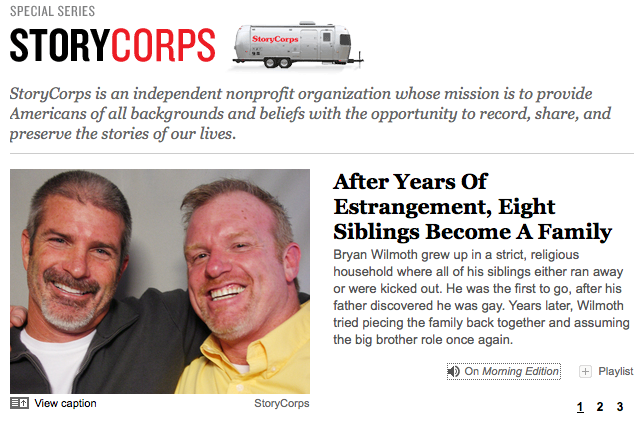 There’s an old Christian folks song that proclaims, “They will know we are Christians by our love, by our love; they will know we are Christians by our love.”
As you listen to this StoryCorps story of how a family of eight siblings were reunited by the love of their eldest (and gay) brother after all of them had been driven away for one reason or another by their religiously (Christian?) fanatical parents, you decide whose actions were more loving.
 Image and Likeness