Not that the Irish ever need a reason for a drinking song, but on this day always think of The Clancy Brothers and Tommy Makem performing this. This a cappella rendition from 1963 showcases the group at its best.

Not that the Irish ever need a reason for a drinking song, but on this day always think of The Clancy Brothers and Tommy Makem performing this. This a cappella rendition from 1963 showcases the group at its best.
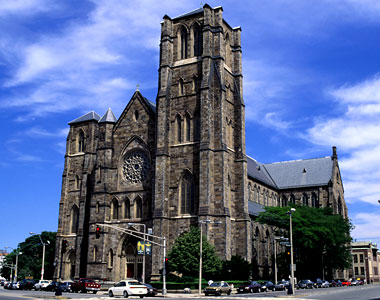 In part, this is how the Boston Globe reported (on June 21, 1987) what took place at the Cathedral of the Holy Cross twenty-five years ago today:
Fourteen seminarians were ordained to the priesthood by Cardinal Bernard F. Law yesterday in a ceremony at the Cathedral of the Holy Cross in Boston’s South End.
Of those ordained, 11 completed their studies at St. John’s Seminary in Brighton, two at Pope John Seminary for Delayed Vocations in Weston and one at North American College, Rome.
The ordained from St. John’s Seminary are Rev. Michael A. Alfano, Stoughton; Rev. Robert J. Bowers, Needham; Rev. David P. Callahan, Lawrence; Rev. Robert E. Casey, Dorchester; Rev. Thomas F. Coronite, Hingham; Rev. James A. Flavin Jr., Billerica; Rev. John W. Gentleman, Lynn; Rev. William M. Kennedy, West Roxbury; Rev. Timothy MacGeorge, Holliston; Rev. Paul G. McManus, Lynn and Rev. Paul F. Russell, Alpena, Mich., and formerly of Lynn.
The two seminarians from Pope John Seminary are Rev. Richard W. Fitzgerald, Boston, and Rev. Ronald A. Gomes, Cambridge.
Rev. Robert Congdon, of Millis, is completing his studies in Rome.
June 20, 1987 was unusually hot and humid in Boston, so you can imagine what it was like to be dressed not only in black, but also to be further garbed in the vestments of priestly ordination. Nonetheless, I still remember that day with great joy and happiness — despite being told by Cardinal Law just moments before the Liturgy of Ordination was to begin that we wouldn’t be sure we had vocations to the priesthood until the moment in the Liturgy when he, the archbishop, accepted the recommendation of the seminary rector and formally called us to ordination!
The past quarter of a century has lead the 14 of us ordained that day along different paths, down different roads. Some are still active in priestly ministry, others (myself included) have felt called elsewhere. Catholic sacramental theology holds that ordination is irrevocable — once a priest, always a priest. And so while I could never have imagined then that I would be in life where I am now, I try as best as I can to bear the fruits of that special day in everything I do.
To my classmates, my brothers, my friends — you are in my thoughts and prayers this day and always. Ad multos annos!
Kenilworth Aquatic Gardens is one of the treasures of DC that not many people visit. Perhaps this is because it’s somewhat off the beaten path, tucked in on the easternmost edge of the city, just inside the Maryland border. I spent a lovely Sunday afternoon with my friends Carter and Steve, enjoying some of this garden’s beautiful treasures. In addition to the water lilies and lotus blossoms, this marshy area is also home to many red winged blackbirds. As I was taking a picture of one in the distance, he flew right toward me and I could see the full red of his wings’ underside — beautiful!
(Click on any image to begin the slideshow)
 This is a question I’ve been meditating on in recent weeks, perhaps even longer. In his daily meditation continuing his reflections on Eucharist, Richard Rohr puts it this way:
Somehow we have to make sure that each day we are hungry, that there’s room inside of us for another presence [emphasis added]. If you are filled with your own opinions, ideas, righteousness, superiority, or sufficiency, you are a world unto yourself and there is no room for “another.”
As a gay man “of a certain age” who is also single and would prefer not to be, I wonder if the history of my own life sometimes gets in the way of having youth’s openness to possibility, to new experiences, and especially to new people whom God may bring my way? I ask this of myself, but also wonder if it might be true for others who have also lived for some time, perhaps many years, establishing their own daily routines, interests, and ways of spending time? Are our lives so utterly fulfilling that there is no longer any room for “another”? How do my/your “independence” fit with our “interdependence” as neighbors, acquaintances, friends, dates or partners? As Fr. Rohr says, if there is no emptiness or hunger, then what is there to be satisfied? To be sure, only God can fulfill that ultimate emptiness and hunger so eloquently stated by Augustine — “My heart will not rest until it rests in Thee” — but are there not hungers at the level of human relationship and intimacy that we are called to fulfill for one another?
Just as there is possibility within every springtime bud, is there not great possibility within every human heart and soul?
For the communities of Dignity/NoVA at Emmanuel Church-on-the-Hill in Arlington, VA and Dignity/Washington at St. Margaret’s Episcopal Church, Washington, DC.
June 10, 2012
Today we celebrate a feast that has been a part of the Church’s liturgical calendar since the thirteenth century. In English we call it the Solemnity of the Body and Blood of Christ, but it’s also commonly known by the abbreviated version of its Latin name, Corpus Christi. Although I’ve never actually participated in it, one of the special ways in which this feast can be celebrated is to have a public Corpus Christi Procession. While the liturgical norms provide great detail on how to conduct such a procession, it essentially is quite simple. After Mass, the gathered community is lead through the streets of their city or town by the celebrant of the Mass. He carries the Eucharist, which in turn is held under a canopy of some sort – a sign of respect for our belief in the Real Presence of Jesus in the Eucharist.
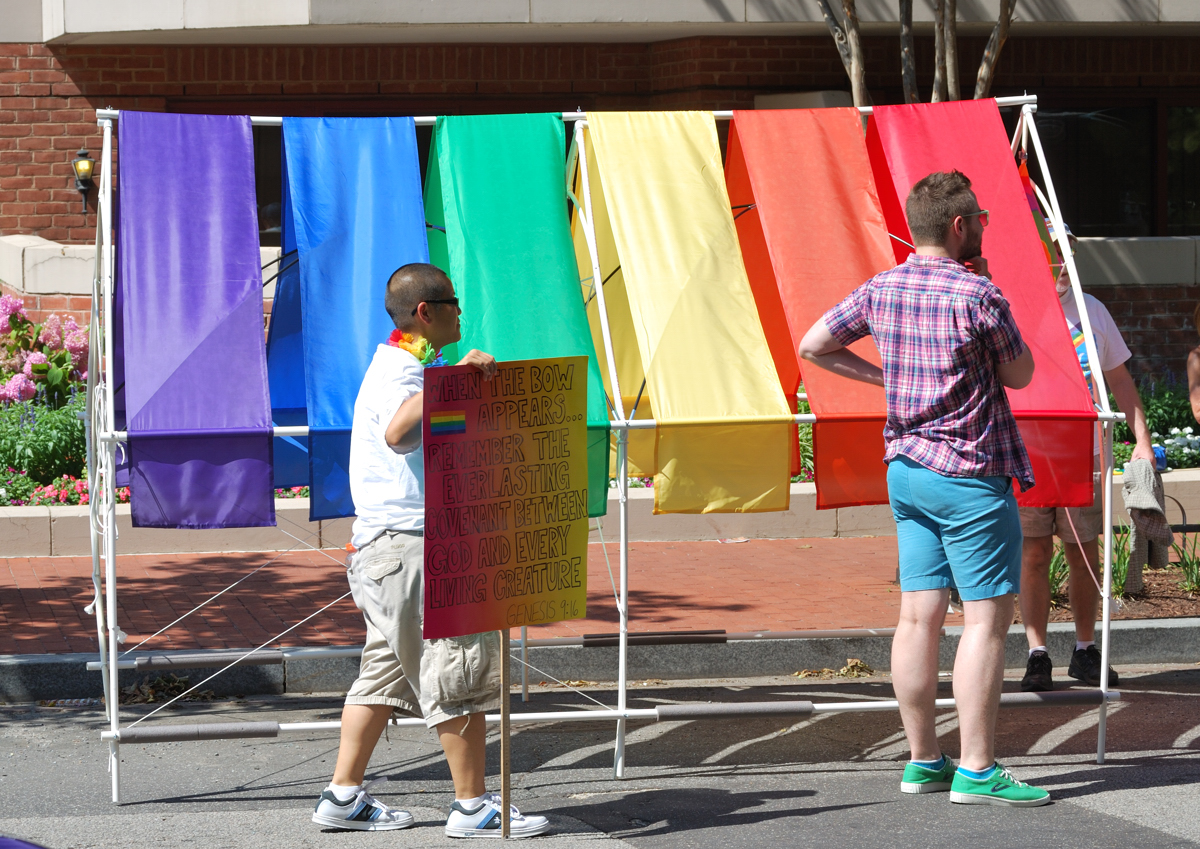 I couldn’t help but think of that image yesterday as a group of us – over 40 members of this community – joined with many hundreds of others in marching in yesterday’s Capital Pride Parade. Thanks to the artistic skills of Larry Ranly, we had our own version of such a Corpus Christi canopy. Constructed in the shape of a chapel, our lightweight canopy was draped in the colors of the rainbow, and it was carried by six of us as we walked the parade route behind a banner indicating that we were the Dignity/Washington contingent.
Even as I thought of that image in relationship to today’s Feast, I couldn’t also help but think of what this feast – the feast of Corpus Christi – means for me personally. For the past quarter of a century, it has been a very special day. Although it’s been quite a few years since I was in active parish ministry, it was on this weekend twenty-five years ago that I was ordained a priest. And so it was on this feast day that I had the great joy of presiding at the Eucharist as a priest for the very first time.
 In the diocese where I was ordained, the tradition is that a newly ordained priest would often invite someone else – perhaps a close friend, maybe a classmate from another diocese, or someone who had been influential in one’s years of seminary study – to give the homily. And so it was that I asked my good friend Gerry – ordained several years ahead of me and who, sadly, has since passed away – to give the homily at my first Mass. In that homily, Gerry talked about the room on Mount Zion in Jerusalem that has been venerated as the site the “Upper Room” since the 4th century. In that room, there is a carving at the top of a stone pillar. It’s a carving of a mother pelican feeding here young with her own flesh and blood – a symbol of Jesus who gave the ultimate sacrifice for us, who gave us the gift his very self on the cross, a gift which we remember and receive again and again every time we share in Eucharist.
It you either marched in or were present for yesterday’s Parade, you know what a wonderful spirit was there – a spirit of celebration blessed by the beautify of a warm June day, but also marked by a sense of a changed or changing landscape for the LGBT community in the U.S. When we look at past Gay Pride events – events which have become the “High Holy Days” for the gay community around the globe – one cannot fail to recognize how different things are for us in 2012 than they were say, in 1987 when I was ordained … and maybe even before some of you were even born! So much has changed, in fact, that I’ve heard a number of people say over the past year or so that the struggle for gay rights and for the full inclusion of LGBT people in civil society here in the US is just a matter of time. I think perhaps the general consensus is that, although there are goals yet to achieve, it really is just a matter of time before the barriers toward such full inclusion in civil society are greatly diminished or eliminated. Indeed, I think there is strong evidence to support this perspective.
If that is true – and I hope and pray it is – I think it presents to us as LGBT Catholics an important time for reflection. At the heart of this is the fact that what can be said about civil society, the broader culture, and even many other branches of the Christian family tree … those things unfortunately cannot yet be said about our Catholic community. While there are many positive indications about where we as LGBT Catholics are today when compared with two decades ago … it is not quite so clear that the tide has turned, or that full inclusion of LGBT Catholics into the life of the Church at all levels is in any way imminent. If it is indeed, just a matter of time for such inclusion to come about, I daresay we’re probably talking in terms of decades and even longer, rather than months and years.
So if that is true, then what does this mean for us as a community of LGBT Catholics? Where do we want to be in 5, 10, or 25 years in terms of our relationship with the broader Catholic community … and how do we get there? What does this mean for how we will move forward in ensuring that popes and bishops and other leaders of our Church – as well as those of our lay brothers and sisters who still accept what the media call the church’s “official teaching” regarding human sexuality and the rejection of God’s image and likeness reflected in people like you and me – what does this mean for how we ensure that they understand that we, too, are members of the one Body of Christ? How do we share with our fellow Catholics at all levels of the church’s structure the truths of our own lives? How do we help them to understand that the there is indeed room under that Corpus Christi canopy for ALL members of Christ’s Body? How do we do all this and still remain faithful to our call to live our Christian faith in the context and tradition of Catholicism?
I don’t know the answers to these questions, but if we are to take seriously the fact that through our Baptism we have been made part of that One Body of Christ, then I think we at least need to think about this unique moment in time, recognizing who we are, where we are, and being thoughtful about where we are heading. While I don’t know all the answers, I have no doubt that sacrifice will be involved. Just as that mother pelican gave her life for her young, and as Jesus gave up his very self so that we might have access to the fullness of life, we too must be prepared to give up and let go of what is non-essential, so that our voices may be unified and the core truth of our message will be not only heard, bur received.
As you’ve heard before and I’m sure will hear again … this year marks a very special anniversary. It’s the 50th year since the Second Vatican Council began its work in Rome in 1962. If you’re not familiar with that Council’s 16 Constitutions, Declarations and Decrees, maybe you should pick up a copy and add it to your summer beach reading list! There is in those documents great richness for today that goes beyond what is sometimes minimizes the Council’s work by referring to the “spirit of Vatican II, ” as the documents themselves paint a picture of a Church very different than what some current leaders would have us see. In the Dogmatic Constition on the Church, Lumen Gentium (#12), the Council Fathers wrote:
“The entire body of the faithful, anointed as they are by the Holy One, cannot err in matters of belief. They manifest this special property by means of the whole peoples’ supernatural discernment in matters of faith when “from the Bishops down to the last of the lay faithful” they show universal agreement in matters of faith and morals.”
I don’t know how you could be more clear in declaring that every member of the Body of Christ has a role to play and a voice to speak in discerning matters of faith. As we claim our rightful place within the Body of Christ – as we become more fully what we receive in Eucharist – our task as faithful members of Christ’s one Body – is to discern rightly and to live out that discernment in faith and in hope and in dignity.
 Loving God…
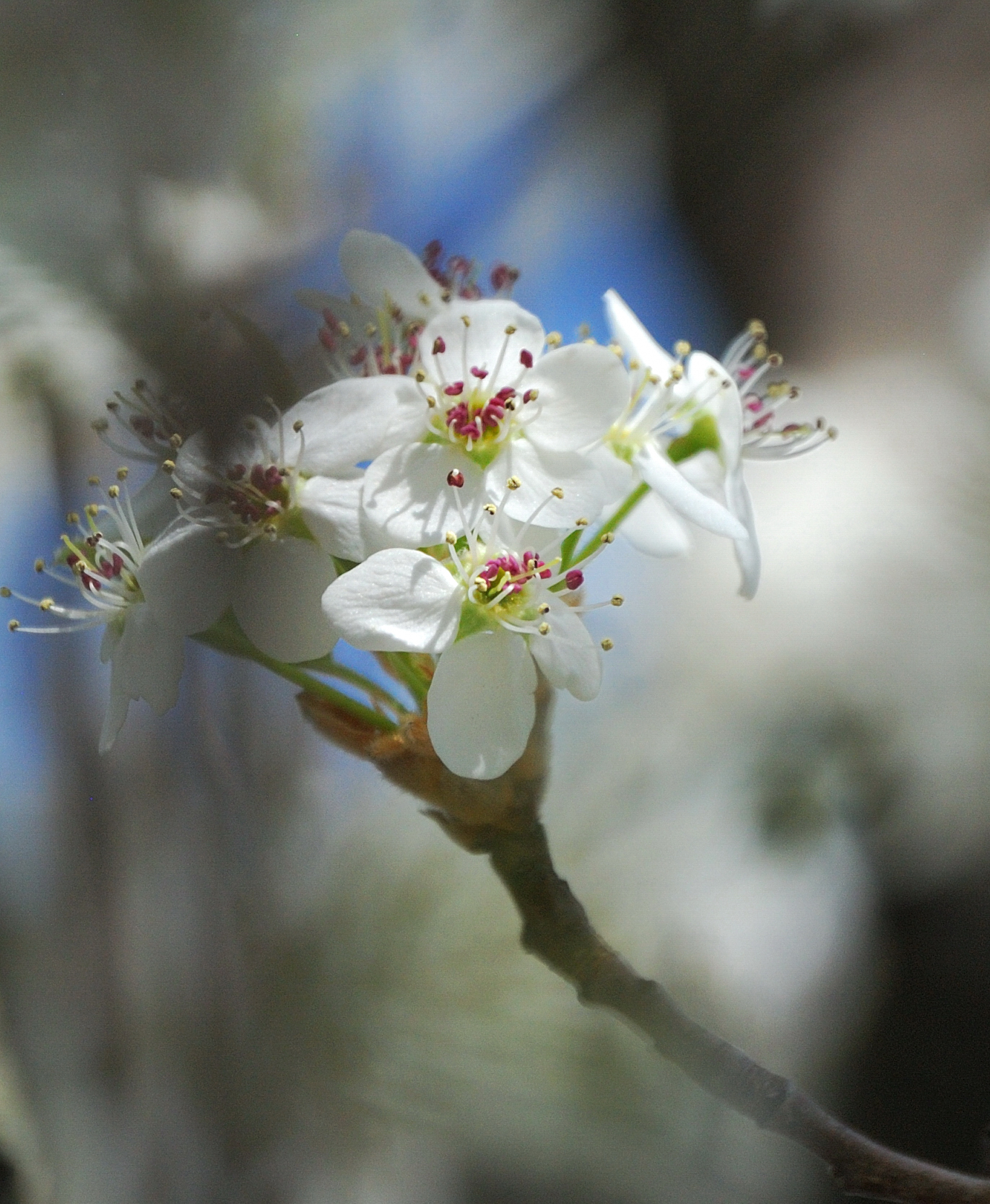
My fascination with birds (and flowers) continues! Here are a few pictures from my recent trip to Palm Springs, CA.
Yesterday was my birthday.
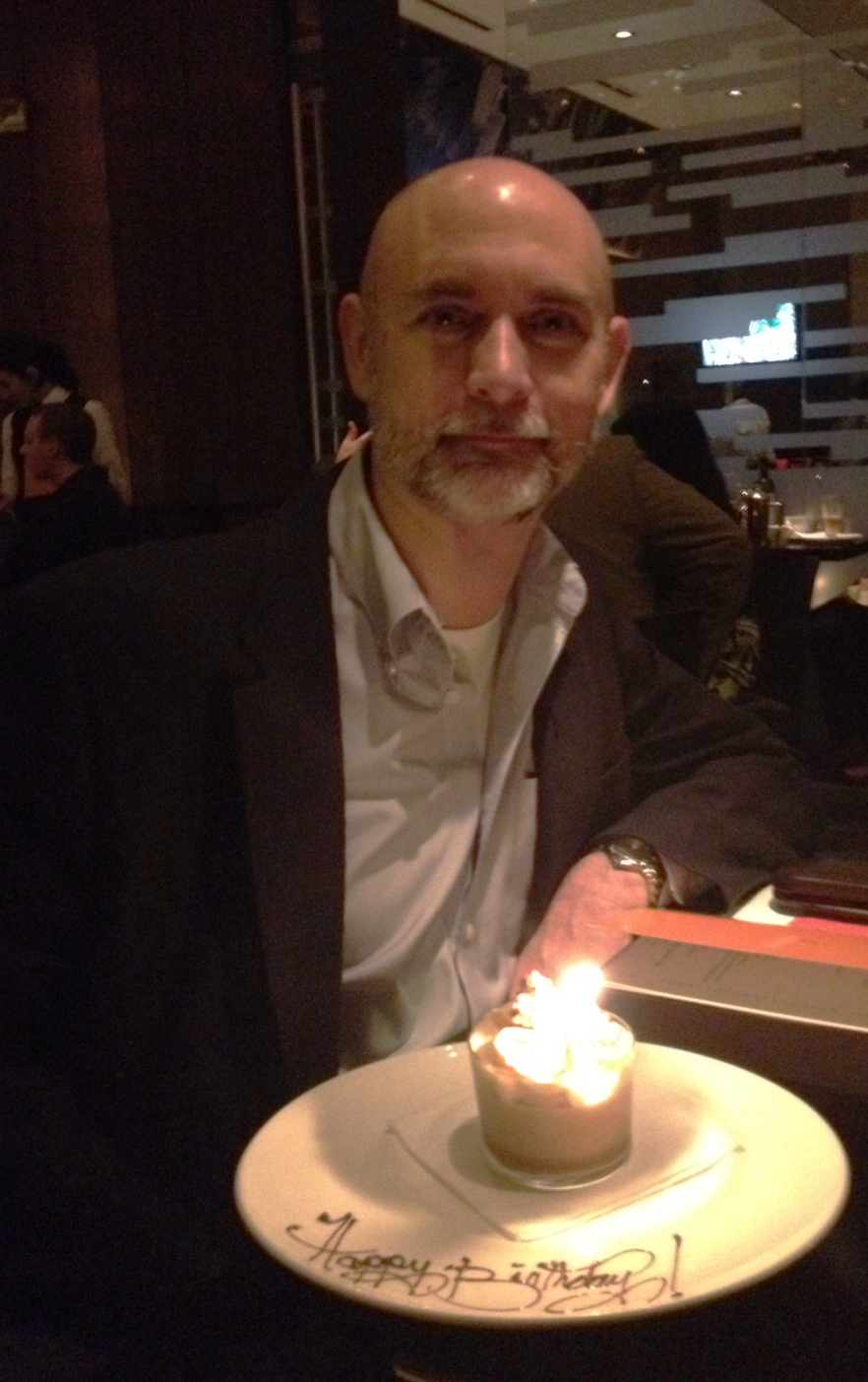
There really was just a single candle in my panna cotta, even though it looks like the fire department might be on its way!
I usually observe that day each year by taking off from work and going for a long walk here in DC. Invariably I stop in to the National Gallery of Art (NGA) to enjoy the beauty of its architecture, sculptures, and other artwork from across the centuries.
Sometimes I just relax in the rotunda of the Gallery’s west wing, sitting back and taking in all the activity of visitors from around the country and around the world enjoying this national treasure.
While I wasn’t able to get away from work for the entire day, nor was I able to make it to the NGA, I did leave early and enjoyed a wonderful dinner with some special friends. Throughout the day I continued to be periodically delighted as more and more Facebook friends and acquaintances offered best wishes and congratulations. It felt good to be remembered.
Birthdays are gifts; they are snippets of time out of Time that encourage us to pause for a moment on our life’s journey —
remembering what was,
pondering what might be, and
most especially being grateful for what is.
Dignity/NoVA recently celebrated its 20th Anniversary of serving the community of LGBT Catholics in the Northern Virginia area. On Saturday evening (May 12, 2012) an intrepid crew of about 30 members set sail for a three-hour tour on the Potomac, past the iconic monuments of DC and beyond the Georgetown harbor.
We don’t teach meditation to the young monks. They are not ready for it until they stop slamming doors.
~ Thich Nhat Hanh to Thomas Merton in 1966

“Charlotte Pastor Mark Harris and Cindy Marrelli of Raleigh celebrate the passage of the N.C. marriage amendment during an election night party at the North Raleigh Hilton.”
I began my morning by reading the daily meditation from Richard Rohr, which begins with the above. I then saw several pictures online and in print picturing so-called “pastors” jubilantly celebrating the passage of Amendment 1 in North Carolina, and it struck me that these are exactly the kind of people that Fr. Rohr is talking about when he comments:
First stop slamming doors, and then you can begin in the kindergarten of spirituality. Too many priests, bishops, and ministers are still slamming doors.
No one who supports the right of God’s LGBT children to live their lives honestly, openly, freely and without fear is surprised to hear that much (most?) of the bigotry that opposes such honesty and freedom is rooted in religion. Nonetheless, it never ceases to shock me in one way or another when the strong-arm of this bigotry exercises its might as it did yesterday in North Carolina.
The picture of a “pastor” raising his clenched-fist, smiling and expressing support for the fact that a majority of his fellow citizens have slammed the door on the faces of so many tens of thousands of their brothers and sisters — well, this just doesn’t seem very “pastoral,” now does it? This man — and too many other religious administrators (I won’t call them “leaders”) — would probably not yet be ready to begin to take the baby-steps that truly faithful people people take when they seek to know the path to God in humility and compassion.
Some may say this sounds judgmental, even a bit harsh. To that I plead guilty. But I think a little anger is justified when those whose actions seeking to deny the fundamental rights of others are temporarily successful. Thankfully, there’s that thing called the arc of history … and towards a better world characterized by Justice and Peace I hope and pray it will continue to bend!
 Image and Likeness