Loves Urgent Longings …

“Love’s urgent longings …” — this phrase from The Dark Night by St. John of the Cross has been echoing in my mind and resounding in my heart today. Would that every human heart knew the love of which the Spanish saint writes, and that laying our face on our beloved, we might leave our cares among the lilies!

Stanzas Of The Soul

One dark night,
fired with love’s urgent longings
– ah, the sheer grace! –
I went out unseen,
my house being now all stilled.

In darkness, and secure,
by the secret ladder, disguised,
– ah, the sheer grace! –
in darkness and concealment,
my house being now all stilled.

On that glad night,
in secret, for no one saw me,
nor did I look at anything,
with no other light or guide
than the one that burned in my heart.

This guided me
more surely than the light of noon
to where he was awaiting me
– him I knew so well –
there in a place where no one appeared.

O guiding night!
O night more lovely than the dawn!
O night that has united
the Lover with his beloved,
transforming the beloved in her Lover.

Upon my flowering breast
which I kept wholly for him alone,
there he lay sleeping,
and I caressing him
there in a breeze from the fanning cedars.

When the breeze blew from the turret,
as I parted his hair,
it wounded my neck
with its gentle hand,
suspending all my senses.

I abandoned and forgot myself,
laying my face on my Beloved;
all things ceased; I went out from myself,
leaving my cares
forgotten among the lilies.

Homily for the Solemnity of the Assumption – 1987

I wrote this homily twenty-five years ago, just a couple of months after being ordained.  I share it now because I think the message — simple as it is — is relevant today as it was then.

SOLEMNITY OF THE ASSUMPTION – St. Anne’s Parish, Littleton, MA

August 15, 1987

Today we celebrate the feast of Mary’s Assumption — a day on which we affirm that Mary, as the earthly mother of the Divine Son of God, now lives body and soul and the fullness of her person in the presence of God.  But even as we affirm the truth of Mary’s existence in heaven, if we are truly to celebrate this feast, we need, in a sense, to bring Mary a bit more down to earth.  I say this because on such an occasion the tendency seems to be to see Mary only as the Queen of angels and saints now reigning gloriously in heaven.  And while she may be all this and more, to see only this aspect of her is to rob her of the power to speak to each and every one of us in this church today, to speak to us as a model of faith and obedience to the will of God.

In the Gospel of Luke, we find Mary’s beautiful song of praise — the Magnificat — and in that passage we hear Mary describe herself not as a Queen but as a lowly servant — in the original language, ”anawim,” one of the little poor ones, one of the powerless on the lower rungs of society’s ladder.  She was on earth without privilege or rank, yet God chose her to bring His only Son into the world.

“Well,” we may say, “that in itself is certainly greater than any earthly glory” — and while this is true, we do well to remember that Mary’s saying “Yes” to God’s will for her did not bring her a life of joy.  For she endured society’s scorn for being an unmarried woman with child, thus allowing herself to be placed at the risk of being ostracized from the society in which she lived.  And then, she lived to see this son grow up to be rejected, arrested, and executed as a common criminal or a slave would be on a cross.

She knew the pain of a parent losing a child.  Surely her faith was challenged to the core, yet indeed she did keep faith.  She continued to believe in spite of all that she saw and experienced.  For she trusted that God would somehow make things right, that her son’s sufferings and her own in turn were not in vain.  Mary was not blessed with foreknowledge or superhuman powers.  Like the other disciples, she too had to suffer and endure until she saw God’s promise fulfilled in her son’s resurrection.  Thus, for her obedient “yes” to God’s will, for her persevering in faith in spite of the cost to her personally, in spite of her own sorrow and suffering — it is for these reasons that we celebrate Mary today.  For on earth, she was one of us, and as such she is a model for us so that we too can follow her lead, we too can say “yes” to God’s will for our lives; we too can persevere in faith in spite of what sufferings come our way in this life, and although the Assumption we reserve for Mary, we too can trust that if we keep faith, we shall one day live as Mary does now, body and soul in the presence of God.  For as we are now, so once was Mary — as she is now, so we hope to be.  This is truly cause to celebrate the feast of her assumption.

The Heart’s Desire for the Divine

A few gems from Fr. Joseph Komonchak’s blog, In verbo veritas and his homily for this weekend:

Hearts that are satisfied with what they have made of themselves do not hunger for the righteousness, the integrity that only God can make real. The self-satisfied experience no need of him. [emphasis added]

Love of the truth, delight in the truth, is at least incipient love of God and of Christ. This surely is the ordinary way in which people begin to move toward God long before they know they are being drawn toward God, if indeed they ever come to know that it is God whom they love and desire.

Silence and Solitude: Tools of the Soul

For the past three days I’ve been attending a work-related conference on health communication, marketing and media. As you might expect, almost every session refers to the “new media” tools used to communicate in today’s digital world.  “Facebook and Twitter” is spoken as a single word, and it’s invariably followed by other social media tools used both to communicate and measure that communication. Topics such as “engagement,” “reach,” “influencing,” and being “connected” with one’s target audience are pervasive.

A monarch butterfly enjoys the garden at Thomas Jefferson’s Monticello.

I get that this is the world in which we live. I also understand that these tools are just that — tools in a larger toolbox that has been around since the first humans realized that they were not alone, that there were others like them, and that they wanted to reach out to others, interact with others, and be connected. The need and desire for human connectedness is even more self-evident than the truths penned by Thomas Jefferson; we are social beings, and we want to know one another, to interact with one another, to touch one another.

Yet, in the midst of all the talk of connectedness, I’ve found myself these past days seeking and relishing moments of quiet and solitude. And by that I don’t mean time simply alone.  As a single man I have lots of that! I am by myself more than I am with others, and so the need I’ve been experiencing went beyond that. I’ve been experiencing a need to be “disconnected” from all the texts and tweets and emails and surfing and simple “noise” that at times can be so very overwhelming.  Perhaps that’s why I find myself now — in the middle of the night — sitting in the silence of a darkened hotel room, relishing the silence and the opportunity to be alone in a deeper, more profound way.

A large bird — is it a vulture? — flies overhead at Monticello.

Silence and solitude are tools, too. They are not the tools of social engagement, but are the tools of the soul. Without our occasional (dare I say regular?!) forays into silence and solitude, our souls in shyness can become bewildered. When we are so utterly “connected” and so constantly engaged with an outward gaze, we can lose the necessary perspective that an inward gaze provides. We can lose touch with the deepest part of who we are, or even forget that there is a part of who we are that doesn’t need our gadgets and technologies.  What I’m speaking of is not so much the need to be disconnected from that which is outside of us, but rather the need to be equally connected with that which is within us. Deeper connection with myself, and with the Other Whom I find in the quiet depths of my soul forms and informs and blesses my connections with others.

Even more than FB and Twitter, Silence and Solitude are tools everyone can use (and there’s no username of password required!).

Reconciliation, Forgiveness, and “Letting go”

Yesterday, in reflecting on some particular aspects of my life over the past few years, I found myself meditating on the difference between Reconciliation and Forgiveness.

Fr Rohr’s daily meditation is timely:

“The religious word for this letting go is forgiveness. You see the imperfect moment for what it is, and you hand it over to God. You refuse to let any negative storyline or self-serving agenda define your life.”

To let go isn’t always easy, especially when there is the need for forgiveness without the possibility of reconciliation. Reconciliation with another means both must be involved; both must actively be seeking to mend that which has been injured or broken. Forgiveness, on the other hand, is something I can (and often must) do on my own. When we find ourselves in situations where, for whatever reasons, the cooperative work of reconciliation isn’t possible, we must still work to find the ability to forgive, lest we allow some past hurt or injury to keep us from being who we are called to be.

And, as Fr. Rohr points out, letting go of something doesn’t mean simply ignoring it, denying it, or tossing it away with the morning trash. It means handing it over to God, trusting that God will do with it whatever is best to bring about full healing in ways we can’t even imagine.

In Response to Hate: Homily for the 17th Sunday in Ordinary Time

July 28/29, 2012 (Readings)

For the communities of Dignity/NoVA at Emmanuel Church-on-the-Hill in Arlington, VA and Dignity/Washington at St. Margaret’s Episcopal Church, Washington, DC.

No doubt the biggest news items you’ve heard over the past week or so include:

  • Coverage of the horrific violence that happened last weekend in Colorado when a heavily armed man – who is probably mentally ill – shot up a movie theater, killing and injuring so many; or
  • The build up to and the non-stop coverage of the Olympic Games that are getting underway in London; or
  • Local coverage of the 19th International AIDS Conference that was finally able to be held here in the US; and
  • Of course, the coverage of this year’s campaign as President Obama and Governor Romney continue to slug it out for the keys to the White House.

What you might not have heard, however, are these stories about…

  • The man in Oklahoma City who sustained 2nd degree burns after his car was vandalized and fire-bombed; or
  • The 17-year old young woman in Louisville, Kentucky who was attacked by a group of adults as she walked home from a convenience store with two younger boys, who are neighborhood friends; or – and most troubling of all,
  • The 33-year old woman in Lincoln, Nebraska whose home was set on fire after 3 masked men broke in during the night and mutilated her skin, carving slurs that justified the classification of this horrific act as a Hate Crime.

The common thread between these last three is that all three victims are gay.  All three were known to be gay or lesbian and were simply going about living – just like you and I do every day – their daily, fairly mundane lives.  Suddenly, out of the blue and without warning, a violence borne of hate tore their lives apart in ways they will never forget and in ways that will leave lasting scars – both literally and figuratively.

Today’s Gospel reading is the first 15 verses of the 6th chapter of the Gospel of John.  Over the next several weeks – in fact for the entire month of August – we will hear practically the entire rest of this chapter and its more than 70 verses.  For the most part, this section of John’s Gospel is referred to as the “Bread of Life Discourse,” and it starts off with this passage we just listened to, the miracle story of the multiplication of five barley loaves and a few fish so very familiar to us all.  As we move through the following weeks and hear Jesus explain in various ways that the Bread of Life, the Bread from Heaven, is indeed his very Body and Blood, the final Gospel reading of August will conclude with these words:

“’The words I have spoken to you are Spirit and life. But there are some of you who do not believe’….  As a result of this, many of his disciples returned to their former way of life and no longer accompanied him.”

To be a follower of Jesus is not easy – it never has been and never will be. If we doubt that, we simply need to hear again that even among those who knew Jesus in the flesh, even among those who saw him with their own eyes and who heard him with their own ears – even among these some came to a place where following him was too difficult, where being his disciple was too demanding, and so they turned around, they went back to a “former way of life” and could not find it in their minds or their hearts to continue accompanying him, allowing their lives to be transformed by the Gospel of Love and of Peace that he preached.

What I’d like to draw our attention, to, however, is not the theological and spiritual significance of these very important Gospel passages.  These Scriptures are indeed quite formative for us as Catholic Christians, and especially for our understanding of sacramentality and our unshakeable belief in what we call the “Real Presence” of Jesus in the consecrated bread and wine of Eucharist.

No, what I’d like to draw our attention to is the second reading from Ephesians – especially in view of those news stories I mentioned.  Scripture scholars tell us this letter was written probably not by Paul himself, but by a disciple of Paul. As a whole, the overall theme of the Letter to the Ephesians speaks to the Unity that should exist among the followers of Jesus. As the letter states, we are called to preserve unity in the Spirit through the bond of Peace.  The author challenges us not simply to believe something, but actually to live our lives marked by virtues that characterize Christian behavior. The three virtues named here are humility, gentleness, and patience.  By embracing these and living these, we will then be united in the Spirit through that bond of Peace.

That’s all well and good for us who believe the same things, who see the world through similar eyes, and who place our faith in the same God Whom we believe is indeed “over all and in all and through all.”  But what about those who may not only believe differently than we do, but who even hate or despise us for whatever reason?  How do we respond to those who speak words of hate to us or to any one else who is “other” simply because of who they are? What do we when face to face with those who who teach their children to hate, and who say that it’s OK to do violence – which is the offspring of hate – towards those who are different? What do we do when words which sew the seeds of hate sometimes come from those in our midst most called to preach the Gospel and its fundamental assertion that we are all the beloved sons and daughters of God? And … when we see what others can do to our LGBT brothers and sisters, how is it possible to be humble, gentle, and patient in the face of that!? And of course, perhaps the most difficult question of all is, where might there be hatred in our own lives and hearts, and how do we respond when the forces of this world tug at us incessantly, trying to pull us back to a “former way of life”?

I ask these questions not because I have any answers, but simply to remind us that the world in which we live and the Peace that God alone gives will shine forth only when we who claim to be Jesus’ disciples live our lives each day with greater humility, gentleness, and patience.  Even for those who would do us harm, is not this our call as disciples? Let us pray that even in the face of the most horrific acts of violence as well as the daily acts of unkindness we may encounter, we may always respond to one another and to all with humility, gentleness and patience.

Fidelity Oaths Revisited – part 1

Last week I wrote briefly about the rise in so-called “fidelity oaths” in which Church workers are being asked by local bishops to pledge their belief in and support of positions put forth
by Church office-holders.

As I concluded my comments I wrote this: “Anyone who fully understands and values the breadth and depth of Catholic Christianity must be appalled by this trend, especially when such oaths appear to be written in ways that clearly are contrary to Catholic teaching.”

I realize that this broad declaration needs further clarification, not only for those who may be less familiar with the “breadth and depth of Catholic Christianity,” but also for those who may be wondering why, precisely, might such oaths be “contrary to Catholic teaching.”

Here are three reasons:

  1. First, they offend the principle which respects the primacy of the well-formed conscience in moral decision-making.
  2. Second, they can exemplify a type of creeping infallibility that seems to be a growing trend in some quarters of the Church.
  3. Third, and most important, they seem to usurp the fidelity oath that we already have as Catholic Christians, i.e. the Creed or Profession of Faith we profess at every Sunday liturgy.

I’ll write about each of these over the next week or so. But in order to understand the first point in particular, as well as to set this in a specific context, it would be helpful to look specifically at an example of what one such “fidelity oath” states and demands. As referenced in the Washington Post article, the former bishop of the Diocese of Baker (Washington) included the following in that diocese’s 201-page Pastoral Guidelines from 2006 (full text here). (These Guidelines, by the way, go so far as to include the Archdiocese’s of Los Angeles’ list the vintages and vineyards of wines – California produced, of course – that are “approved to sacramental use.”).

Lest I be accused of taking something out of context, here are three relevant sections:

25. The Affirmation of Personal Faith asks candidates for ministry to state unequivocally: “I believe and profess all that the Holy Catholic Church teaches, believes and proclaims to be revealed by God.” This carries with it the affirmation of specific teachings of the Catholic Church. A non-exhaustive list of these is provided in the form of individual affirmations. They include statements on the inviolability of human life, the sinfulness of contraception, the evil of extra-marital sexual relationships, the unacceptability of homosexual relationships, the wrongness of cohabitation before marriage, the significance of the Real Presence of Christ in the Eucharist, the legitimacy of Marian devotions, the existence of hell and purgatory, the uniqueness of the Catholic Church, the legitimacy of the Holy Father’s claim to infallibility and the moral teaching authority of the Catholic Church.

26. It is hoped that no one who presently serves will be excluded from future ministry as a result of this insistence on a clearer Affirmation of Personal Faith but if anyone is unable in good faith to make the Affirmation then this indicates a need to study and understand the Faith more thoroughly before seeking approval for public ministry. In the event that someone indicates that they cannot make the required Affirmation no public announcement will be made about the reasons for their end of service. An inability to make this Affirmation does not necessarily exclude someone from the possibility of receiving Holy Communion but it would indicate a need to look at his or her own life more carefully and consider, before God, the acceptability of his or her moral status.

27. While there is a possibility that someone may object that such a policy is an unjust infringement on an individual’s right and duty to follow their own conscience such an objection is invalid. Conscience is not something which exists in a vacuum. No one can claim a legitimate right to follow a conscience which is clearly not formed in a fashion consistent with the very clear teachings of the Catholic Church. The following of one’s own conscience is a strict moral obligation but that obligation is preceded by the obligation to assure that the conscience one is following is properly formed. When that conscience leads to judgments which are diametrically opposed to the clear and consistent teachings of the Catholic Church then the conscience has established itself as a new and individual, infallible personal magisterium which far exceeds the definition of conscience. Furthermore, it is one thing to claim a right to follow one’s conscience, even if it is erroneously formed, it is quite another to insist that one be afforded certain privileges, to which one has no right, while following that manifestly ill-formed conscience.

to be continued…

Bishops, Oaths, and Conscience

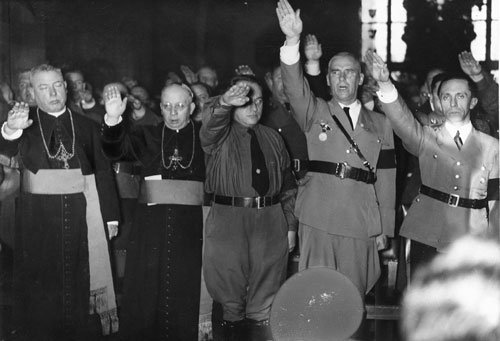
Catholic bishops joining in the Nazi salute.

Today’s Washington Post reports on a highly troubling story (Arlington Diocese parishioners question need for fidelity oath) about a rising trend in Catholic dioceses to require workers — including volunteers who teach religious education — to affirm some sort of “fidelity oath” in order to continue their work or ministry. The story ends with this:

The Rev. Ronald Nuzzi, who heads the leadership program for Catholic educators at the University of Notre Dame, said many bishops “are in a pickle.” They want Catholic institutions to be staffed by people who not only teach what the church teaches but whose “whole life will bear witness.”

Nuzzi said he keeps a photo on his desk from the 1940s that shows all the German bishops in their garb, doing the Nazi salute.

“I keep it there to remind people who say to do everything the Church says, that their wisdom has limitations, too.”

Anyone who fully understands and values the breadth and depth of Catholic Christianity must be appalled by this trend, especially when such oaths appear to be written in ways that clearly are contrary to Catholic teaching. What is more troubling, however, is the perspective expressed by some — both clergy and laity — who see no problem with such a practice.

Morning Prayer

This rainbow — the perennial reminder of God’s promise — appeared in the Eastern sky after a brief rain on the ride back from a few days at the beach.

Lord, here and now I open my heart, my mind, my soul, my very self to the lessons of this day and all that You desire for me.

Bless at this dawn all people in my life — family, friends, co-workers, neighbors and even strangers.

Bless especially those whom I love and who have touched my heart, whether they know it or not.

Free me from all anxiety and sadness and doubt and fear.

Give me eyes to see and ears to hear all that is wondrous and beautiful in the world.

Help me to do some good — however great or small — so that this world and the world yet to come may be more closely united in the timeless Oneness of All.

Amen.

May the Prophets’ Voice be heard

“And whether they heed or resist–for they are a rebellious house–they shall know that a prophet has been among them.”

I was struck by this line from the first reading of today’s Liturgy. Ezekiel is forewarned that his words may or may not be heard, they may or may not be heeded.

What prophetic voices do I need to hear and heed? Who in today’s world is speaking Divine words to the obstinate of heart?