“A creativity that renews tradition”

Pope Benedict XVI recently traveled to Spain for the dedication of Barcelona’s Sagrada Familia church, a modern cathedral designed by architect Antoni Gaudí.
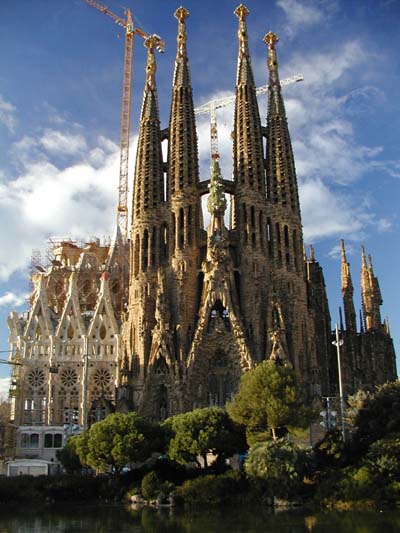
On the plane traveling to Spain, Benedict responded to reporters’ questions and described his admiration for the Catalan architect’s vision, praising him for his ability both to work within the tradition of great cathedral building, but also for not being afraid to explore and develop new forms of creativity.  Said Benedict, “Gaudí had the courage to make himself part of the great tradition of the cathedrals. Using a completely new approach, he dared in his own time to make the cathedral a place for the solemn meeting between God and man. And this courage to remain within tradition, but with a creativity that renews tradition and shows the unity and progress of history, is a beautiful thing.”

“A creativity that renews tradition.” That’s actually a beautiful line, a beautiful way of expressing how Catholic Christianity, at its best, is enfleshed in and lived by God’s people at any one point in time. Ours is a living tradition, one that not only is open to renewal, but that actually requires renewal in each and every generation, in each and every age, and in each and every person. Rooted in that which has been received (which is what “tradition” means), but open also to living this out in ways that could not have been or were not envisioned earlier — this is the essence of a living, creative Tradition.

If Pope Benedict can see this so clearly in art and architecture as expressions of a renewed tradition, I wonder why the Pope is unable to see how contemporary understandings of human sexuality — understandings drawn from so many spheres of human inquiry — could also be described in this way? Contemporary understandings about sexual orientation, understood as an inherent part of who we are as individuals, leads us not away from the tradition, but deeper into it. It leads us to seeing that within God’s wonderful Creation, the diversity that is within the very DNA of humanity is itself a work of art, a beautiful creation reflected in the great diversities of the human family, including the diversity of sexual orientation.

For God’s gay and lesbian children not to live and love as they have been created by God to live and love would be like building a beautiful church like Sagrada Familia, yet never entering it, never celebrating liturgy in it, never using it as it was intended to be used. Churches are not merely works of art to be admired from afar, but are living expressions to house a living people. So too is every human person a living work of art, a living cathedral created by the Divine Architect, carrying within each of us part of the One who not only designed and created us, but who sustains our every breath.

May Pope Benedict and other church leaders come to see the beauty within the fullness of their gay and lesbian sisters and brothers no less than in a wonderful building like Sagrada Familia.

These People are Not Christians

These people are not Christians. That needs to be said simply and clearly. One of the things that those who oppose same-sex marriage often state is the truth that merely stating something doesn’t make it so.  On this principle, they are correct; but it probably applies to them more than it does to anything they say. The mere fact that people like this call themselves Christian doesn’t make them followers of Jesus. The mere fact that they claim to be “bible-based” or “God fearing” doesn’t make them people of faith, people of love, people of charity. Jesus told us to love our enemies, to forgive those who persecute us. Their version of “Christianity” has little room for love or forgiveness, so filled is it with self-righteousness, intolerance, and even hatred of every modern-day Samaritan.

There’s a current country-music song getting some radio airtime by a singer named Josh Thompson.  This mean-spirited guy has a song entitled, Way out Here.  The song starts  with these words:

“Our houses are protected
By the good Lord and a gun
And you might meet ’em both
If you show up here not welcome, son.”

How is it that in America — and in particular, the American South — people have so twisted and perverted Christianity that someone could even think of such lyrics, let alone record them and have that song well-received by so many? What about the message of Jesus of Nazareth do they not get? How can they possibly reconcile a perspective which threatens murder simply because someone is different or “not welcome,” with a supposed belief in “the good Lord”?

If these people are unable to see the face of Jesus in the stranger at their door, is it any wonder they can’t see the face of Jesus in the foreigner, the gay man, the lesbian, the illegal immigrant, the Jew, the Muslim, the black President, or even “the enemy”?

“To live is to change….”

“In a higher world it is otherwise, but here below, to live is to change, and to be perfect is to have changed often.” [emphasis added]
— Venerable John Henry Cardinal Newman, An Essay on the Development of Christian Doctrine (1843)

I’ve read this quotation from Newman before, but stumbled across it recently while reading some of the writings of another learned John, John T. Noonan, Jr.(A Church That Can and Cannot Change: The Development of Catholic Moral Teaching). Newman’s declaration seems particularly relevant today in discussions of same-sex marriage and whether or not society should enact laws that recognize and support such unions. One of the oft-heard arguments from those who oppose such recongition is rooted in the antithesis to Newman’s statement: the assertion that marriage has never changed, that such laws would ‘redefine marriage,’ and that marriage has always and everywhere been between one man and one woman.  Despite the clear historical inaccuracy of the “one-man, one woman, always and everywhere” argument, the first claim is accurate:  yes, same-sex marriage laws would re-define marriage, but that’s what societies across time, culture and geography have always done. Doing so now would only advance the cause of justice by providing societal support to loving unions between those whom God created gay or lesbian.

Hope in the Age of Benedict

Though I don’t always succeed, I try to be a person of hope.

Although hope is at the core of what it means to be a Christian, it’s more and more difficult live in hope during this Age of Benedict.  NCR’s John Allen discusses the continued rise of Archbishop John Burke within the Vatican bureaucracy, most recently having been appointed to a powerful position that oversees the selection of new bishops around the world. Allen reports that, “Since being called to Rome in 2008, Burke has hardly gone quiet. In a September 2008 interview with an Italian newspaper, Burke said that the U.S. Democratic Party risks becoming the ‘party of death’ because of its positions on bioethical questions. He’s also insisted that nothing can justify voting for a candidate who’s ‘anti-life’ and ‘anti-family.'” Lest it not be clear, “anti-family” is a reference to anyone who supports the full rights and legal recognition of gay and lesbian individuals and couples.

Given the state of things, I can’t help but be reminded of the words of Job: “Yet when I hoped for good, evil came; when I looked for light, then came darkness,” (Job 30:26)

Nonetheless…even in the midst of what appear to be dark days within the Church, the words from the Letter to the Hebrews remain strong: “Let us hold unswervingly to the hope we profess, for he who promised is faithful,” (Heb. 10:23)

Bishop Richard Malone and Spiritual Abuse of Power

Richard Malone is the bishop of the Diocese of Portland, Maine. One of his predecessors, William O’Connell (1859-1944), eventually left the backwaters of rural Maine to become the Cardinal Archbishop of Boston. O’Connell pulled off this promotion because of his close friendship with Vatican officials involved in making the selection and because, as secretary to the group of New England bishops putting forth recommendations, he played loose with the facts and the truth, somehow managing to get his own name at the top of the list when he forwarded the bishops’ recommendations (which did not include O’Connell) to Roman officials.

Looking at the statements of Richard Malone on the Portland diocesan Web site — statements that include a “Referendum Alert to Faithful Catholics” (see below) and a 12-minute video in which Malone calls same-sex marriage a “dangerous sociological experiment” — one wonders if Malone has inherited from O’Connell more than just a title, a cathedral, and a diocese.  Malone’s “Alert” quotes Cardinal Ratzinger in stating that Catholics have a duty to oppose civil efforts to recognize same-sex marriage.  Ratzinger’s statement certainly deserves respect and consideration — but neither this nor any particular statement by a Church leader on any particular issue can ever supersede what the Church has always taught is the ultimate norm — the individual’s well-formed conscience.

Malone’s statement is an abuse of his episcopal  role, an example of spiritual abuse causing great harm to the thousands of good and faithful Catholics who, having used the many tools that go into forming one’s conscience, have come to a conclusion different from his. The role of any bishop is to help people form their consciences — it is NOT to be their consciences, telling them what their conscience alone can tell them.

The Catechism of the Catholic Church (CCC) states that “…conscience is man’s most secret core and his sanctuary. There he is alone with God whose voice echoes in his depths.” Catholic moral teaching is unequivocal in stating that, “A human being must always obey the certain judgment of his conscience,” (CCC, 1800). Bishop Malone (and Cardinal Ratzinger, for that matter), in this instance would usurp this sacred place of the human conscience, standing between the individual and his or her relationship with God, saying that “I have the truth” on the issue of same-sex marriage, and all you need to do is listen to us and do what we say.

Sadly — Malone’s strong-arm tactics with the good people of Maine have contributed to a temporary setback for those seeking justice and civil respect for God’s gay and lesbian children. Voters in Maine yesterday approved a referendum repealing earlier legislation granting same-sex couples the right to marry. I know in the depths of my heart that this setback is indeed temporary, that this example of the “tyranny of the majority” to deny a minority its rights will one day be relegated to the wrong side of history. I had hoped that yesterday’s vote would bring that day closer. While not yet fully within sight, that day will indeed come and one day not only civil society but even the Church and leaders like Bishop Richard Malone will see their gay and lesbian neighbors as the children of God we are.

———————————————————————————————————
Posted on the diocese of Portland, Maine prior to the vote on November 3, 2009:

REFERENDUM ALERT TO FAITHFUL CATHOLICS
A group of self-described Catholics who have chosen to dissent publicly from established Catholic doctrine on the nature of marriage as the union of one man and one woman recently published a paid political ad entitled “Statement of Conscience by Maine Catholics Regarding Marriage Equality.”The evidence for their dissent runs through the statement and is crystallized in the following sentence: “…we find disturbing any suggestion that formal Church teaching obligates all Catholics to oppose marriage equality.”In contrast, please let your conscience be formed by these clear and authoritative words of Pope Benedict XVI (Joseph Cardinal Ratzinger): “In those situations where homosexual unions … have been given the legal status and rights belonging to marriage, clear and emphatic opposition is a duty.” (Congregation of the Doctrine of the Faith, July 2003)A Catholic whose conscience has been properly formed by Scripture and the teachings of the Catholic Church cannot support same sex marriage. Please vote YES on question 1.

Most Reverend Richard J. Malone, Th.D.
Bishop of Portland