
A truly Christian perspective on the killing of Osama bin Laden in today’s blog posting at America magazine.
Category Archives: Commentaries
Challenging Thought for Holy Week
“Christians may not feel the full impact of Passion week because they fail to see that Jesus Christ is still betrayed for the sake of safe religion and imperious tribe or nation.”
from The Word Embodied, by John Kavanaugh, S. J., Saint Louis University
(One of) The Problem(s) with Biblical Literalism
An interesting piece that says much more about fundamental problems of fundamental biblical literalism than it does about any controversy over whether “hell” really exists.
Are Lay Catholics Less “Catholic” than Church Leaders?
From today’s Washington Post about Maryland’s movement to recognize the right of same-sex couples to marry: “But the presence of three Catholics at the helm in Annapolis hasn’t stopped a same-sex marriage bill from wending its way through the legislature, triggering deep disappointment among church leaders as it suggests a waning of Catholic influence in this heavily Catholic state,” (emphasis added).
Some see the role of Catholic politicians in advancing Maryland’s soon-to-be enacted (hopefully!) legislation recognizing same-sex marriage as indicative of decreased “Catholic influence.” Such a conclusion would be justified if only bishops and other “official” Church leaders were seen as the bearers of that influence. But Catholics know that the Church is more than the pope, more than bishops, more than those who hold a particular office or position. The Church is — as the Second Vatican Council taught so clearly — the People of God. From this perspective, the roles played by Catholic leaders in advancing the rights of God’s gay and lesbian children — especially when the positions those leaders take are rooted in Catholic ideas on human dignity and justice — can be seen not as a diminution but rather an expansion of influence of true Catholicism in the public square.
Thoughful analysis of Phoenix “abortion”
This is a very helpful, thoughtful article (National Catholic Reporter), and it would be instructive to read the entire analysis that Professor Lysaught provided.
I wonder if Bishop Olmsted has an equally thoughtful and detailed analysis of his own position, one that is not simply an “argument from authority,” (i.e. “it’s wrong because I say it’s wrong,” or simply “I disagree” without giving detailed explanation as to why he disagrees)?
However, seeing how Bishop Olmsted has handled this situation, I won’t hold my breath.
Stop Blaming “Washington”
“‘Earmarks are a symptom of wasteful Washington spending that the American people have said they want reformed,’ [Texas Republican Sen. John] Cornyn told reporters,” reports today’s Washington Post (Republican senators say they’ll vote against their own earmarks).
I know that when it’s used in this sense, “Washington” means so much more than the 68 square mile piece of land along the Potomac River and its 600,000 inhabitants. But as one of those inhabitants for over seventeen years, it irks me to no end that “Washington” as a word so often becomes politicians’ shorthand way of doing just what Sen. Cornyn did to describe all that is bad with federal government and politics. The truth is, it’s not Washington that spends money or that imposes taxes or that sneaks earmarks into legislation. No, it’s the very politicians from Texas and Florida and Kansas and South Dakota and every other state in the nation that sends Texans and Floridians and Kansans and South Dakotans to do these things. Instead of blaming “Washington” — whose citizens don’t even have the full representation that the citizens of these other states enjoy — why don’t these senators and representatives take responsibility for their own actions and simply replace “Washington” with “we” or “senators and representatives.” More honestly, Cornyn should have said, “Earmarks are a symptom of wasteful spending by me and my fellow senators…”
That would certainly be more accurate, though perhaps, like earmarks themselves, just a little too close to home.
A Catholic Family Conversation on LGBTQ Issues at Georgetown University
Last evening I attended A Catholic Family Conversation on LGBTQ Issues with speakers Andrew Sullivan and Maggie Gallagher, moderated by EJ Dionne. The event was held at Georgetown University, sponsored by the school’s Democrat and Republican clubs.
Sullivan was thoughtful and articulate in his presentation as he told his own story and shared with the audience why it’s important for LGBT people to have the same civil rights as all other people. Saying that the first person he came out to was God, at an early age he understood that “this thing” (i.e. his experience of same-sex attraction, only later to be labeled as homosexuality or being gay) was part of his very nature, his very core; part of who God made him to be. I can identify!
While Sullivan’s starting point in the discussion was his own lived-experience, Gallagher’s starting point was an abstraction. This, I think, exemplifies the fundamental flaw in the arguments of those who seek to deny God’s gay and lesbian children their rights and rightful place in society. Gallagher’s argument goes essentially like this:
Because there is something unique and special in the way humans procreate; and because this involves the coming together of a man and a woman in the act of sexual intercourse; and because the child produced from such intercourse deserves to be raised by the mother and father who created him/her; the social bond which we call “marriage” is unique and limited to those couples who can procreate. Thus, because same-sex couples cannot produce and raise children in the same way as heterosexual couples, they therefore should not be afforded the same social recognition of their relationships in the institution which societies throughout history and across cultures have called “marriage.”
So what’s the problem? Well, the many self-evident holes in that argument notwithstanding, the problem is that she’s barking up the wrong tree; she’s arguing the wrong issue. No one who seeks to advance the rights of gay people within society at large or within the Church is in any way “attacking” heterosexual marriage or seeking to change the way children are produced and raised. The starting point for advocates of LGBT rights is the lived experience of those of us whom God created gay. That’s what this is about — simply recognizing that there is now, always has been, and probably always will be a significant part of the human family whom God creates gay or lesbian. Given this unavoidable fact, we’re faced with the question of how God’s gay and lesbian children can and should live within society.
Gallagher may well have legitimate concerns about the “breakdown of [heterosexual] marriage” or “what’s best for children” or any other social issue that warrants its own discussion. But many of us who hope for change in church and society regarding gay people are concerned less with issues and more with people. In fact, I have to wonder if the evening would have unfolded differently if that distinction had been recognized from the beginning. If this had been a “Catholic Family Conversation about LGBTQ People,” would that have made a difference?
Choice in cellphone plans? Not really!
Isn’t the rallying cry of uncontrolled capitalism that markets will respond to what consumers demand? Isn’t that how supply and demand is supposed to work? Don’t the loudest voices from the pro-business-keep-government-out-of-my-life world unabashedly proclaim that businesses and entrepreneurs simply need unregulated freedom to give the customer what he wants, and all will be well with the world?
Today’s Washington Post story about our increasingly complex cellphone bills, made more complicated by the speed and size of various data plans, notes the following:
“In a recent survey, the research arm of investment house Sanford C. Bernstein found that consumers were not happy with the idea of usage-based pricing plans. ‘They’re generally ill-equipped for any estimation of their usage and they are ill-equipped to judge its implications,’ Bernstein analyst Craig Moffett wrote. ‘Given the option, the vast majority of respondents would stay with their unlimited plans.'”
So, wireless providers are just jumping at the bit to beef up their competition by providing unlimited plans that are more competitive, more responsive to what consumers want, right?
Not so fast (literally!). Wireless companies, it seems, will do what they will do, focusing more on how to collectively increase the costs their customers are forced to pay. They’ll do this not only by offering plans that they want to offer, but also by ignoring their customers’ wishes, even moving away from providing the one option — unlimited usage plans — that the “vast majority” of consumers seem to want.
“Verizon Wireless and T-Mobile are moving toward tiered pricing packages based on how much data a customer uses. All-you-can-eat plans are no longer available to AT&T’s new customers, who must choose from a menu of data services.”
“‘What we’re trying to do is offer choice, and there will always be those that then say choices are too many. So you’re darned if you do and darned if you don’t,’ said John Walls, a spokesman for wireless industry trade group CTIA.”
Well, Mr. Walls, if the list of “choices” doesn’t include the one option you really want, what good is that?
The Sad State of Episcopal Affairs
“Just how deeply insular and inward-looking the conference has become was apparent in the fact that the agenda for this year’s meeting, conducted amid the greatest recession since the Great Depression, contained no mention of the poor, the jobless or the state of the economy.” (from Shake up in the bishops’ conference, NCR)
“A creativity that renews tradition”
Pope Benedict XVI recently traveled to Spain for the dedication of Barcelona’s Sagrada Familia church, a modern cathedral designed by architect Antoni Gaudí.
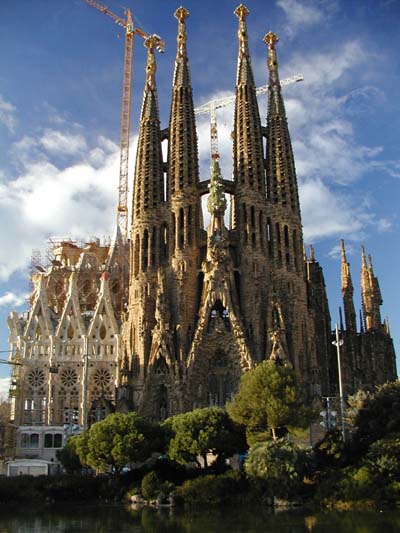 On the plane traveling to Spain, Benedict responded to reporters’ questions and described his admiration for the Catalan architect’s vision, praising him for his ability both to work within the tradition of great cathedral building, but also for not being afraid to explore and develop new forms of creativity. Said Benedict, “Gaudí had the courage to make himself part of the great tradition of the cathedrals. Using a completely new approach, he dared in his own time to make the cathedral a place for the solemn meeting between God and man. And this courage to remain within tradition, but with a creativity that renews tradition and shows the unity and progress of history, is a beautiful thing.”
“A creativity that renews tradition.” That’s actually a beautiful line, a beautiful way of expressing how Catholic Christianity, at its best, is enfleshed in and lived by God’s people at any one point in time. Ours is a living tradition, one that not only is open to renewal, but that actually requires renewal in each and every generation, in each and every age, and in each and every person. Rooted in that which has been received (which is what “tradition” means), but open also to living this out in ways that could not have been or were not envisioned earlier — this is the essence of a living, creative Tradition.
If Pope Benedict can see this so clearly in art and architecture as expressions of a renewed tradition, I wonder why the Pope is unable to see how contemporary understandings of human sexuality — understandings drawn from so many spheres of human inquiry — could also be described in this way? Contemporary understandings about sexual orientation, understood as an inherent part of who we are as individuals, leads us not away from the tradition, but deeper into it. It leads us to seeing that within God’s wonderful Creation, the diversity that is within the very DNA of humanity is itself a work of art, a beautiful creation reflected in the great diversities of the human family, including the diversity of sexual orientation.
For God’s gay and lesbian children not to live and love as they have been created by God to live and love would be like building a beautiful church like Sagrada Familia, yet never entering it, never celebrating liturgy in it, never using it as it was intended to be used. Churches are not merely works of art to be admired from afar, but are living expressions to house a living people. So too is every human person a living work of art, a living cathedral created by the Divine Architect, carrying within each of us part of the One who not only designed and created us, but who sustains our every breath.
May Pope Benedict and other church leaders come to see the beauty within the fullness of their gay and lesbian sisters and brothers no less than in a wonderful building like Sagrada Familia.
 Image and Likeness