Why I Will Vote for Obama: Appointments to the Federal Bench are Every President’s Lasting Legacy

All the news these days centers on the Republican Convention in Tampa and the storm battering the Gulf coast. In the midst of that, let’s not forget stories like this:  Texas redistricting discriminates against minorities, federal court says.  The unanimous decision — handed down by three judges appointed by George W. Bush and one appointed by President Obama — is clear and direct:  the congressional redistricting plan developed by the GOP leaders of Texas is discriminatory and cannot stand.

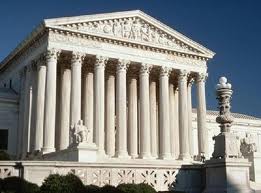
We all have good reasons (hopefully!) for making the choices we do at the ballot box. The President of the US has many powers and influences our country in countless ways. But long after any president forwards his mail from 1600 Pennsylvania Avenue, one of those presidential powers stands alone in significance:  it’s his (her?) prerogative of nominating judges to the Federal Courts. Certainly the bench of the US Supreme Court is paramount there.  But, as the story above reminds us, federal judges at all levels play a critically important role in implementing the laws of our country and ensuring that America — as the inscription over the Supreme Court building  says — is a place where there is Equal Justice Under Law.

There’s no doubt that the next president will appoint at least one new justice to the Supreme Court, with Justice Ruth Bader Ginsburg turning 80 next March (2013).  Not far behind are Justices Antonin Scalia and Anthony Kennedy, both of whom are over 76 yrs.  The next Court will have an enormous impact on the lives of LGBT people for years, perhaps decades, to come as it rules eventually on the cases that have challenged the federal “Defense of Marriage Act” (DOMA). This decision will proclaim to the world whether LGBT Americans truly do enjoy the full blessings of liberty enshrined in our Constitution, or whether we will continue to live in a country where “some are more equal than others.” 

This fact alone — the president’s right of nominating justices to the US Supreme Court — is sufficient for for me to support President Obama in his bid for re-election.  What’s your reason for your choice this election year?
Not the Republican Party of Yesteryear

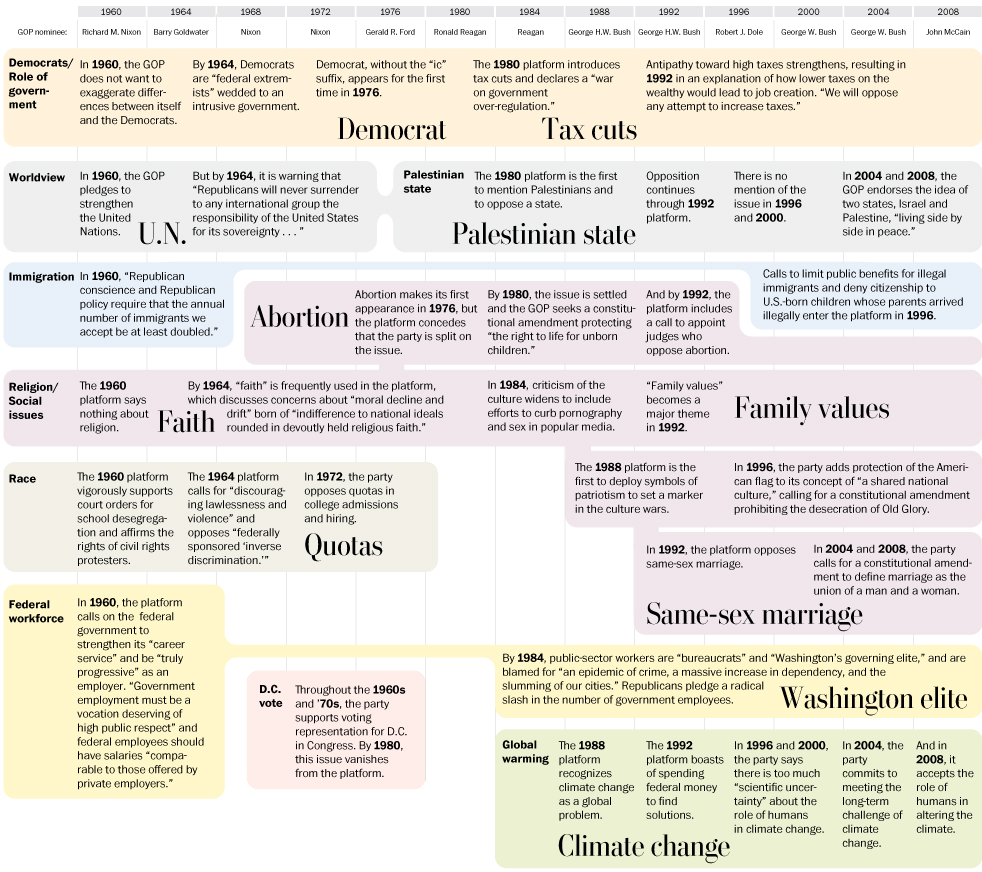
Most of us who are “of a certain age” know that the Republican Party of 2012 is very different than the one we saw in our formative years during the 60’s, 70’s and early 80’s.  Although I’ve always had a sense of this — having grown up in Massachusetts where African American Ed Brooks, a Republican, was one of our Senators — but I probably couldn’t name the specifics behind this change.  This article in today’s Washington Post, GOP platform through the years shows party’s shift from moderate to conservative, helps fill in those blanks.

The full story is worth reading, but the graphic puts in in visual perspective.


Bishops, Oaths, and Conscience

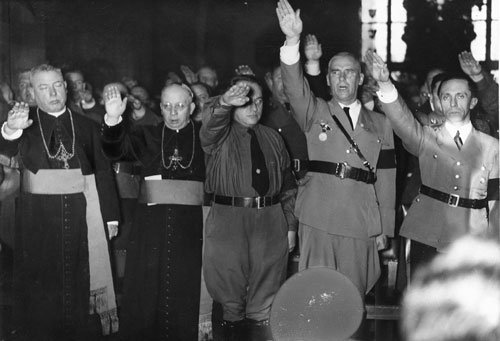
Catholic bishops joining in the Nazi salute.

Today’s Washington Post reports on a highly troubling story (Arlington Diocese parishioners question need for fidelity oath) about a rising trend in Catholic dioceses to require workers — including volunteers who teach religious education — to affirm some sort of “fidelity oath” in order to continue their work or ministry. The story ends with this:

The Rev. Ronald Nuzzi, who heads the leadership program for Catholic educators at the University of Notre Dame, said many bishops “are in a pickle.” They want Catholic institutions to be staffed by people who not only teach what the church teaches but whose “whole life will bear witness.”

Nuzzi said he keeps a photo on his desk from the 1940s that shows all the German bishops in their garb, doing the Nazi salute.

“I keep it there to remind people who say to do everything the Church says, that their wisdom has limitations, too.”

Anyone who fully understands and values the breadth and depth of Catholic Christianity must be appalled by this trend, especially when such oaths appear to be written in ways that clearly are contrary to Catholic teaching. What is more troubling, however, is the perspective expressed by some — both clergy and laity — who see no problem with such a practice.

“First stop slamming doors…”

We don’t teach meditation to the young monks. They are not ready for it until they stop slamming doors.
~ Thich Nhat Hanh to Thomas Merton in 1966

“Charlotte Pastor Mark Harris and Cindy Marrelli of Raleigh celebrate the passage of the N.C. marriage amendment during an election night party at the North Raleigh Hilton.”

I began my morning by reading the daily meditation from Richard Rohr, which begins with the above. I then saw several pictures online and in print picturing so-called “pastors” jubilantly celebrating the passage of Amendment 1 in North Carolina, and it struck me that these are exactly the kind of people that Fr. Rohr is talking about when he comments:

First stop slamming doors, and then you can begin in the kindergarten of spirituality. Too many priests, bishops, and ministers are still slamming doors.

No one who supports the right of God’s LGBT children to live their lives honestly, openly, freely and without fear is surprised to hear that much (most?) of the bigotry that opposes such honesty and freedom is rooted in religion. Nonetheless, it never ceases to shock me in one way or another when the strong-arm of this bigotry exercises its might as it did yesterday in North Carolina.

The picture of a “pastor” raising his clenched-fist, smiling and expressing support for the fact that a majority of his fellow citizens have slammed the door on the faces of so many tens of thousands of their brothers and sisters — well, this just doesn’t seem very “pastoral,” now does it? This man — and too many other religious administrators (I won’t call them “leaders”) — would probably not yet be ready to begin to take the baby-steps that truly faithful people people take when they seek to know the path to God in humility and compassion.

Some may say this sounds judgmental, even a bit harsh. To that I plead guilty. But I think a little anger is justified when those whose actions seeking to deny the fundamental rights of others are temporarily successful. Thankfully, there’s that thing called the arc of history … and towards a better world characterized by Justice and Peace I hope and pray it will continue to bend!

Benedict, Nuns, Christians…and “freedom” to proclaim the Gospel

In his daily meditation for today (April 24, 2012), Franciscan Fr. Richar Rohr writes:

I am not denying that Jesus could and undoubtedly did physical healing. It still happens, and I have seen it, but the healings and exorcisms in Mark’s Gospel are primarily to make statements about power, abuse, relationships, class, addiction, money, the state of women and the poor, and the connections between soul and body—the exact same issues that we face today. [emphasis added]

Just as Jesus’ actions made statements about those parts of the world in need of healing, so have the actions of many of his followers. In the United States, religious women — sisters and nuns (there is a difference, by the way!) — for more than two centuries have been at the heart and forefront of two of the most important activities of any society:  Education and Healthcare.  Communities of religious women have founded hospitals and clinics and hospices; they have opened schools and colleges and universities. And while they have ministered to people across the social spectrum, they typically would be willing to serve where others would dare not tread.

Even Pope Benedict XVI has praised the historic role of women in building the Church in America.  Just yesterday, the pope noted that two women from this continent will be canonized later this year — Blessed Kateri Tekakwitha and Blessed Mother Marianne Cope.

While recalling the historic role of women in the Church in the United States, the pope notably did not praise the current role played by so many tens of thousands of women religious in the daily lives of hospitals, schools, parishes and communities across this land.  Instead, he gave voice to that growing canard that the bishops of the US have latched on to, i.e. the notion that the “freedom” of religion is somehow under attack.  In concluding his speech to some visiting Americans, Benedict stated:

In these days I ask your continued prayers for the needs of the universal Church and in particular for the freedom of Christians to proclaim the Gospel and bring its light to the urgent moral issues of our time.

I don’t know where the Pope gets his information, though given the Vatican’s recent actions regarding congregations of women religious in the US (see coverage in US Catholic for one perspective), I suspect it’s not from very good sources. Concerning religious freedom, however, I’ve yet to see any roadblocks put forth hindering the proclamation of the Gospel or the light it sheds on the “moral issues of our time.”  What the Pope fails to understand is that his voice and the voices of his brother bishops are not the only voices empowered to proclaim the Gospel. The voices of religious women and men, of priests and lay people, all the Baptized together have a right and responsibility to proclaim the Gospel in both word and — like Jesus in Mark’s Gospel — in action. At times, those voices will differ as we collectively discern “the signs of the times” and struggle to understand where and how God’s Spirit might be leading us here and now.

Benedict rightly notes that “Christians” (he didn’t limit this to the hierarchy!) have the freedom to proclaim the Gospel.  I pray that he and his brother bishops will listen to the voices of Christians doing just that, even when what they have to say might not be what Benedict wants to hear!

Prayerful Vigil at Catholic University

It was great to gather earlier this evening with students from CUAllies, the gay/straight alliance at The Catholic University of America. CUAllies is not yet formally recognized by  CUA, as other student groups are. This gathering — not of protest but of prayer — bore witness on the grounds of this most Catholic of universities, praying that God’s LGBT children might enjoy at CUA the same rights and respect that as their straight brothers and sisters. Drawing upon our rich Catholic heritage, we heard passages from Vatican II’s Gaudium et Spes and the US Bishops’ Always Our Children. Prayers were offered on behalf of LGBT youth throughout the world — especially those who feel isolated and alone — that they might know there are people who love and care for and accept them just as God created them to be. 

This slideshow requires JavaScript.

“He was an angel, a balm on our hearts”

Even as we struggle with how to respond to the abusive action of Fr. Marcel Guarnizo in denying the Eucharist to Barbara Johnson at her mother’s funeral, and even as we look forward to further action from the Archdiocese of Washington in response, let’s be thankful for priests like Fr. Peter Sweeney of Silver Spring, MD. According to the coverage in the National Catholic Reporter, Barbara Johnson described Fr. Sweeney this way:

“He was an angel, a balm on our hearts,” she said. “He was everything I knew the Catholic church to be.”

Amen!

An Act of Gracious Self-Forgetting

I received an email this morning from a dear friend who said he had been listening to today’s episode of “On Being,” with Krista Tippett.  In The Inner Landscape of Beauty, Tippett speaks with John O’Donohue, an Irish priest, poet, and philosopher whom she interviewed shortly before his unexpected and all-too-early death in 2008 at the young age of 52.  So moved was I by what I heard (moved even to tears, I’m not ashamed to say), that I immediately bought O’Donohue’s first book, Anam Cara: A Book of Celtic Wisdom.

I look forward to spending mornings of the coming weeks the thoughts and beautiful words from this, the first of O’Donohue’s books.  Only a few pages in, I know this is the kind of book in which my underlining could get carried away, but here’s just a taste of what he says:

Love begins with paying attention to others, with an act of gracious self-forgetting.  This is the condition in which we grow.

Thank you, Cardinal George

Most of us are pretty good at calling someone out when they say mean, untruthful, or outrageous things.  Thus, it was no surprise that recent remarks made by Chicago’s Catholic archbishop, Cardinal Francis George, comparing the gay rights movement to the Ku Klux Klan were met with justified outcry and condemnation.

Cardinal Francis George

Cardinal Francis George, Archbishop of Chicago

The Chicago Tribune is reporting today that His Eminence has publicly apologized, stating that he is “…truly sorry for the hurt my remarks have caused.”

Just as quickly as we stand up against that which is wrong, we must also stand up quickly in support of that which is right.

Cardinal George deserves to be thanked for recognizing the real impact of his words and the potential harm they could have done, had they been left as is. He should also be thanked for providing the example of what any Christian should do whenever he recognizes he has made a mistake. The simple word “sin” has many variations in our Hebrew and Greek patrimony. Among these various terms are words that mean “missing the mark” or suggest that a relationship has been harmed or broken. Cardinal George’s apology publicly recognizes that whatever point he was trying to make, his comparison to the KKK was way off the mark. He also recognizes that words are powerful — they can both build up and tear down. While they can never be unspoken, they can and must be corrected whenever we realize that something we have said has done harm to others. This, Cardinal George has done. And for that, he should be thanked.

My prayer this Saturday morning is that the Cardinal’s apology will be welcomed and met with forgiveness. Perhaps this will be the dawn of a new day in the Church, and I pray that a spirit of reconciliation will help create an atmosphere of openness and dialogue between Church authorities and those of us who seek a deeper and richer theology of sexuality in light of the lived experience of God’s LGBT children.