
Author Archives: Tim MacGeorge
Backyard Breakfast

A group of white ibis enjoy breakfast in the backyard.
Ducks, Lies, and the Truth about God’s LGBT Children
“An untrue or inaccurate statement that may or may not be believed true by the speaker.” That’s one definition of lie provided by Merriam-Webster. I do not know if Laire Lightner believes what she says, but I do now that it is a lie. Ms. Lightner, it seems, is “the driving force” behind an online petition to have Duck Dynasty personality Phil Robertson reinstated. Mr. Robertson was recently removed from that program for his comments denigrating LGBT people in an interview (perversely entitled, “The Gospel According to Phil”) with GQ magazine.

Laire Lightner (with her husband) is leading the charge to reinstate ousted, anti-gay Phil Roberston (Photo: John Osborne / Naples Daily News)
In today’s edition of the Naples Daily News (Naples, FL), Ms. Lightner is quoted as follows: “Homosexuals and Christians have different values, but I will fight to make sure their rights are protected.”
While the second part of her statement is laudable, the first part is blatantly a lie. It is a longstanding canard of fundamentalists and Biblical literalists to claim that Christianity condemns homosexuality, that one cannot be both gay and a disciple of Jesus. Thankfully, the facts of history — as well as the lived experience of thousands, perhaps millions — of LGBT Christians undercuts that assertion on its face. As a gay man and a Christian, I am just one example of someone who is gay by Nature and Christian by Grace — and both Nature and Grace are authored by God.
I suppose it shouldn’t surprise us that Ms. Lightner “studied divinity at Liberty University,” the fundamentalist school in Lynchburg, Virginia founded by Jerry Falwell. Having only studied divinity for two years, perhaps Ms. Lightner would be open to continuing her education by learning about LGBT Christians and then reconsidering her statement.
Christmas quickly approaches. This Feast of the Incarnation celebrates our belief that, by taking on human flesh, God reminds us in Jesus that every human person is created in the image and likeness of God. As an early Christmas gift, here are some resources for Ms. Lightner — and all those who hold that same false belief — to begin that education.
- What Does the Bible Say About Homosexuality?
- Dignity/USA (Roman Catholic)
- Reconciling Works (Lutheran)
- IntegrityUSA (Episcopalians)
- Affirmation (United Methodist)
First Time, now The Advocate — quite the year for Francis!
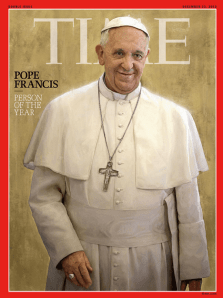
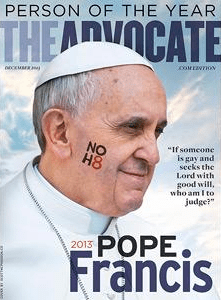 For Pope Francis to be named Person of the Year by Time magazine … that’s understandable. After all, Pope Francis has captured the hearts (and, with his recent Apostolic Exhortation, Evangelii Gaudium, the minds) of countless millions around the world — Catholics and non-Catholics alike. But to be named Person of the Year by The Advocate, a leading magazine covering “Gay News, LGBT Rights, Politics and Entertainment”? Now that’s progress!
Spirituality Quote for the Day
“Spiritual seeking, when it is done by the false self, might be the biggest problem of all. …. Is it any surprise that America has churches on every corner and yet remains a highly racist, materialistic, militaristic, and superficial culture? We have found the way to feel good about ourselves and to think badly of everybody else that is not like us. Only one thing is more dangerous than the individual ego, and that is the group ego. Religion produces saints and very whole people, but it also produces and protects people with high capacities for delusion and denial.”

From ‘Contemplation’ as the False Self, in Contemplation in Action, Richard Rohr and Friends, A Crossroad Book, 2006 (pp. 80-81)
Pilgrims, Lincoln, and Francis — Thoughts for Thanksgiving
Homily for Thanksgiving Day / Thursday, November 27, 2013
 Thanksgiving Day is that quintessential American holiday – as close as we come in the US to an exercise of civic religion. The observance of a special day for giving thanks for some perceived blessing – be it an observance by the settlers of Jamestown in 1610, or the celebration of thanks offered by Pedro Menedez de Aviles here in our own state of Florida in 1565, or be it that celebration about which most of us were taught, the one in 1621 observed by the settlers of Plimouth Plantation and the native Wampanoags of what is now Massachusetts – such celebrations have been a part of our national and cultural history for centuries. During America’s first decades as a nation, there were various declarations of specials days of thanksgiving. As was typical, they were usually written with broad references to God or The Almighty or The Divine – Deist perhaps, but certainly not Christian, as some today would claim. Those early proclamations lead finally to the 1863 declaration by Abraham Lincoln which made the last Thursday of November an official federal holiday.
Students of history will note that this declaration of Thanksgiving was made during an unusual time, right in the middle of the Civil War – and it’s noteworthy that Lincoln called upon his fellow citizens to do not just one, but two things on that Thursday. The first is what you’d expect. In the proclamation’s words, Lincoln called upon Americans “to offer up such the ascriptions justly due to Him [to God] for such singular deliverances and blessings…” – translated simply, to give thanks. The second was a little more sobering, a little more self-reflective, and a little more oriented toward being a call to social action. Again, in the proclamation’s words, Lincoln called upon Americans “with humble penitence for our national perverseness and disobedience,” to commend to God’s tender care all those who were suffering in one way or another due to the ravages of war, “our lamentable civil strife.”
 As tempted as I am to offer my own thoughts on what might be some 2013 examples of America’s “national perverseness and disobedience,” let me simply remind us that Lincoln’s declaration was two-pronged. It called not only for thanksgiving for blessings received, but also corrective action for our national failures and shortcomings. Certainly we all have many blessings for which we are grateful. To varying degrees, we all have so very, very much. We have roofs over our heads, more food than we could ever eat and more clothes than we could ever reasonably wear. We are blessed with jobs, or retirement security; and most importantly we are blessed with family and friends who love us and sustain is in times of sadness as well as joy. And so while we gather her on this day to give thanks to God for these blessings, the challenge of Lincoln – and more importantly, the challenge of the Gospel – is for us not to stand idly by when we have so very much and when so many millions – so many hundreds of millions – have so very little.
 In his Apostolic Exhortation published earlier this week, Pope Francis speaks about the Joy of Evangelization (Evangelii Gaudium). I suspect you’ve read or heard the news coverage of this very important document. Some have called it a “tour de force,” perhaps representing a sea change for the Church. In a long section devoted entirely to what Francis calls “The Inclusion of the Poor in Society,” he states that those of us who have so much should not only be concerned with the most basic needs of those living in poverty. He challenges us to go further. Francis writes:
“Yet we desire even more than this; our dream soars higher. We are not simply talking about ensuring nourishment or a ‘dignified sustenance’ for all people, but also their ‘general temporal welfare and prosperity.’ This means education, access to health care, and above all employment, for it is through free, creative, participatory and mutually supportive labour that human beings express and enhance the dignity of their lives. A just wage enables them to have adequate access to all the other goods which are destined for our common use.”
To some, those words no doubt, are challenging. Regardless of where one stands on the issues that the Pope addresses – regardless of where one stands politically or economically or socially – if reading or hearing his words is challenging, the Pope has done his job. As we gather around this Eucharistic Table of thanksgiving this morning, let us do our best to follow in the footsteps of the one man – the outsider, the Samaritan – who recognized that his healing was not of his own making, but that his healing – like all things was a gift from God, giving thanks where thanks is always due.
“…so unlike Jesus and the God he loved…”
“Today many would say that Christians have become major purveyors of exclusion, guilt, and shame for too many of its own people, and surely for the other religions, instead of absorbing shame, healing guilt, and living in solidarity with human suffering as Jesus did so clearly on the cross. No wonder so many no longer take us seriously. We are so unlike Jesus and the God he loved. Jesus was totally inclusive in his entire public life, and yet we created an exclusionary religion in his name. It makes no sense.“
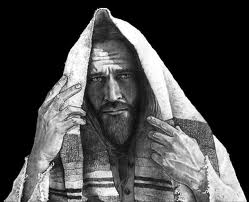
from Richard Rohr’s Daily Meditation: Whoever Told You That You Were Naked (Nov.9 2013)
Presiding at Eucharist — An Open Letter to the Dignity/Washington Community
A (Long) Open Letter to my friends at Dignity/Washington
Dear Friends,
This evening, a Dignity/Washington “Task Force considering the issue of Women Presiders at Mass will facilitate a 1-hour community dialogue … to express thoughts and opinions on this issue.”
 For many years, D/W was my spiritual home, a place where I was privileged, along with other LGBT Catholics, “our family and friends,” to gather regularly for the celebration of Eucharist. As I am not able to be present for this community dialogue, I’d like to do the next best thing. I’d like to say from afar what I wish I could say in person. So, I am putting in writing my thoughts and ideas on this fundamentally significant issue. I say it’s “fundamentally significant” because, for us as Catholics, the Eucharist is the “source and summit” of our lives as Christians. That phrase from the Second Vatican Council (Lumen Gentium, ch. II) reminds us that it is most clearly in the public celebration of Eucharist that we tell the world who we claim to be, and that we are united with all of our sisters and brothers throughout the world and even across the centuries who share this same apostolic faith. It continues to be a truism that any Catholic can go into a Catholic church anywhere in the world and join in the Eucharistic celebration — even if that celebration is in a different language and an entirely different culture — and still feel very much “at home.”
At the beginning of this dialogue, it’s essential to define some terms and then clarify what this discussion is really all about. Without those definitions, I contend that the conversation would be one of mere emotion and opinion, and as such, would be incomplete.
First, what does “presider” mean? In liturgical practice, a “presider” is any person who leads a community during a liturgical prayer. It is a term that has meaning precisely in the act of doing. Thus, in the Catholic context, it is a functional term only. There is no such thing as a presider outside of the act of presiding. The term should not be confused with terms referring to an office or position in the Church (such as “Pastor” or “Catechist”), nor with terms that denote one’s sacramental character. “Pastor,” for example, indicates someone who holds an official position as the leader of a local parish and “Catechist” is someone who has been designated to teach and guide those seeking full initiation into the Church (as in the RCIA process). “Baptized” and “Confirmed” and “Ordained” indicate the sacramental character of a person who has received those respective Sacraments. By way of illustration, consider the Abbess of a community of nuns who leads her religious sisters daily in praying the Liturgy of the Hours. Each time she does this, she is “presiding.” While engaged in the act of presiding at morning and evening prayer, it would be correct to say she is the Abbess and that she is functioning as the presider at those particular liturgical celebrations. Outside of those times, she would still be Abbess, which is the formal office which is hers as the leader of her community. Outside of those times of liturgical celebration, however, it would be somewhat meaningless to refer to her as “presider” because there is no “presiding” going on. Similarly, there have been many times when the D/W community has had prayer services of various types and a community member — male or female — has led that prayer. At such times, that person could properly be called “presider” because he or she was engaged in the act of presiding over the celebration. Once the act of presiding is over, one is no longer a presider.
Second, what does “Mass” mean? Mass is a term which Catholics use to refer to our primary liturgical celebration. The Mass is the celebration of the Eucharist, and the Eucharist is at the heart of the Sacramental life of the Church. One of the hallmarks of the D/W community’s celebration of Eucharist is that it has, heretofore, always adhered to the Roman Catholic Church’s norms for what is called a “valid” celebration of the Eucharist. The apostolic Christian Churches of both the East and the West have, for two millennia, recognized the importance of “validity” in celebrating the Sacraments. For example, in order for the celebration of Baptism to be valid, water must be used, along with the invocation of the Trinity. If someone were baptized simply “In the name of Almighty God,” that baptism would not be considered valid Christian Baptism, because the Holy Trinity was not invoked. For some sacraments, one essential element for validity is the “minister of the sacrament.” Catholic and Orthodox Traditions have always identified a validly ordained priest as the minister of the Eucharist. Thus, as a way of expressing its own commitment to our Catholic identity, Dignity/Washington has always celebrated Eucharist with a presider whom the Catholic Church recognizes as a validly ordained priest. (I used this phrase very deliberately, because I suspect that those who would like to see a change in D/W’s current practice would state that there are women who have been ordained as priest. It is not my purpose — nor do I think it should be D/W’s purpose — to enter the contentious discussions about the validity/invalidity of any such ordinations.) It is this fact — that D/W has always celebrated Eucharsist with a presider whom the Catholic Church recognizes as a validly ordained priest — which has allowed many leaders of the D/W community to answer in the affirmative when a visitor or potential new member has inquired, “Is this really Catholic? Is that a ‘real’ priest?” Those leaders could honestly answer, “Yes, it is really Catholic, and yes, that’s a real priest.”
It is my perspective that this practice has been the hallmark of D/W community. Were it not, I know that I and many others would never have called D/W our spiritual home, because it would have felt illegitimate to call our celebrations of Eucharist “Catholic.” While there is no doubt that many Catholics — myself included — believe that women should be admitted to ordination within the Roman Catholic Church, the sad fact is that this is currently not our Church’s practice. I wish it different — but it’s not.
It’s About Sacrament (and not sex or gender)
Catholicism takes Sacraments seriously. They are the glue which binds us together. They mark not only significant moments in our individual lives, but also have, at their very core, the Mystery of Faith which brings us into the Christian family and which nourish, strengthen, and restore us throughout our lives. Because Sacraments are so central to the life of the Universal Church, no individual community — no parish, no diocese, no religious order — has the liberty to change by their own authority the fundamental character of how the Sacraments are celebrated. To do so would, in a significant way, “break communion” with the rest of our brothers and sisters around the world with whom we are united each time we gather “in word and in sacrament” to hear the Word of God and to be nourished by the Real Presence of Christ in Eucharist.
And so, I believe that the question posed by the D/W Task Force is fundamentally not about women, no matter how strongly we feel about the inclusion of women and their many gifts in the ranks of the Church’s ordained ministers. The question IS about whether or not the D/W community wishes to continue to celebrate Eucharist with presiders whom the Catholic Church recognizes as validly ordained priests. The question IS about whether the D/W community wishes, in all honesty, to be a Catholic community and not just a “Catholic-like” community.
Pope Francis and Hope for the Future
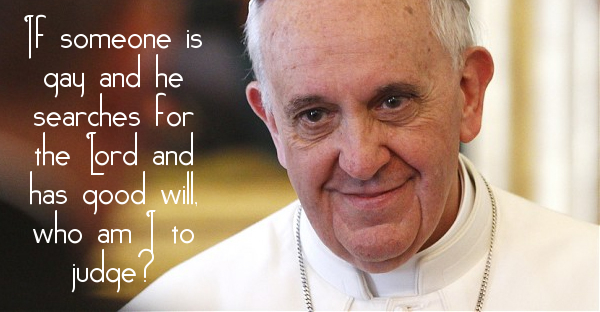 Most of us have been overwhelmingly surprised and pleased by the ways in which Pope Francis has made positive overtures to the LGBT community in the months since his election as the Bishop of Rome and the Successor of St. Peter. For the first time in decades, LGBT Catholics have legitimate reason to hope that the years ahead might be very, very, very different than what was imagined only a few months ago.
Until now, the D/W community can correctly state that what has separated us from the wider Church was not of our own choosing. If D/W strays from its practice of celebrating Eucharist with presiders whom the Catholic Church recognizes as validly ordained priests, that would no longer be true. The D/W community could no longer state that any distance between us and the wider Church was not of our creation. Rather, we ourselves would have taken steps to further separate ourselves from the institutional Church. A decision to move in this direction is a decision one would anticipate if D/W wished to become its own independent denomination rather than a community that proudly proclaims its status as an integral part of the Roman Catholic Church. Given the hope that fills the Church now under the leadership of Pope Francis, now is not the time to move further away from the Church we love and the Church we call home.
It is my prayer that Dignity/Washington will continue to be a place where LGBT Catholics not only are welcomed — for we are welcome in many gay-affirming Christian Churches — but that it will also continue to be a place where, through the community’s wonderfully rich, beautiful, and inspiring Eucharistic liturgies, LGBT Catholics, our family and friends, feel very, very, very much “at home”!
In God’s Peace!
Tim
“The Tea Party’s Last Stand”
Love this observation from The Tea Party’s Last Stand (commentary in the Catholic news magazine, Commonweal):
“Having talked incessantly about how useless and destructive government can be, House Republicans are now testifying to their reverence for what government does for veterans, health research, sick children and lovers of national parks, especially war memorials.
Appreciation for government rises when it’s no longer there.”
QUOTE TO NOTE: Recognizing a Gay Reality in the Church
So much more so than the recent “guidelines” issued by the likes the Archbishop Timothy Broglio for Catholic military chaplains — guidelines which continue not only to treat LGBT people as third-class citizens, but which also treat priests serving in the military as if they were mere underlings unable to make sound pastoral decisions about how to respond to all Catholic military personnel with charity and love — this story reminds us of the truth that millions and millions of Catholics have been ministered to by gay men all their lives. It’s a good reminder of the challenges we face when a truth is finally spoken and the hard work that all Truth asks of us.

 Pope Francis’ interview last week reiterated his July comments about gay priests, “Who am I to judge?” In light of all this, many Catholics wonder how this new pope will lead on LGBT issues and whether there will even be change. Bill McGarvey writing at America Magazine shares a story from his own life to explain just how Pope Francis might change the Church on LGBT issues.
McGarvey writes about making a comment to his college spiritual director about seminarians being “light in the loafers,” and the director after a momentary pause replied:
“ ‘You know, McGarvey,’ he said calmly, ‘you’ve been ministered to by gay men your whole life; you just didn’t know it.’…
“As I sat there, countless episodes from my life and the lives of family and friends all flooded back—from periods of darkness and personal crises, through life-threatening illnesses and deaths in my family, not to…
View original post 161 more words
 Image and Likeness