
Please support Catholics United for Marriage Equality.
Author Archives: Tim MacGeorge
Simple Maine Eloquence about What America Stands For
Letter to Bishop Malone of Maine
Richard Malone, the Bishop of Portland (Maine), was on the faculty of St. John’s Seminary College when I was a student there in the early 1980’s. Fr. Malone was not only an instructor in theology, the college’s academic dean, and my own faculty advisor; he was also one of about ten resident priests who shared daily life with the seventy or so seminarians in resident at the college commonly referred to as “St. Clement’s.” Fr. Malone was generally very well-liked and respected, an excellent teacher, and — at the time — considered by most to be open and progressive.
Because Bishop Malone has been in the forefront of efforts to undo the legislative action which expanded the right of civil marriage to same-sex couples, I felt compelled to write to him to express an alternative perspective. Here’s my recent letter:
October 18, 2009
Most Rev. Richard J. Malone, Th.D.
Bishop of Portland
510 Ocean Avenue
P.O. 11559
Portland, ME 04104
Bishop of Portland
510 Ocean Avenue
P.O. 11559
Portland, ME 04104
Dear Bishop Malone,
You may not remember me, but I was one of your students when you were on the faculty of St. John’s Seminary College. In fact, for one year at least, you were my faculty advisor and helped me to make the most of the educational opportunities provided at St. Clement’s. When you were appointed Bishop of Portland, I was pleased that a man I had known to be intellectually gifted, theologically balanced, personally affable, fair, reasonable and pastoral would be receiving the miter and crosier and would be in a position not only to shepherd the good people of Maine, but might also have an impact on the wider Church, perhaps counterbalancing the actions of some of your more reactionary brothers in the episcopate.
Earlier this year, however, I was saddened to see a story in The Pilot that highlighted your homily of November 16, 2008. In that homily, you took issue with Protestant leaders of Maine who publicly support the right of God’s gay and lesbian children to enter into unions that are legally recognized and that guarantee the rights that married heterosexual couples receive. While I was pleased to read your reiteration of the position that homosexual persons should be respected in their full human dignity, and that homosexual couples should be allowed hospital visitation rights and the right to share health insurance benefits, I’m sure you’re well aware that same-sex couples do not currently have such rights and no mechanism exists to ensure them. Insurance companies, hospitals, state and federal governments, and even family members who “disapprove” of their relative’s same-sex relationship are all huge obstacles to ensuring that the rights you recognize are respected and honored.
By most estimates, there are approximately 1,400 specific rights that are automatically accorded to married couples in the U.S. All of these accrue automatically the moment any 18-year old opposites-sex couple says “I do” in a Las Vegas wedding chapel and their marriage is civilly and universally recognized. Unfortunately, the 80 year old gay or lesbian couple who has lived in a committed and faithful relationship for more than half a century has no such rights. Because they have been denied the rights that come with civil marriage, millions of gay and lesbian couples have been forced to consult expensive attorneys to craft legal documents stipulating their legal wishes in very detailed contracts. Sadly, the bigotry against God’s gay and lesbian children that you claim to disavow has also given rise to attempts in some states to make even such contracts as these illegal.
I am writing to you now because the vote to reconsider the legislation in Maine allowing same-sex couples to marry is coming close. While I harbor no illusions that you will change your mind and come to realize that there is no conflict between your understanding of the official Church’s position on “homosexuality” and the civil law at hand, I nonetheless feel compelled in conscience to ask that you consider doing just that. There is nothing in the legislation allowing same-sex couples to marry that undermines families, that infringes on religious rights, or that hurts society in the way claimed by so many who trade in fear, hatred, and ignorance.
I urge you as the good man I know you to be to consider the grave harm that would be done to God’s gay and lesbian children under your pastoral care if the voters of Maine rescind the legislation that has been a beacon of light for the rest of the nation. At the core of his ministry, Jesus never sought to exclude, but rather included all those whom society or religion had otherwise discarded. Please follow His example by not being an obstacle for God’s gay and lesbian children to participate fully in the fundamental human right to form relationships and establish families as they believe God is calling them to do.
In Christ’s Peace,
Cardinal O’Malley, Senator Kennedy and Changing Hearts
In his blog shortly after the funeral liturgy for the late Senator Edward Kennedy of Massachusetts, Boston’s Sean Cardinal O’Malley provided reflections in response to the many Catholics who thought that providing the Senator with a Catholic funeral was “scandalous.” For those who fully understand Catholic teaching and even church law on this subject — not to mention the Gospel of Jesus — there never was any question whatsoever whether Kennnedy would or should be burried from the Church.
In part, Cardinal O’Malley stated: “We will not change hearts by turning away from people in their time of need and when they are experiencing grief and loss.” These are pastoral words from a pastoral heart. These are words that answer with Gospel values the question, “what would Jesus do” in a similar situation.
"Kansas City-St. Joseph diocese priest criticizes his bishop’s leadership" – from NCR
Today’s National Catholic Reporter reports, “Father Michael J. Gillgannon, a widely respected missionary priest of the diocese of Kansas City-St. Joseph, has written an open letter to his bishop, Robert W. Finn, taking strong exception to his leadership….” Read the full story and Fr. Gillgannon’s wise and thought-provoking letter.
Marianne Duddy-Burke in Huffington Post
See the commentary in the Huffington Post by Dignity/USA Executive Director Marianne Duddy-Burke on the death of Sen. Ted Kennedy and political leadership for issues of importance to Gay Catholics.
"Let’s start at the very beginning…"
One of the most familiar songs from “The Sound of Music” can be used to teach youngsters about the notes on the scale that get “mixed up” to make music. “Do-Re-Mi” is catchy, fun, and easy to remember. Its opening words — “Let’s start at the very beginning…” — also have application far beyond music hour at the local elementary school.
Failing to start at the beginning can lead to all sorts of trouble. Anyone who’s ever followed a recipe, read a book, or built a house knows this intuitively. Unfortunately, failing to start at the beginning (i.e. the complete beginning) is the fundamental intellectual failure of all those who “oppose homosexuality” and thus oppose any rights, including marriage rights, that society might accord its gay and lesbian citizens. Today’s Washington Post has an article about the family-friendly-sounding National Organization for Marriage (NOM) and its apparently likable and talented executive director, Brian Brown (who, by the way, is a devotee of Mass in Latin). As the Post reports, NOM is good at providing its supporters information and talking points that “support” heterosexual marriage, saying that they should avoid speaking about “banning same-sex marriage,” and that they should only speak positively about how heterosexual marriage is the way it’s always been, and that this is what’s best for families, and that there’s no reason to change.
Mr. Brown is presented in the Post article as a well-educated and intelligent man (though, he does seem to be ignorant of much of history, with such statements as, “‘I think it’s irrational that up until 10 years ago, all of these societies agreed with my position” on same-sex marriage,”). Despite such historically sweeping and inaccurate statements, Mr. Brown and those who share his view have the intellectual part of this discussion only half right. The “half right” part is that they do “start at the very beginning” when addressing the lived experience of most of the world’s inhabitants who are heterosexual. All of NOM’s arguments that support marriage for straight men and women — individuals whom God created with an opposite-sex attraction, and all the hormones and urges that come with it — are perfectly valid for those who are straight.
Their intellectual shortcoming is that they fail to recognize that for those whom God has created gay (and, being an apparently good Catholic, I’m sure Mr. Brown wouldn’t suggest that one “chooses” one’s sexual orientation), there’s a different starting point. Gay men and women are created as such by God. Same-sex attraction is part of the gay person’s very being, in the same way that opposite-sex attraction is in the genes of straight people.
Supporting the rights of gay men and women to form socially-recognized unions, allowing them the same rights and privileges of all heterosexuals, is the only logical and reasonable conclusion one can arrive at if one “starts at the very beginning” of who gay men and women are. As persons created by God, is not their lived experience just as valid as their straight brothers and sisters? As persons created in God’s image and likeness, isn’t it possible that their hopes and dreams, desires and longings, might have something to say to all of us about God’s hopes and dreams, desires and longings for His people?
The strugle of gay and lesbian people to have their legitmate relationships fully-recognized by society (and, hopefully one day, by the Church) is a struggle to ensure that the full humanity of all God’s children is recognized and supported. The only way this will be achieved is when straight men and women are able to step back and recognize that their gay brothers and sisters don’t experience human relationships and interactions in exactly the same way, that for them there is a different starting point, a different beginning. This beginning is not of human creation or will, but is part of the “givenness” of all of us, reflecting the beautiful diversity within humanity that is part of the divine plan. I pray that Mr. Brown and those who currently share his perspective will come to realize that their gay brothers and sisters have a lived experience that may be different, but that is no less worthy of equal respect and rights within society.
And, as Maria von Trapp would say, starting at the very beginning is indeed “a very good place to start.”
Edward M Kennedy – RIP (1932-2009)
Directionally Challenged yet Democratic Bishop of Tulsa
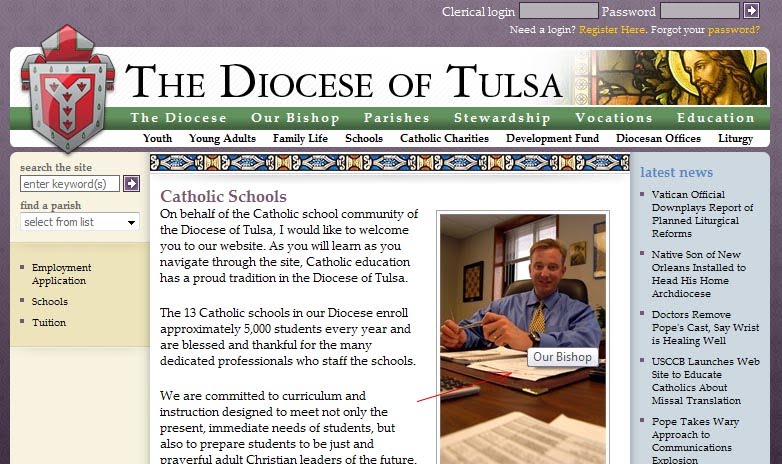
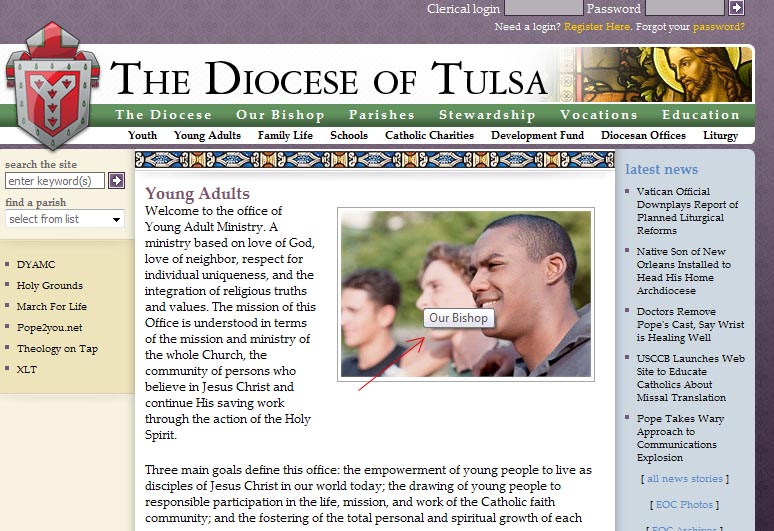
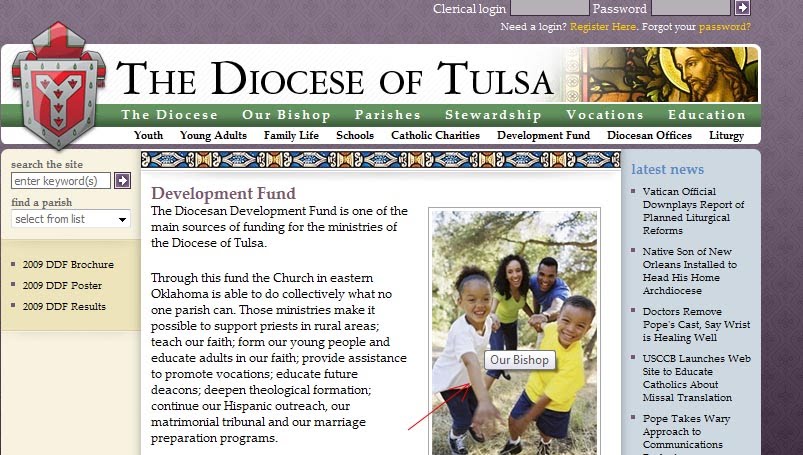
Given his recent decision to celebrate the Liturgy with his back to the people in a desire to celebrate the liturgy “Ad Orientem,” (i.e. “facing east”), some might think that the current bishop of the diocese of Tulsa, OK would be keen on maintaining hierarchy and status. A recent visit to the diocesan website, however, betrays another picture altogether. In fact, the bishop seems very committed to recognizing the dignity of God’s People, he even has refers to all members of his flock as “bishop,” having instructed the diocesan webmaster to label every picture of people (including women and children) on the diocesan site with “Our Bishop.” (By the way, the only problem with the bishop’s desire to celebrate the Liturgy Ad Orientem in the diocesan cathedral is that Holy Family Cathedral seems to be on a southwest-northeast axis … oh well!)
 |
 |
 |
 |
Catholicism, Fundamentalism, and the Presences of Christ
Homily for the 21st Sunday in Ordinary Time – August 22/23, 2009
For the communities of Dignity/NoVA at Emmanuel Church-on-the-Hill in Arlington, VA and Dignity/Washington at St. Margaret’s Episcopal Church, Washington, DC.
Readings: Jos 24:1-2a, 15-17, 18b; Eph 5:21-32; Jn 6:60-69
I won’t ask for a show of hands, but was anyone just a little bit uncomfortable when we listened to that passage just heard a few moments ago – the passage from Paul’s Letter to the Ephesians in which he says that wives are to be subordinate to their husbands? No doubt that is one of those passages in Scripture that can offend the sensibilities of many of us. In the Gospel passage from John, which continues the long “Bread of Life Discourse” that we have been hearing these past weeks, and in which Jesus previously said his followers must eat his flesh and drink his blood, we hear these followers today saying that these words are hard to accept. For those of us in 21st century America, Jesus could well be speaking about the passage from Ephesians when he asks his followers, “Does this shock you?” While we may not be shocked by more conservative societies around the world displaying their very rigid social norms about how wives and husbands, men and women – as well as young and old, parents and children – are to relate to one another, we are I think just a bit shocked when we hear scripture passages such as this one – and many others like it – which on their face can seem very much out of step with the norms and values that we seek to uphold in a free, democratic and open society, a society which claims to see equal human dignity present in every person.
By drawing our attention to this passage, I intend not to raise for our reflection the particulars of how husbands, wives, spouses should relate to each other; but rather I’d like to say a few words about a bigger issue about who we are as Catholics and how we understand and hold together some of the basic and formative elements that define us as Catholic Christians.
In 1963, the Fathers (and yes, they were all men) of the Second Vatican Council and Pope Paul VI approved and promulgated the first of 4 “Constitutions” of Vatican II. This first constitution—Sacrosanctum Concilium – was The Constitution on the Sacred Liturgy. Early on in the text, the document identifies four ways in which Christ is present in the Sacred Liturgy. Specifically the document states:
“To accomplish so great a work, Christ is always present in His Church, especially in her liturgical celebrations. [Christ] is present in the sacrifice of the Mass, not only in the person of [the] minister, …but especially under the Eucharistic species. …[Christ] is present in His word, since it is He Himself who speaks when the holy scriptures are read in the Church. [Christ] is present, lastly, when the Church prays and sings, for He promised: “Where two or three are gathered together in my name, there am I in the midst of them” (Matt. 18:20)”
These four presences – the minister, the Word of Scripture, the Bread and Wine of Eucharist, and the Gathered Assembly – these all speak to the richness of who we are and what we do whenever we gather together “in word and in sacrament.”
Why is this important? Why does it matter that we are conscious of these various ways in which Christ’s presence is known and experienced? Well, I think it’s important – especially in our own day – because we are constantly surrounded by and bombarded with declarations about “what Scripture says” and “the authority of God’s word” and “the Bible says…” Such declarations claim that Scripture is the final authority on all things, and they come very close to home when people claim they are just adhering to “biblical precepts” when they make pronouncements about the sinfulness of homosexuality, or about justifications for war, or about the distribution of the wealth and the world’s resources that keep so many millions in poverty; … and yes… we still hear Scripture used to justify the oppression of women and so many others.
Perhaps you’ve seen that bumper sticker or t-shirt that reads: “God said it, I believe it, that settles it.” This sort of fundamentalism, a fundamentalism that leaves no room for the assent of faith, no room for the human person struggling to balance faith and reason, doubt and certainty; a fundamentalism that in effect denies the presence of Christ in the Gathered Assembly – such fundamentalism is foreign to us as Catholic Christians, and truly foreign to the most traditionalist understandings of Christianity.
Earlier I mentioned Vatican II’s Constitution on the Sacred Liturgy. In that document’s opening paragraph, it states that one of the constitution’s purposes is, “to adapt more suitably to the needs of our own times those institutions which are subject to change.” Let me read that again: “to adapt more suitably to the needs of our own times those institutions which are subject to change.”
Fundamentalists thinks that when it comes to God and religion, nothing is “subject to change.” They dismiss adaptations to the needs of our times as being unfaithful at best, and heretical at worst. And yet, throughout the history of the Church, faithful Christians have struggled with how to live out the truly fundamental, the foundational beliefs of Christianity, the ones that transcend time and place and culture, giving them concrete expression in the context of the times and circumstances in which they found themselves. We saw an example of this just yesterday as the Evangelical Lutheran Church in America – the largest Lutheran denomination in the US – voted to lift a ban that effectively required gay and lesbian ministers to be celibate. Their action affirms the loving, committed relationships that gay and lesbian people can and do form and recognized that our understandings about sexuality and human relationships have grown and evolved with the passage of time. As one man quoted in the today’s Washington Post story about the ELCA’s action put it, “We are responding to something that the writers of Scripture could not have understood.”
Applying this same approach to this passage from Ephesians about husbands and wives, isn’t it possible to understand that, even though there may be suggestions of male dominance, influenced by the context of the first-century in which Paul was writing, the real and enduring meaning of this passage is that spouses are to put each other first? Of course it is.
When Jesus saw others leaving because they were not able to hear the deeper meaning of his words within the depths of their hearts, he turned to the Twelve and asked if they were leaving as well. Like Peter and the others, we have come to believe that Jesus is the Son of God, that Jesus does have the words of eternal life. We believe that Jesus is present not only in the Words of Scripture and the Bread and Wine we bless, but that Jesus is also present in each of us and in our community, gathered as we are in His name. Although there may be some who might want us to leave, let us today make our own the words of Peter. Peter said, “Master, to whom should we go? You have the words of eternal life.” Put another way, our response might well be: “You know, Lord, we’re staying with you; we’re not going anywhere.”
 Image and Likeness