Choice in cellphone plans? Not really!

Isn’t the rallying cry of uncontrolled capitalism that markets will respond to what consumers demand? Isn’t that how supply and demand is supposed to work? Don’t the loudest voices from the pro-business-keep-government-out-of-my-life world unabashedly proclaim that businesses and entrepreneurs simply need unregulated freedom to give the customer what he wants, and all will be well with the world?

Today’s Washington Post story about our increasingly complex cellphone bills, made more complicated by the speed and size of various data plans, notes the following:

“In a recent survey, the research arm of investment house Sanford C. Bernstein found that consumers were not happy with the idea of usage-based pricing plans. ‘They’re generally ill-equipped for any estimation of their usage and they are ill-equipped to judge its implications,’ Bernstein analyst Craig Moffett wrote. ‘Given the option, the vast majority of respondents would stay with their unlimited plans.'”

So, wireless providers are just jumping at the bit to beef up their competition by providing unlimited plans that are more competitive, more responsive to what consumers want, right?

Not so fast (literally!).  Wireless companies, it seems, will do what they will do, focusing more on how to collectively increase the costs their customers are forced to pay.  They’ll do this not only by offering plans that they want to offer, but also by ignoring their customers’ wishes, even moving away from providing  the one option — unlimited usage plans — that the “vast majority” of consumers seem to want.

“Verizon Wireless and T-Mobile are moving toward tiered pricing packages based on how much data a customer uses. All-you-can-eat plans are no longer available to AT&T’s new customers, who must choose from a menu of data services.”

“‘What we’re trying to do is offer choice, and there will always be those that then say choices are too many. So you’re darned if you do and darned if you don’t,’ said John Walls, a spokesman for wireless industry trade group CTIA.”

Well, Mr. Walls, if the list of “choices” doesn’t include the one option you really want, what good is that?

The Sad State of Episcopal Affairs

“Just how deeply insular and inward-looking the conference has become was apparent in the fact that the agenda for this year’s meeting, conducted amid the greatest recession since the Great Depression, contained no mention of the poor, the jobless or the state of the economy.” (from Shake up in the bishops’ conference, NCR)


“A creativity that renews tradition”

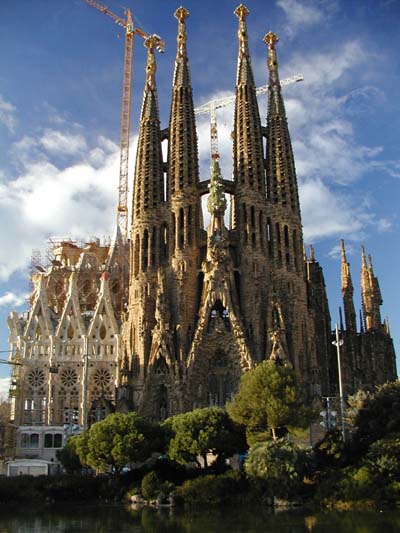
Pope Benedict XVI recently traveled to Spain for the dedication of Barcelona’s Sagrada Familia church, a modern cathedral designed by architect Antoni Gaudí.

On the plane traveling to Spain, Benedict responded to reporters’ questions and described his admiration for the Catalan architect’s vision, praising him for his ability both to work within the tradition of great cathedral building, but also for not being afraid to explore and develop new forms of creativity.  Said Benedict, “Gaudí had the courage to make himself part of the great tradition of the cathedrals. Using a completely new approach, he dared in his own time to make the cathedral a place for the solemn meeting between God and man. And this courage to remain within tradition, but with a creativity that renews tradition and shows the unity and progress of history, is a beautiful thing.”

“A creativity that renews tradition.” That’s actually a beautiful line, a beautiful way of expressing how Catholic Christianity, at its best, is enfleshed in and lived by God’s people at any one point in time. Ours is a living tradition, one that not only is open to renewal, but that actually requires renewal in each and every generation, in each and every age, and in each and every person. Rooted in that which has been received (which is what “tradition” means), but open also to living this out in ways that could not have been or were not envisioned earlier — this is the essence of a living, creative Tradition.

If Pope Benedict can see this so clearly in art and architecture as expressions of a renewed tradition, I wonder why the Pope is unable to see how contemporary understandings of human sexuality — understandings drawn from so many spheres of human inquiry — could also be described in this way? Contemporary understandings about sexual orientation, understood as an inherent part of who we are as individuals, leads us not away from the tradition, but deeper into it. It leads us to seeing that within God’s wonderful Creation, the diversity that is within the very DNA of humanity is itself a work of art, a beautiful creation reflected in the great diversities of the human family, including the diversity of sexual orientation.

For God’s gay and lesbian children not to live and love as they have been created by God to live and love would be like building a beautiful church like Sagrada Familia, yet never entering it, never celebrating liturgy in it, never using it as it was intended to be used. Churches are not merely works of art to be admired from afar, but are living expressions to house a living people. So too is every human person a living work of art, a living cathedral created by the Divine Architect, carrying within each of us part of the One who not only designed and created us, but who sustains our every breath.

May Pope Benedict and other church leaders come to see the beauty within the fullness of their gay and lesbian sisters and brothers no less than in a wonderful building like Sagrada Familia.

Homily for the 31st Sunday in Ordinary Time

For the communities of Dignity/NoVA at Emmanuel Church-on-the-Hill in Arlington, VA and Dignity/Washington at St. Margaret’s Episcopal Church, Washington, DC.

Oct. 30/31, 2010

Readings: Wis 11:22-12:2; Ps 145:1-2, 8-14; 2 Thes 1:11-2:2;  Lk 19:1-10One of the persistent themes in the writings of Franciscan Richard Rohr is summed up in the title of one of his books, “Everything Belongs.”  This basic concept – which is truly at the heart of not only Christianity, but also at the center of all great religious and spiritual paths – involves recognition of the fact that we truly grow only when we begin to move from seeing the world in a “dualistic” way to seeing it in a “non-dualistic” way. When we are able to move beyond the categories and boxes and labels that we use in almost every dimension of daily life, when we can begin to see what mystics of all spiritual traditions speak of as God or the Divine or Mystery or simply Love, then we are becoming more fully human, more fully ourselves, more fully alive.

Today’s Gospel passage tells a story in which it’s so easy to use categories and labels, to see things with “us and them” eyes.  Even commentators who write about this story and probably most homilists are usually quick to point out that Zacchaeus was a bad guy. There are lots of reasons for giving him this label and putting him in that box. By being not just a tax collector but a chief tax collector, he had opted to side with the Roman occupiers of Israel, those who oppressed his own people. Being a tax collector wasn’t just a job, but was something that he would have had to seek out as an enterprising businessman, an entrepreneur, a skilled negotiator and dealmaker. Because he is described as wealthy, he most likely had a lucrative arrangement with the authorities from Rome in which he paid the area’s taxes for the year up front, and then had the right to collect taxes from the people throughout the year; including whatever percentage markup or profit he could get. And of course, the fact that “the crowd” grumbles and refers to him as a sinner is further indication that Zacchaeus was seen as “the bad guy” and certainly not “one of us.”

Looking more deeply, however, some scholars suggest there is evidence that Zacchaeus wasn’t so bad after all. There are several indications in the text itself that suggest this. First, the Greek verb that is here translated in the future tense in the second part of this conditional sentence – “If I have extorted anything from anyone I shall repay it four times over” – could also be translated with a more present, ongoing meaning, in a way that indicates that such repayment, if it were necessary, had been his practice all along. Plus, there’s the fact that Zacchaeus is committed to repaying extorted funds not just in full, nor with a 20% penalty – as would have been required by Jewish law – but rather is committed to repayment “four times over,” which is what Roman law required, but required only for those who were convicted criminals. In addition, his very name – Zacchaeus – which occurs in the Scriptures only here and two other places – comes from a Hebrew word which means, “clean, pure, innocent.”

So … perhaps in his own way, our Gospel author is trying to tell us that things aren’t always as black and white as they seem. Even Zacchaeus … the traitor to his people by his chosen profession … may actually have carried out his work in a way that was fair and considerate and respectful. This is not to say he was perfect; by no means.  Even he recognizes his need and is drawn to Jesus.  And, in the presence of Jesus to whom he is open and whom he seeks out, Zacchaeus is transformed. For his part, Jesus sees Zacchaeus in all his fullness, in the totality of who he is. Jesus sees him as both good and not-so-good; honorable yet sometimes shady; generous yet highly tempted by money; a Jew as well as a collaborator.  Because Jesus sees with the eyes of God, he is able to proclaim Zacchaeus as a man of faith and a “son of Abraham.” In the midst of what seems black and white – there really is a lot of gray!

You know, it’s be been said that if any community should be a model of inclusivity and openness, it should be ours. As members of the LGBT community we individually and collectively know what it’s like to be excluded, to be rejected, to be told we’re no good, to be told we’re bad, or that we’re sinners not because of anything we’ve done, but because of who God has made us to be. And even while much of institutional religion and many loud voices in the public square continue to demonize us, aren’t we called – in turn – to be better than that?  Aren’t we called not to exclude, but to include? Not to close, but to open? Not to turn away, but to welcome? Not to hate, but to love? Not to demonize others, but to speak the truth in charity? Shouldn’t ours be the loudest of all voices in proclaiming that not only do we have a rightful place at the table, but so too does every man, woman and child on the face of the earth?

Here’s an example of what I mean about speaking the truth in charity. Even though some of the most vocal catholic bishops – like John Nienstedt from Milwaukee – continue to speak untruths about God’s gay children and our relationships – thankfully there are people like Fr. Michael Tegeder, pastor of St. Edward Parish, Bloomington, Minnesota.  After Bishop Nienstedt and the other Minnesota bishops sent a DVD to all parishes in the state, a DVD in which same-sex marriage was described as “a dangerous risk” for society, Fr. Tegeder had the courage to speak up, saying that the real danger to marriage was not the loving unions of same-sex couples; he voiced the truth borne out by evidence from so many sources, namely that biggest danger to stable relationships is poverty and the many stresses that come to couples and who are not able to take care of their families due to lack of financial resources.

This city was a busy place yesterday [“Rally to Restore Sanity“], as it was a number of weeks back when a similar event [“Restoring Honor” rally] was held. These two rallies – representing different aspects of the political spectrum – were both held on the Mall, that place that those of us from New England would call “the common.” The common is that public space in every village, town, or city where people could gather to express their views, to hear those of others, and where everyone was welcome. Certainly many of us would find ourselves more drawn to the views expressed at one of those rallies than the other. But regardless of our views on this or that public issue, and regardless of whether we express those views in simple conversation or the voting booth, shouldn’t those conversations and those votes be rooted in our belief that we are ALL children of the one God, the one God who calls us to love others as God loves us?

Let me end by reading once again part of that passage from Wisdom, asking each of you to remember that in God, everything, everyone does belong … and that in faith, we are challenged to do our part to ensure that no thing, no one is excluded from the banquet: “For you, God, love all things that are and loathe nothing that you have made; for what you hated, you would not have fashioned. And how could a thing remain, unless you willed it; or be preserved, had it not been called forth by you? But you spare all things, because they are yours, O LORD and lover of souls, for your imperishable spirit is in all things!”

NCR Commentary on the Hierarchy’s Usurpation of the Role of God’s People

Here’s a thoughtful and insightful commentary on what so many of us have known for decades. What commentator Regina Schulte says quite respectfully about the posture of the bishops usurping the vital roles of others, especially the laity, in the collective process of discernment could also be described biblically:  “Having eyes do you not see? Having ears do you not here?

These People are Not Christians

These people are not Christians. That needs to be said simply and clearly. One of the things that those who oppose same-sex marriage often state is the truth that merely stating something doesn’t make it so.  On this principle, they are correct; but it probably applies to them more than it does to anything they say. The mere fact that people like this call themselves Christian doesn’t make them followers of Jesus. The mere fact that they claim to be “bible-based” or “God fearing” doesn’t make them people of faith, people of love, people of charity. Jesus told us to love our enemies, to forgive those who persecute us. Their version of “Christianity” has little room for love or forgiveness, so filled is it with self-righteousness, intolerance, and even hatred of every modern-day Samaritan.

There’s a current country-music song getting some radio airtime by a singer named Josh Thompson.  This mean-spirited guy has a song entitled, Way out Here.  The song starts  with these words:

“Our houses are protected
By the good Lord and a gun
And you might meet ’em both
If you show up here not welcome, son.”

How is it that in America — and in particular, the American South — people have so twisted and perverted Christianity that someone could even think of such lyrics, let alone record them and have that song well-received by so many? What about the message of Jesus of Nazareth do they not get? How can they possibly reconcile a perspective which threatens murder simply because someone is different or “not welcome,” with a supposed belief in “the good Lord”?

If these people are unable to see the face of Jesus in the stranger at their door, is it any wonder they can’t see the face of Jesus in the foreigner, the gay man, the lesbian, the illegal immigrant, the Jew, the Muslim, the black President, or even “the enemy”?

They Should Get 5 Years

I don’t consider myself a vindictive person, and think that mercy needs to play a large role in the application of justice, but when I saw and read about this sad, tragic story, I said to myself that the two students who appear to be responsible for this young man’s death should be convicted and get the 5 year sentence that comes with the charges before them.

http://www.comcast.net/ve/1.0/1603345561/555/457/

Vatican Condemns Proposed “Koran Burning Day”

It’s not often that some small, fringe pastor and his version of Christianity receive papal attention.  Fortunately, the Vatican has stepped up to the plate and clearly condemned the planned “Koran Burning Day” being sponsored by Terry Moran and his Dove World Outreach Center (Gainesville, FL), which proudly proclaims the reasons for burning the sacred text of the world’s 1.5 billion followers of Islam.

Thoughts on a Rally

On Saturday (Aug. 28), I decided to ride my bike down to the Washington Mall to witness the “Restoring Honor” Rally organized by Glenn Beck.  Other than having an unexplainable sense that “I didn’t belong” and that “I think these these folks and I see the world very differently,” it’s been hard for me to articulate what I thought and felt about being in the midst of this crowd who were drawn to what I sensed was largely an anti-Obama celebration.  I realize that my sense of things was as much (if not more) an expression of my own biases than the real perspectives held by so many thousands of individuals, but that was my sense, nonetheless.

I didn’t hear many of the main speeches, but the bits and pieces I did hear were largely religious. I saw (on one of the large monitors) and heard bits of the remarks from Alveda King, niece of Rev. Dr. Martin Luther King, Jr. and the African American Outreach Director for the Roman Catholic group, Priests for Life. The part and prayer I heard dealt with abortion, but I heard no mention of or call to abolish the death penalty — one of the positions that Priests for Life espouses. I couldn’t help but wonder why?

Today’s Daily Meditation from Fr. Richard Rohr probably explains better than I can the underlying sense of division that seemed so palpable to me on Saturday.  Would that it were not so!

“We thought that we overcame racism in the 60’s; we thought the church overcame triumphalism at Vatican II, and now forty  years later we are right back into this regressive and dualistic thinking all over again.  …. this judgmental thinking will continue to happen in every group, in every denomination if we see everything with a dualistic mind.  No new emerging church will emerge very far.

The judgmental mind is not looking for truth; it is looking for control and righteousness.  For some reason when we split and refuse to receive the moment as it is, we end creating and even reveling in those splits as our very identities.  These are the culture wars and the identity politics we suffer from today.  They will not get us very far spiritually, because they are largely ego-based.”