
For more than a decade, the Catholic Church in Boston has more frequently been associated with priests and bishops who failed miserably in their personal and professional lives in protecting the most innocent among us. Finally, some truly “Good News” came yesterday when St. Cecilia’s Church celebrated its “All Are Welcome” Mass to proclaim the Gospel Message that all God’s children — including those whom God created gay or lesbian — are not only a part of God’s family, but are truly welcome in the doors and at the Eucharistic Table. I’m so very proud of my friend Fr. John Unni, pastor of St. Cecilia’s, for having the faith and the courage to stand up and proclaim what Jesus would no doubt have proclaimed.
Author Archives: Tim MacGeorge
Who is Joe Sacerdo?
The Boston Globe reports that the Mass “marking gay pride” is back on. A special liturgy with the theme “All are Welcome” was originally scheduled to be held at St. Cecilia’s in Boston on Sunday, June 19. Pressure from conservatives — including a blogger under the pseudonym “Joe Sacerdo” — apparently lead to the Mass being canceled by officials of the Archdiocese of Boston just days before it was scheduled to take place. Now the Mass has been re-scheduled for July 10. This is, indeed, good news!
When I saw the references to blogger “Joe Sacerdo” in the Globe stories announcing the Mass cancellation, I was surprised that an pseudonymous source was given such weight by a such a major news publication. Though I’m no journalist, it’s my understanding that media of a certain caliber have very strict guidelines on the use of “anonymous sources.” Globe reporters David Abel (see Canceled Mass outrages gays) and Mark Arsenault (see For one priest, the choice is clear) both admitted that they did not know “Sacerdo” was a pseudonym and that they would not have cited him as a source had they known this.
So the question is: Who is ‘Joe Sacerdo’?
Possibly a priest (the Latin word for priest is “sacerdos”), one wonders why this person, whether priest or not, feels compelled to hide behind the veil of a made-up name. If you are a priest, what are you afraid of Fr. Joe? While there are many reasons for choosing to write under a pseudonym, it’s hard to understand what such a reason might be in this case. The blog that Joe authors (Bryan Hehir Exposed) is “focused on sharing and exposing the actions and words of Fr. J. Bryan Hehir, Cabinet Secretary of Social Services for the Archdiocese of Boston and a key aide to Cardinal Sean P. O’Malley, O.F.M. Cap.” [Apparently Joe thinks that Fr. Hehir, a well-respected priest in Boston and throughout the country, is simply too liberal and needs to be “exposed”!]
Come to think of it, it’s rather ironic that Joe authors a blog about exposing someone else, while he himself remains pointedly unexposed.
All Are Welcome — Homily for Trinity Sunday
The Solemnity of the Most Holy Trinity – June 18/19 2011
For the communities of Dignity/NoVA at Emmanuel Church-on-the-Hill in Arlington, VA and Dignity/Washington at St. Margaret’s Episcopal Church, Washington, DC.
This is probably one of the least “theological” homilies I’ve ever given. The homily, after all, is supposed to “break open the Word of Scripture,” it’s supposed to be the time when we explore the meaning of what we’ve just listened to, when we take time to reflect on God’s Word and try to come to deeper understanding of the stories of our ancestors in Faith, seeking to see the Hand of God at work in our lives today, just as they saw the Hand of God at work actively in their lives so many centuries ago. The homily is an exercise in what might be called “theological reflection,” a time to reflect on and offer a lot of words about “The Word.” And yet, today we celebrate what is formally called the Solemnity of the Most Holy Trinity, this Sunday after the Feast of Pentecost that draws our attention to one of the most basic elements of our Christian faith, our belief that we express physically every time we sign ourselves with the Sign of the Cross and remind ourselves that the God in Whom we express faith is not just One, but rather Three in One. Whether we speak of Father, Son and Holy Ghost or Creator, Redeemer and Sanctifying Spirit …. Christians believe that God is fundamentally Mystery, Three in One in way that we can’t fully understand and surely can’t adequately express in words.
In fact, there’s a story about St. Augustine, the great theologian, who was walking along the shore of the ocean, pondering the Mystery of the Trinity, trying to understand the Trinity in new and different ways. He came across a child who had dug a hole in the sand and was busy pouring bucket after bucket of water from the ocean into the sandy hole. Augustine asked what he was doing, the boy replied: “I’m going to pour all the water of the sea into this hole.” Augustine told him, “That’s impossible. The whole ocean will never fit into that small hole you’ve dug.” The boy looked at him and said, “In the same way, you can never fit the Trinity into the smallness of your human mind.” And with that … the boy disappeared.
And so, because at the end of the day there’s very little that can be said about the Trinity Who is Mystery, I’m not even going to try. Instead, I’m going to tell you what happened to me last weekend! The Trinity may be about “Three Divine Persons in One God,” but my story is about “three priests in one weekend.” And no, that’s not the beginning of a bad joke with an even worse punch line, but it sums up what I experienced a little bit last weekend as I headed home to Massachusetts for my nephew’s high school graduation. It’s the story of three encounters with three very different priests. Each of these gives a little insight into the different ways in which “the Church” interacts with the community of which we are a part, God’s gay and lesbian children.
As I was waiting last Thursday to catch a flight to Boston, I had the thought that I would probably see a priest on my flight – Boston being such a Catholic city. And, sure enough, I did run into a priest whom I actually knew, a man who had been a seminary professor of mine years ago. And although we never discussed these matters at length, the only time the subject of homosexuality ever came up, even in a roundabout way, leads me to believe that he would probably be supportive of the Church’s official positions against things like same-sex marriage or a more progressive view of human sexuality. Priest Number 1.
After I landed and picked up my rental car, I began the 90 minute drive from Boston down to Cape Cod where my sister lives. I hadn’t had any lunch, so I stopped south of Boston to get a bite to eat. And as I paid for the burrito I had ordered at a Chipotle restaurant, I turned and saw Priest # 2 – a guy I had been in the seminary with me, ordained a few years after me. Dan – not his real name – left active ministry more than a decade ago in part because he found he could no longer minister in a Church that denied the full humanity of LGBT people. In fact, the Church’s position on this left him so angered and hurt, it virtually caused him to turn away from faith almost entirely. To this day, faith and religion practically have no place whatsoever in the life that he shares lovingly and openly with his partner of six years.
And so now we come to priest # 3. He’s the only one whose real name I’m going to tell. He’s also a friend of mine, a guy who was ordained four years after me, and is now the pastor of a vibrant, inner city parish in Boston. Some of you, I know, saw the newspaper stories about what happened at St. Cecilia’s parish last weekend, and what the pastor, my friend Fr. John Unni did in response. As part of its Rainbow Ministry to the gay and lesbian community, St. Cecilia’s had scheduled a special liturgy for this weekend with the particular theme, “All Are Welcome.” Well, because this Liturgy coincided with the Gay Pride events celebrated during this month of June, some anonymous people thought this was just unacceptable, and their complaints apparently caused the archdiocese of Boston to intervene and force the cancellation of that Liturgy. And, although that is indeed what happened, John still had the courage to stand up at Masses last week and preach the Gospel message that … at least in St. Cecilia’s Parish … ALL means ALL, and all indeed are welcome not as the Church or anyone else says they should be, but all are welcomed “AS THEY ARE.” Essentially John was preaching the message that – just as the Trinity is a community of Persons most notably characterized by love – so too is the Church of Jesus called to be a community of persons brought together in love, brought together as we are, as God made us – young, old, male, female, black, white, gay, straight, rich, poor, immigrant, native-born – each and everyone of us is – or, better yet, should be – welcomed in the family of God.
During this past week, I’ve read any number of commentaries and blogs about what happened at St. Cecilia’s and its pastor. The conservatives condemn the parish and pastor for doing anything to welcome gay people; while the writers on the left condemn the pastor for not acting more boldly, for not defying the Archdiocese and going forward with the cancelled liturgy anyway. I don’t envy my friend John, or the place he now finds himself in. However, as another John, John the Evangelist tells us so powerfully in today’s Gospel reading, God did not send Jesus into the world to condemn the world. Rather, Jesus came in the world as the very embodiment of unconditional divine love.
If Jesus came not to condemn, but rather to welcome, to accept, and to love – how can the Church of Jesus do anything less?
Archbisop’s Argument Supports Gay Marriage Argument
He doesn’t seem to know it, but Archbishop Timothy Dolan of New York is actually expressing public support for the basic values and arguments in support of same-sex marriage. In a blog entry entry entitled The True Meaning of Marriage, here’s what Dolan wrote just the other day:
 “Last time I consulted an atlas, it is clear we are living in New York, in the United States of America – not in China or North Korea. In those countries, government presumes daily to “redefine” rights, relationships, values, and natural law. There, communiqués from the government can dictate the size of families, who lives and who dies, and what the very definition of “family” and “marriage” means.”
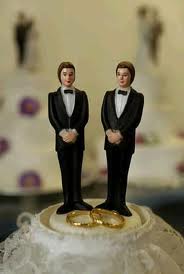 His point seems straightforward and simple enough — governments have little business involving themselves in defining or limiting the most basic and fundamental of human relationships. Isn’t this what the supporters of same-sex marriage are seeking to do, namely to have existing state laws updated to reflect this “less government intrusion in the lives of individuals” approach?
Except in those situations where there is potential harm to individual or to society (as in the case of children, or close relatives, or those already married), what interest does government have in placing limitations on which two adults — male, female, gay, straight, young, old, black, white, citizen, non-citizen, etc. — may or may not enter into that most fundamental of human relationships in which spouses commit to one another to share their lives, their resources, and their very selves?
Archbishop Dolan, I’m with you! Those government communiqués dictating limits on fundamental human rights need to stop. How best to do this? By telling the government it can’t limit these rights and by supporting marriage equality for all in New York State!
Are All Truly Welcome in the Church?
The Archdiocese of Boston has apparently decided to intervene in the liturgical life of St. Cecilia’s, a vibrant inner-city parish in the heart of Boston. As part of its outreach ministry committed to spreading the Gospel of Jesus, St. Cecilia’s had scheduled a liturgy for next weekend with the radical theme, “All Are Welcome.” Perhaps seeing this theme (which the parish bulletin did announce in conjunction with the celebration of Boston Pride 2011) as somehow contrary to that Gospel message, the archdiocesan powers-that-be forced the Mass to be cancelled.
Two ironies come to mind.
First, there’s the timing of it all. By that I’m not referring to the cancelled liturgy having been scheduled during this season of Gay Pride celebrations around the country, but rather the fact that the institutional church decided to cancel an “All Are Welcome” celebration during this Season of Pentecost. After all, Pentecost is when we celebrate the “birth of the Church” and are reminded in no uncertain terms that the Gospel message is intended not just for a few, but for all.
Second, there are the forces behind this action. I don’t claim to have any inside knowledge and know only what I’ve read in the media. However, the Boston Globe’s coverage seems to rely, in part, on the writings of a blogger using the pseudonym “Joe Sacerdo,” author of the blog, “Bryan Hehir Exposed.” It’s ironic that “Joe” (perhaps a priest, as “sacerdo” comes from the Latin meaning “priest”?) writes about “exposing” when he himself remains decidedly unexposed. To what can this be attributed other than cowardice, a mean spirit, or simply ill will? Veiling himself in secrecy, Joe seems to have no qualms casting aspersions on the good names of men like Fr. J. Bryan Hehir, one of the most well-respected priests in the country, and Fr. John Unni, the well-loved pastor of St. Cecilia’s.
I hope and pray that the Archdiocese will stand firmly with Fr. Unni, the Rainbow Ministry of St. Cecilia’s, and announce to the good people of the parish and the wider community that all, indeed, are welcome.
______________
Here’s what the parish bulletin said in announcing the liturgy:
“Liturgy to commemorate Boston Pride 2011
The Rainbow Ministry of Saint Cecilia Parish invites all friends and supporters of the LGBT community to a Mass in celebration of Boston’s Pride Month. The liturgy will take place on Sunday evening, June 19, at six o’clock, with a reception following. The theme of the liturgy, “All Are Welcome,” honors Christ’s message of hope and salvation to all people. We will also celebrate the diverse community that finds its home at Saint Cecilia and acknowledge, in a special way, the generous and warm welcome extended to the members of the Jesuit Urban Center in 2007. The Mass will be celebrated by Father John Unni and concelebrated by several of the priests who faithfully ministered at the Jesuit Urban Center for so many years. Please plan to attend this special liturgy and support the diversity that makes Saint Cecilia such a special place.”
Fr. John Unni Lives the Gospel
I’m proud to call John Unni a friend; but more importantly, he’s clearly a friend of Jesus, Whose love and message John lives daily.
I Never Knew!
So I was adding movies to my Netflix queue and one of the suggestions was, “Gay Sex in the 70s.” After adding it, Neflix asked if I wanted to “move it to position # 1.”
I never knew they were numbered!
“Go to the World”
 “Go to the world!
Go struggle, bless and pray;
the nights of tears
give way to joyous day…”
This past weekend marked an important one year anniversary for me. It was a year with many nights of tears; and I pray those tears will truly give way to joyous day.
Homily for the 5th Sunday of Easter – May 22, 2011
For the communities of Dignity/NoVA at Emmanuel Church-on-the-Hill in Arlington, VA and Dignity/Washington at St. Margaret’s Episcopal Church, Washington, DC.
There is a story based on that line from today’s gospel about Jesus going to prepare a place for his faithful disciples. It’s the story of a very wealthy man who died and went to heaven. He was met at the gates of heaven by Jesus, true to his word that he would prepare a place for his followers. Jesus led the man down many beautiful roads and streets, on the sides of which were beautiful homes. Each one was very different and unique, some larger, some smaller, some with beautiful gardens and landscapes – and as you looked at them, you could almost tell that they outwardly exemplified the character of the person who dwelled there. Finally they came to the end of a road and off to the side, behind some overgrown brush was a hut, a shack made of very cheap material, with no windows or even a door in the door frame. When the man realized that this was his new dwelling place, he asked Jesus why he was getting this rundown place when there were so many beautiful homes and dwelling places. Jesus simply looked at him and sighed and said, “Well, we did the best we could with what you sent us.”
I tell that story not simply for the humor in it, but because I think it does, in its own way, have a message for us today, especially as we find ourselves living in what everyone calls “tough economic times.” In such a period some in our world see a growing disparity between rich and poor, between those who enjoy many of the blessings of this world and those who struggle day in and day out to have the most basic human needs met. And … lest we think that the recognition of such tensions are new, or that they came to be only with the writings of Karl Marx and are expressive of some sort of “socialism” which most Americans find anathema … we need only listen to today’s first reading from the Acts of the Apostles. There, it is quite clear that there is a growing tension between one group and another, between those who have their needs met, and those who “are being neglected” in the daily distribution of the things that were held in common. In this “daily distribution,” the Greek-speaking widows in this early community of disciples were clearly relegated to second class citizenship, not being treated as equals, not being treated like the widows from the Hebrew and Aramaic-speaking part of the community were treated.
I don’t think we have to look very far to see that the labels of “second-class” or “third-class citizenship” – or even “no citizenship at all” – apply to countless millions here in our own country. There are indeed many who, like the Greek widows, “are being neglected” – a neglect that comes about because of the ways that we as a nation and as a world decide to spend our common and shared resources. Perhaps you heard recently about a letter that some 70 Catholic theologians sent to John Boehner in the days before he gave the commencement address at Catholic University last Sunday. While written very respectfully for the office he holds, the theologians representing a wide spectrum of views and approaches, pulled no punches in stating the following: “Mr. Speaker, your voting record is at variance from one of the Church’s most ancient moral teachings. From the apostles to the present, the Magisterium of the Church has insisted that those in power are morally obliged to preference the needs of the poor.” They then went on at length to point out some specific elements of the current budget process which – in their view – seem to be at odds with Gospel values and Catholic social teaching, and they called on the Speaker to sign what a number of Catholic Bishops and over 50 other Christian leaders of national organizations have signed. A “Circle of Protection” is a pledge that seeks to put into practice at the national level Jesus’ call to treat “the least of these” as we would treat Jesus Himself, being sure that “the voice of those who have no voice” is heard when decisions that affect all of us are being made by those whom we’ve elected.
Now, I say all this not because I wish to make a political point, to say that the positions of Mr. Boehner are wrong and that the positions of those who oppose him are right. We all recognize the complexities of the issues and challenges that we as a nation and a world face. Would that they could be solved as easily as the Apostles dealt with the problem they faced, simply by appointing others from among the community to carry on a neglected ministry, the ministry of diakonia / of service. Rarely do complex problems admit of easy solutions. Nonetheless, our Christian faith constantly reminds us that we must never lose sight of the simplicity of the goal … a goal which the Apostles achieved by ensuring that ALL in the community were cared for, were welcomed at table, and had their rightful share in that “daily distribution” of what was held in common.
And so, recalling that humorous story of the man disappointed with his dwelling place in heaven, let us take a moment today and in the days this week to ask ourselves, through our actions and our lives here on earth, what are we sending to Jesus who, even now, is preparing a dwelling place in heaven? What have I done today to care for the least among us, to care for those “who are neglected”? What will I do tomorrow to express my faith and carry on the work of the Lord in the communities of which I am a part? And, believing in a God of infinite love as we do, I suspect there’s room not just for 144,000, but for all God’s children who, as Jesus says, have faith in him and do his works.
Justice? Yes. Rejoicing? … Maybe not
A truly Christian perspective on the killing of Osama bin Laden in today’s blog posting at America magazine.
 Image and Likeness