Benedict XVI on Poverty, Wealth and the Responsibilities of States

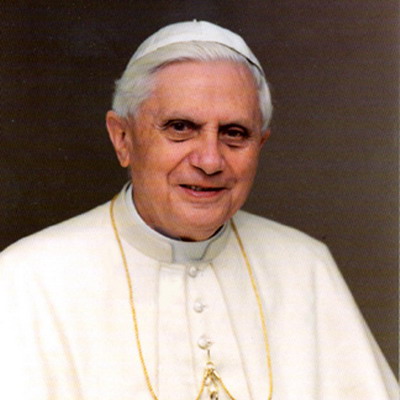
Pope Benedict XVI

Earlier today (May 4, 2012) in his address welcoming several new ambassadors to the Holy See, Pope Benedict stated:

“When poverty coexists with enormous wealth, a sense of injustice arises … Therefore it is necessary for States to ensure that legislation does not increase social inequality and that people can live dignified lives.”

I wonder how much this principle is kept in mind around the world as governments debate and pass legislation? How many Members of Congress, and their staffs, consider the growing disparity not only between the rich and the poor, but even between the majority in the middle and the extremes of either end?

How often do legislators ask this question when considering the many bills and motions and amendments that come before them in their work: “Will this legislation help people lead more dignified lives?”

Democracy: America’s Unopened Gift to the Church

We have a mission and a mandate, in independence and baptism, that will not allow slavery again in this nation, this time under the guise of religious tyranny. For we have been called to freedom by something even more awesome than the Declaration of Independence. We have been called to freedom by Christ. [emphasis added]

Anthony T. Padovano

That’s the closing paragraph of Chapter 2 in Anthony T. Padovano’s book, A Path to Freedom. The chapter’s title, The American Catholic Church: Assessing the Past, Discerning the Future, gives a sense of what it’s about. Padovano argues convincingly that we are in a unique moment in history where the ideals of American democracy can and must continue to push for reform within the Catholic Church.

Padovano is not naive. He notes:

The fact that Americans cannot bring democracy … to the Catholic Church at large is the single greatest failure of American Catholicism. The fact that American bishops repeat enthusiastically that the Church must not be a democracy is anti-American and anti-Christian. … Loyalty to Christ, after all, is not essentially connected with monarchy and ecclesial feudalism.

Democracy is without doubt the greatest gift that America has given to the world. Our system is not perfect, to be sure, but the ideals enshrined in our founding political documents envision a world very different from the world in which they were written. Those of us who’ve been both raised and long-educated in the the spirit and practice of Catholicism will agree that the values of democracy are not only consistent with but are natural sisters to the ideals of Catholicism’s world-view where charity, justice, and all God’s People live in freedom. Let me be clear: by Catholicism I mean the Catholicism of the broad universal Church with its rich tradition of intellectual rigor and pastoral sense of mission, and not the “Catholicism” that is increasingly characterized by anachronistic liturgical practice and a childish adherence to rules meant to form and guide and lead to freedom, not to squelch and imprison and lead to a slavery of the soul.

When and how will this gift of democracy be received by the institutional Church? Padovano notes some movement toward this over the past century, though that movement has been marked both by periods of great progress, as well as periods of retrenchment. It seem that this is where we are now, in a period where forces within the papacy, the episcopacy, the clergy and even among the laity are hearkening back to a fantasy vision of the Church they think once existed, but never really did. In noting a list of pressing pastoral issues that a small group of US bishops identified in 1995, this one seems to be the most overarching and is behind so much of what we see today: it’s the practice of Presenting the minority position of Vatican II as though it were the majority.

As American Catholics try to find a way forward during these challenging times, Padovano’s words are worth remembering … again, and again, and again.

We have come this far with broken hearts and bruised spirits, betrayed too often by shepherds who became predators and preyed on our trust. But no more. We ourselves were not always sinless. But the crimes of democracy are always less than those of tyranny. We are free of that now.

Amen!


These are some of my thoughts; what are yours? Would love to read your comments and feedback.

“Connected, but alone?” — Sherry Turkle’s TED Talk

If you’re not familiar with the TED Talks, you should be.  A “non profit devoted to ideas worth spreading,” TED (Technology, Entertainment, Design) engages in a number of activities that fulfill its mission:  Spreading ideas.

This TED Talk by psychologist Sherry Turkle looks at technology and texting and the many devices to which we have tied our ourselves, and wonders if expecting more from technology means we expect less of one another?

It’s a question that probably resonates with all of us.  I have a friend who, while no luddite, is definitely not infatuated with technology. I used to get slightly annoyed when I would call his cell phone and I’d get voicemail.  “Why doesn’t he answer?” I’d quietly wonder, thinking “I know he’s not at work, doesn’t he have his phone in his pocket, close at hand?”  When I was in his physical, real time company, however, I realized that his phone was not on, not accessible, and that if someone were trying to reach him, they’d get voicemail too.  You see, my friend had made choices about the importance of presence. He knew intuitively that “divided attention” is really “no attention,” and that when he is with he, he is truly with me. He knows that to be with another person, to enjoy his company, to engage her in conversation, all this means saying “Yes” to the “you” I’m with right now, and “No” — or at least, “Not right now” — to all others.

But it wasn’t this idea of presence that first jumped out at me. It was Turkle’s statement that our infatuation with technology and all our devices are getting in the way of people’s capacity for self-reflection. Time by oneself is necessary for healthy development, yet increasingly we hear of studies measuring the increased anxiety that comes with being “unconnected” to the virtual world.

Turkle is a psychologist and she speaks from that discipline. But it’s no great leap to hear her words from a spiritual perspective. The Hebrew and Christian scriptures are filled with examples bespeaking both the importance of true presence to one another, and the need for occasional trips into the desert, alone.

What richer lives we might lead if we can appreciate just a little more the real value of the present moment, including those moments of solitude which invite us more deeply into ourselves.  After all, it’s only by knowing ourselves as deeply as we can that we are able to share our true selves with one another.

61% of Irish Catholics Disagree with Bishops on Homosexuality

Irish people are often reported in the popular media to be “socially conservative,” the deep roots of Catholicism on that island nation often cited as the reason. Like most generalizations, such characterizations are not only overly simplistic, they’re often wrong. New findings from research conducted by Amárach Research for Ireland’s Association of Catholic Priests paints a very different, though not surprising, picture of the state of Irish Catholicism as seen from the perspective of the ones who really matter — Irish Catholics themselves.

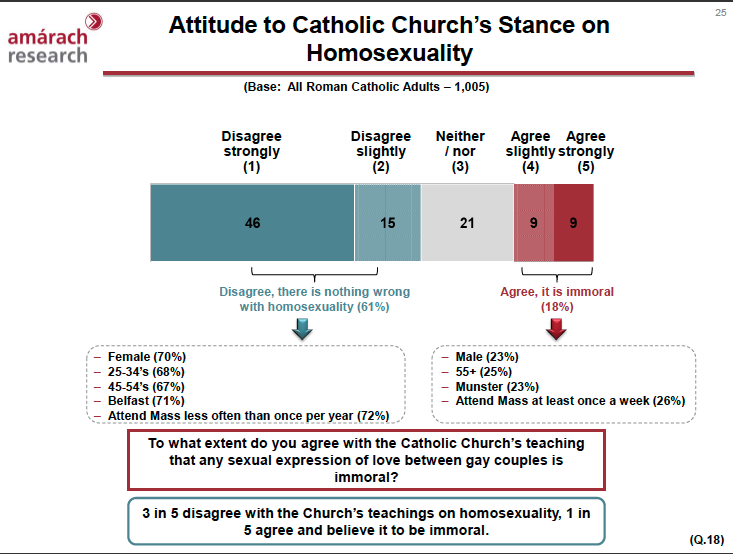
Take homosexuality, for instance. When asked specifically, “To what extent do you agree with the Catholic Church’s teaching that any sexual expression of love between gay couples is immoral?” only 18% agreed. A full 61% disagreed!

Views of Irish Catholics on "official" Church teaching about homosexuality (Amarach Research conducted for the Association of Catholic Priests)

The report covers a wide range of issues affecting Irish Catholicism today and is worth a look. See the full report here (pdf).

Benedict, Nuns, Christians…and “freedom” to proclaim the Gospel

In his daily meditation for today (April 24, 2012), Franciscan Fr. Richar Rohr writes:

I am not denying that Jesus could and undoubtedly did physical healing. It still happens, and I have seen it, but the healings and exorcisms in Mark’s Gospel are primarily to make statements about power, abuse, relationships, class, addiction, money, the state of women and the poor, and the connections between soul and body—the exact same issues that we face today. [emphasis added]

Just as Jesus’ actions made statements about those parts of the world in need of healing, so have the actions of many of his followers. In the United States, religious women — sisters and nuns (there is a difference, by the way!) — for more than two centuries have been at the heart and forefront of two of the most important activities of any society:  Education and Healthcare.  Communities of religious women have founded hospitals and clinics and hospices; they have opened schools and colleges and universities. And while they have ministered to people across the social spectrum, they typically would be willing to serve where others would dare not tread.

Even Pope Benedict XVI has praised the historic role of women in building the Church in America.  Just yesterday, the pope noted that two women from this continent will be canonized later this year — Blessed Kateri Tekakwitha and Blessed Mother Marianne Cope.

While recalling the historic role of women in the Church in the United States, the pope notably did not praise the current role played by so many tens of thousands of women religious in the daily lives of hospitals, schools, parishes and communities across this land.  Instead, he gave voice to that growing canard that the bishops of the US have latched on to, i.e. the notion that the “freedom” of religion is somehow under attack.  In concluding his speech to some visiting Americans, Benedict stated:

In these days I ask your continued prayers for the needs of the universal Church and in particular for the freedom of Christians to proclaim the Gospel and bring its light to the urgent moral issues of our time.

I don’t know where the Pope gets his information, though given the Vatican’s recent actions regarding congregations of women religious in the US (see coverage in US Catholic for one perspective), I suspect it’s not from very good sources. Concerning religious freedom, however, I’ve yet to see any roadblocks put forth hindering the proclamation of the Gospel or the light it sheds on the “moral issues of our time.”  What the Pope fails to understand is that his voice and the voices of his brother bishops are not the only voices empowered to proclaim the Gospel. The voices of religious women and men, of priests and lay people, all the Baptized together have a right and responsibility to proclaim the Gospel in both word and — like Jesus in Mark’s Gospel — in action. At times, those voices will differ as we collectively discern “the signs of the times” and struggle to understand where and how God’s Spirit might be leading us here and now.

Benedict rightly notes that “Christians” (he didn’t limit this to the hierarchy!) have the freedom to proclaim the Gospel.  I pray that he and his brother bishops will listen to the voices of Christians doing just that, even when what they have to say might not be what Benedict wants to hear!

“Addiction doesn’t work”

Richard Rohr writes (On the Threshold of Transformation: Daily Meditations for Men, Day 110):

Addiction happens when we no longer want to feel our feelings. Addiction happens when we don’t want to know our own thoughts or feel our own pain. But you know what? Addiction doesn’t work. In the long run, addiction brings ten times more pain than you would experience by accepting the legitimate pain of being a human being. Religion needs to be teaching this up front and without apology.

And by “addiction,” Fr. Rohr refers not only to alcohol, street drugs, or the abuse of other substances that those in treatment facilities and halfway houses are addicted to. He’s also talking about the unfettered consumerism and materialism of our culture. To this list, I would add the addiction to self-righteousness which, in the extreme, is expressed as hate. It’s the view heard so frequently on talk radio, seen often in the comments of “anonymous,”and even heard preached from pulpits. It’s the view that says, “I’m right, you’re wrong; I possess truth, and you are filled with lies.”

There are treatment options and 12-step programs for those struggling with alcoholism or drug addiction. But where’s the 12-step program for consumerism and the addiction to hate? Where’s the treatment plan for the addiction that never has enough “stuff” or that so quickly judges others who are “different” by equating “different” with evil?

The Divine and Religion

I’ve become mesmerized by the words, wisdom, and captivating brogue of the late John O’Donohue.  He died too young, but has left a lifetime’s worth of insight into life, humanity, beauty, the Divine, and the spiritual dimension we call soul so often ignored in our dizzyingly fast world.

Here’s a snippet from Wisdom from the Celtic World:

Everyone hungers and longs for the home that we call the Divine. And what’s really sad is that very often peoples’ ability to come into the Divine presence is most damaged by religion.

Religion has filled so many holy and lovely people with such a sense of fear and sense of guilt. And this fear and guild have often been used by religion to control people.

And you should never let any religious power or institution take away from you that intimacy and depth of belonging that you have to the Divine, because the Divine is your secret name.

LGBT Students at The Catholic University of America

Here’s my letter to John Garvey, President of The Catholic University of America, in support of CUAllies and their request for official recognition as a gay-straight student organization at CUA.

John Hugh Garvey, JD
President,
The Catholic University of America
Washington, DC

April 17, 2012

Dear President Garvey,

Last evening, I had the privilege of gathering with a group of CUA students and their friends in front of Gibbons Hall. We remembered the teachings of the Second Vatican Council (Gaudium et Spes) that the griefs and anxieties of the people of every age are indeed the griefs and anxieties of the followers of Christ. We recalled the teaching of the US Bishops (Always Our Children) that even those whom God created with a homosexual orientation are worthy of dignity, respect and the right to participate actively in their communities. We lit candles, walked to the Przbyla Center, and prayed.

As an alumnus of The Catholic University of America (National Catholic School of Social Service, MSW, 1998), I am writing to add my voice to the chorus of others expressing strong support for the request from CUAllies that this be an officially recognized student organization at CUA.

One of the most fundamental tenets of our Catholic faith is that each and every human person is created in the image and likeness of God. Every human person is to be treated with dignity, respect, charity, and love.  The Catholic understanding of the human person, informed by what we know from so many fields of inquiry, recognizes that one’s sexual orientation is essentially a given and relatively stable reality: it is not a choice or a “lifestyle” or a something that one can change.

You have the great privilege of leading a Catholic university, an institution which seeks not only to explore and impart the truths gleaned from so many fields of scientific and academic inquiry, but also the truths gleaned from the best of our Catholic Christian tradition. Truth, which cannot be incompatible with itself, challenges us to see the full human dignity even in God’s sons and daughters whom He created with a sexual orientation that differs from most of their brothers and sisters.  Some of these sons and daughters are members of the CUA community – they are faculty, staff and alumni. Most especially, however, they are students – students who deserve to learn and grow in an environment that not only tolerates their full humanity, but that also encourages them to grow in understanding themselves so that they are better able to understand others and the richly diverse world their education will help them to serve.

Please recognize CUAllies as an official student organization of The Catholic University of America.

Wishing you Easter joy,

Timothy MacGeorge, MDiv, MSW

Prayerful Vigil at Catholic University

It was great to gather earlier this evening with students from CUAllies, the gay/straight alliance at The Catholic University of America. CUAllies is not yet formally recognized by  CUA, as other student groups are. This gathering — not of protest but of prayer — bore witness on the grounds of this most Catholic of universities, praying that God’s LGBT children might enjoy at CUA the same rights and respect that as their straight brothers and sisters. Drawing upon our rich Catholic heritage, we heard passages from Vatican II’s Gaudium et Spes and the US Bishops’ Always Our Children. Prayers were offered on behalf of LGBT youth throughout the world — especially those who feel isolated and alone — that they might know there are people who love and care for and accept them just as God created them to be. 

This slideshow requires JavaScript.

“Show me your wounds” – Homily for the Second Sunday of Easter

April 14/15, 2012

For the communities of Dignity/NoVA at Emmanuel Church-on-the-Hill in Arlington, VA and Dignity/Washington at St. Margaret’s Episcopal Church, Washington, DC.

Readings

You may not remember where you were last year on this, the “Second Sunday of Easter,” and you may not know where you’ll be next year, but it just so happens that if you did or will miss Church on either of those days … not to worry! Because even though we have a 3-year cycle of Sunday Readings for our Liturgy, this Gospel from the 20th chapter of John is heard every year on this day. And no matter what we may think of some things when it comes to the institutional Church, there is usually great wisdom behind the selection of scripture readings that we have for our Liturgies. Even though the other two readings in our A, B and C cycles do change from year to year, this gospel story — about Jesus’s arrival in the locked room, John’s version of Pentecost, and the story of Thomas, the doubting “twin” — this story is heard in all three cycles. Because of this, I think it’s worth our special attention to look at this story very closely and see why it’s so central to the Easter message and what it means for us in our lives today.

Each of the elements of this passage from John is worthy of our full attention. You will remember that – of the four Gospels – the Gospel of John stands apart. The other three are referred to as the Synoptic Gospels, because they share many of the same stories, they are organized somewhat similarly, and probably drew upon some of the same oral traditions and sources. They were also written before the Gospel of John, which is sometimes called “the Last Gospel” because it was written later.

We could no doubt spend time reflecting on these “Resurrection Appearances” – on how the disciples are full of fear and therefore have locked themselves inside, separated from the outside world. Despite the locked doors, Jesus appears to them and he offers them the gift of Peace.

Likewise we could reflect on John’s description of how Jesus further strengthens these scared disciples by offering not only the gift of peace, but also by bestowing on them the gift of the Spirit. It is through this gift that the ministry of forgiveness and reconciliation springs forth, and it is through the Spirit the scared disciples will again – in time – not be afraid and will follow in the footsteps of Jesus more closely.

It is, however, this encounter with Thomas that I’d like us to focus on for just a bit. From a purely story-telling perspective, one wonders why Thomas wasn’t with the disciples on that first day. We might wonder, “Where was he and what was he doing?” Curious as those questions are, we should be careful not to get bogged down in them. If we do, we run the risk of missing the point of his initial absence. Because remember – what we are reading is not history or some journalistic re-telling of events that took place. No, what we are reading is Gospel. And Gospel is Good News. The author of John’s Gospel wants to emphasize the Good News that Jesus is indeed risen from the dead. The Johannine author wants to use a story about doubt to dispel whatever doubts may exist about the bodily resurrection of Jesus, the Crucified One.

And so we have Thomas demanding to see and experience for himself proof that Jesus is alive. This demand sets the stage for a second appearance – Jesus coming again into that same locked room, and offering again that same gift of Peace. Although John doesn’t say whether Thomas actually does put his finger into the nail marks and his hand into Jesus’ side, it is quite clear that any remaining doubt has been dispelled and Thomas now fully believes that Jesus was and is the Son of God.

Of course, none of us knows what the experience will be like when – God willing – at the end our lives we meet the Lord face to face. But earlier this week I read a possible vision of what that encounter might be like. The author suggested that when we do finally meet Jesus, He won’t question us about how well we carried out our religious obligations. He won’t be interested in whether we followed all the rules and regulations of religious practice; he won’t be interested in so much of the minutiae of life that we too often mistake for what is important. And, despite what many religious leaders and politicians seem to think, he probably won’t even be interested in our sex lives.

On the contrary, the author suggested that our heavenly encounter with Jesus will not be unlike Jesus’ encounter with Thomas. However, the table will be turned. Jesus will ask us to do for him what he did for Thomas. He will ask us to show him our wounds, the wounds that we have received as his faithful disciples, wounds that are the signs we’ve spent our lives imitating him. The wounds we have are not the wounds of soldiers or warriors or those who have engaged in battle; they are not the wounds of those who meet sword with sword, violence with violence. No, the wounds of discipleship come from living as Jesus lived, and most especially loving as Jesus loved.

For us as a community of LGBT people who seek to be such disciples, I often think that one of the core experiences of our communal lives to which all of us can relate is the experience of rejection. This experience, I think, is at the very heart of our call to discipleship. In the liturgy of last Friday we vividly recalled that Jesus, before he died, experienced the pain of rejection, the loss of friendship, and abandonment by those he loved. He knew that very human experience of what it means to give and receive nothing in return, to love and not be loved. And yet through all this, he remained faithful. He did not give in to the temptation to stop giving, to stop loving, or to lash out in anger and vengeance; nor did he give in to that ultimate temptation of thinking he had been abandoned by God. Is not this how we too should respond whenever we experience – as individuals and a community of disciples – that same rejection and abandonment? Many if not most of us bear the wounds of rejection – rejection that comes from family, from society, from the institutional Church, and sometimes even from one another. And yet, if we are able to find deep within our hearts the ability to respond to that rejection with compassion and generosity and love, then those wounds not only are healed, but they also bear witness to our faithfulness in the One who first and always has compassion, generosity and love for us.

Thomas’ doubts were dispelled by the privilege of physically seeing Jesus in Resurrection. As a people who have shared in the death of Christ through Baptism, who have received the Breath of the Spirit in Confirmation, and who are nourished by his living presence in Eucharist, we also have come to believe. We believe that we are the beloved daughters and sons of God; and we believe that for us and for all people, Jesus has overcome the pain of rejection and won victory of death for all time. And although we haven’t seen Jesus in the same way as Thomas and the other disciples did, our faith does indeed give us “eyes to see” the living presence of Jesus who is here, now, in our midst – and if you doubt that, just look around!