So what will Pope Benedict’s first tweet be?? As we wait, here’s an interesting discussion about possible ways to describe Twitter in Latin.


So what will Pope Benedict’s first tweet be?? As we wait, here’s an interesting discussion about possible ways to describe Twitter in Latin.
It’s a serious question.
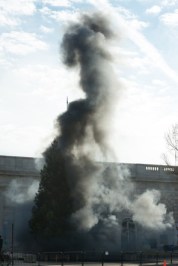
(Photo by Susan L. Voisin – Washington Post)
Chinese artist Cai Guo-Qiang exploded a Christmas tree on the National Mall yesterday.
Never mind that all didn’t seem to go according to plan, leaving onlookers (and even the artist) a bit disappointed (see the video).
My question is this: Why would this be considered “art” in the first place? What’s the artistic value of exploding or setting on fire anything, let alone the principal symbol of Christmas, which has both secular as well as intensely religious meaning to millions and millions of people around the world.
I realize that the artistic, creative side of my brain isn’t as developed as I’d like … but I really, really don’t get this. Anyone?
There’s no doubt that the Catholic Church these days isn’t very high on many people’s lists of respected institutions. There are many valid reasons for this, and there’s no need to restate them here. One of the great and sad side-effects of this largely self-generated reality is that the Church’s moral voice on so many important matters is not able to be heard.
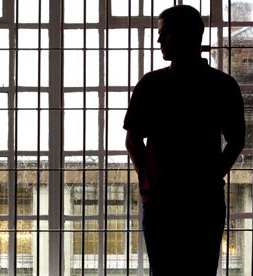 On Thursday, Nov. 22 (Thanksgiving Day in the US), Pope Benedict XVI spoke to European Directors of Prison Administration. His words are rooted in a Catholic Christian Weltanschauung of great depth and richness. As such, I wonder how much, if at all, they would resonate in contemporary American society and politics, especially among those in the public eye who wear their Catholicism or Christianity proudly, but whose politics reflect little of Catholic Christianity’s gospel-rooted values.
In speaking to those who run prisons and are responsible for the care and well-being of convicts, Benedict spoke about justice, about the need for rehabilitation (and not mere punishment), and about the need for their work to focus on the dignity of prisoners. How many American government executives (governors, etc) would say this to prison wardens and administrators in their state:
“Everyone is called to become his brother’s keeper, transcending the homicidal indifference of Cain. You in particular are asked to take custody of people who, in prison conditions, are at greater risk of losing their sense of life’s meaning and the value of personal dignity, yielding instead to discouragement and despair. Profound respect for persons, commitment to the rehabilitation of prisoners, fostering a genuinely educational community: these things are all the more urgent, in view of the growing number of ‘foreign prisoners’, whose circumstances are often difficult and precarious”.
In 2010 about 7.1 million adults were under the supervision of adult correctional authorities in the U.S. Over 3,000 of these were under a sentence of death (US Dept. of Justice, Bureau of Justice Statistics).
While the “Black” in today’s moniker of “Black Friday” might refer to the color of the ink on retailers’ profit statements, for prisons it no doubt has a different meaning. The disproportionate number of US prisoners who are African-American is startling (3.1% of the black male population, compared with 0.5% of the white male population) and the bleakness of prison life no doubt burdensome.
The pope ended his remarks on a somewhat poetic, hopeful note:
“Particularly important in this regard is the promotion of forms of evangelisation and spiritual care, capable of drawing out the most noble and profound side of the prisoner, awakening his enthusiasm for life and his desire for beauty, so characteristic of people who discover anew that they bear within them the indelible image of God.”
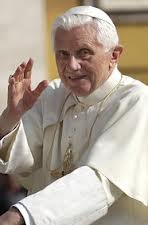
Pope Benedict XVI
Benedict XVI’s words from the Sunday Angelus (Rome, Nov. 18, 2012) provide a helpful perspective on a theme that is often overlooked by Catholics and misunderstood by others — Christian and non-Christian alike:
Jesus does not describe the end of the world, and when He uses apocalyptic images, He does not act as a ‘seer’. On the contrary, He wishes to ensure that His disciples in every age remain unmoved by dates and predictions, and gives them instead a more profound understanding, showing them the right path to take, now and in the future, towards eternal life. Everything changes, the Lord reminds us, but the Word of God does not change, and before it each of us is responsible for our own actions.
November 17/18, 2012*
For the communities of Dignity/NoVA at Emmanuel Church-on-the-Hill in Arlington, VA and Dignity/Washington at St. Margaret’s Episcopal Church, Washington, DC.

Rugged hills at Joshua Tree National Park
Apocalyptic. That’s the word that describes the readings we just listened to, as we hear both Daniel and Jesus speak about “those days after the tribulation.” And if you have any doubt that these are, indeed, times of tribulation and impending doom…well, just listen to the news. We can’t listen to the radio, or pick up a newspaper or turn on the TV without hearing of the impending “fiscal cliff” that lies ahead for the US economy and the dangers that await us all if we plunge off that cliff into some unknown abyss. Some in our country who may have a particular outlook on politics and society see in the outcome of the recent elections signs that the end of civilization as we know it is surely in sight … After all, the presidential election did not go as they had hoped; the first openly gay woman has been elected to the US Senate, and the citizens of four US states voted either to recognize same-sex marriage explicitly, or at least not to prohibit it constitutionally. But for me, however, the clearest signal that the end of the world is in sight came this week with the horrific news that Hostess is going out of business! What could be a more clear sign that the tribulation is at hand than the fact that Hostess Cup Cakes, Ding Dongs, Ring Dings and Twinkies are no more?!
Clearly, I’m joking. But it is true that all of these things are happening in our world today, just as it’s true that they are reported or discussed with great urgency and angst.
It’s also just as true that these types of readings that we have on this, the second to last Sunday of our Liturgical year, can be difficult for many people, especially those who don’t understand what the Bible really is. Those who think that the Bible is a single book and who take literally all that it contains fail to understand that the Bible is actually a collection of books – a small library, as it were – of books that were written over the course of many centuries, in different times and places, even in different languages, for different audiences and with different purposes. Biblical literature comes in many genres – including poetry, history, gospel, as well as the type of apocalyptic literature that we have today.
Today’s first and third readings are clearly apocalyptic writings. Historically, this type of literature seems to arise in unsettled times, times when the authors experience either imagined, exaggerated, or very real tribulation and crisis. It’s the kind of writing that comes about when people who are experiencing great hardship need to know that the hardship will not last forever and that they will survive.
Specifically, the passage from the Book of Daniel describes the time in the 2nd century BCE (Before the Christian Era) when Israel was occupied by the Syrians under the Syrian King Antiochus IV Epiphanes. Under his leadership, the Syrians tried to impose their language, culture and religion on the Jews. The Jews did not have the political or military strength to defeat the invaders, so they found solace in the belief that someday the Syrians would be defeated and leave. That belief gave them courage to endure present trials. They clung to what we as Christians, speaking of the Resurrection, call the “sure and certain hope” that God and God’s goodness would ultimately prevail.
Our Gospel passage from Mark was written when the community of Christians was still quite young. Christians were outsiders – and therefore despised by people and persecuted by the government. Although they were not seeking to replace Roman rule with Christian rule, it was this same experience of being excluded from the wider community that directed their vision to a world beyond the present day, to a time when their faith would be vindicated and the Reign of God, ushered in by God’s Son, would prevail.
I have to be honest and say that I typically pay little heed to Apocalyptic literature – even in the Scriptures. Probably that’s because it seems to attract an odd type of person, but also because they tend to generate in us a sense of anxiety and worry over things that we can do nothing about.
And yet, I also have to wonder if there isn’t a message for us in our own day about what these sorts of writings have to say, some two millennia further down the road of history? Is there a lesson to be learned, a truth to be uncovered, a pearl of wisdom to be appreciated in such writings?
Obviously the answer is yes. Two things come to mind. First, these writings, in drawing our attention to the future, remind us that the present day is passing away and that the world as we know it will not last forever. Our experience of life and the world tells us that all things evolve and change and ultimately pass away … pass away into we know not what. And so whether our future lasts for one year – or a trillion years – it really doesn’t matter, does it? Whether the Second Coming of Jesus happens in our lifetime or not – as it probably will not – it really doesn’t matter, does it? What matters is, as one scripture scholar put it, we need to see these apocalyptic writings “not so much [as] a warning about the end of the world, [but rather] as … a commentary on living in it. This day, this moment, this life, … NOW is the time to bear the fruit” as faithful disciples of the Lord. Now is the time for us to live lives rooted in justice and charity. These writings may draw our attention momentarily toward the future; but they also serve as a reminder that the only real moment we have is NOW.
And so NOW, we believe that life is meaningful and has purpose. We believe that in some way unknown the hand of God is at work in human history. We believe that goodness and not evil will have the last say. And most especially – coming from our own experience as outsiders, as individuals and as part of communities who know what it means to be excluded – we believe that every person on the face of this earth reflects the eternal beauty of the Divine Image and is worthy of dignity, respect, and love.
As we come to the end of this church year, as we celebrate our national day of Thanksgiving this week, and even as we struggle as a Church, a Nation and a World to work together for the good of all, let us make our own the words of the Psalmist: “You are my inheritance, O Lord! You will show me the path to life, fullness of joys in your presence, the delights at your right hand forever.”
*I typically draw upon many sources in preparing my homilies. But this one owes a particular debt to Roger Vermalen Karban and James Smith, Preaching Resources for the 33rd Sunday of Ordinary Time, Celebration Publications (www.celebrationpublications.com).
(c) Copyright 2012 – Timothy J MacGeorge
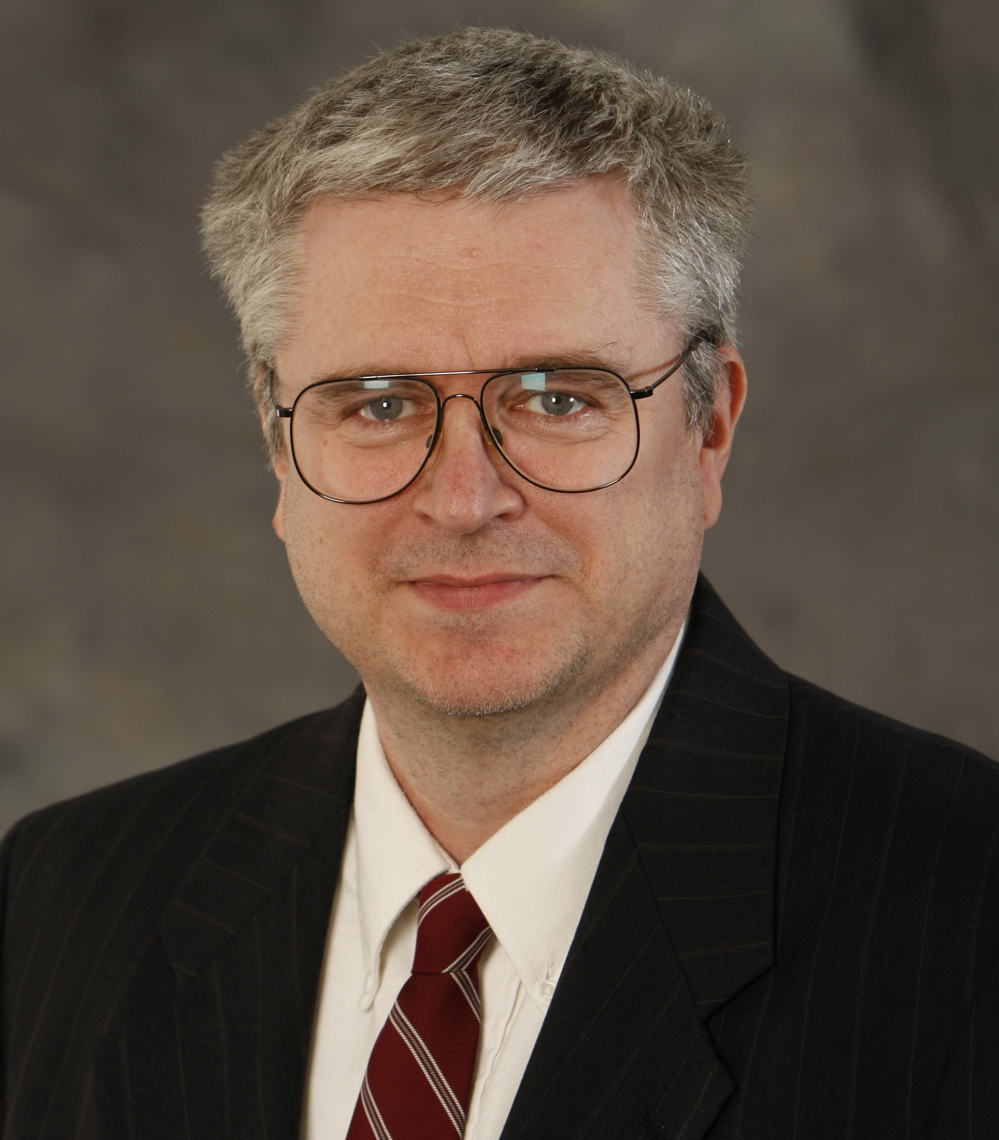
Canon Lawyer Edward Peters
Edward Peters, JD, JCD is a canon lawyer. I occasionally follow his blog, as he sometimes has interesting posts about his take on Church matters in the public eye. I say “occasionally” because his blog does not allow comments or feedback, so I prefer not to give my own time to bloggers who do not allow for such engagement. After all, isn’t engagement and interaction what blogging and the tools of social media are all about? In this regard, I think Dr. Peters confuses “blogging” with “lecturing” … but I digress.
That said, his recent post, Confirmation and advocacy of ‘gay marriage’ [sic] cries out for response.
Two points:
First, my “[sic]” notation is to draw attention to the fact that Dr. Peters is one of those folks who puts the phrase gay marriage in quotations or otherwise off-sets it as a means of communicating that they do not think such a thing is real. If he were speaking to you in person, you could just see him holding up both hands and making finger-quotes as he voiced that phrase, as if to say, “they call it ‘gay marriage,’ but we know such a thing doesn’t really exist.” They think that God’s gay sons and daughters — living their full humanity, including their sexuality, as given by God — are incapable of entering into marital relationships with someone of the same sex. Instead of seeing with open eyes and thoughtful minds the evidence from so many human sciences, including theology (not to mention the lived experience of millions of gay men and women living in committed relationships), Dr. Peters prefers the blinders of ecclesiastical legality to the truth self-evident to so many.

Lennon Cihak
Second, Dr. Peters’ post discusses the situation of a young man who has been denied the Sacrament of Confirmation for his opposition to Minnesota’s recent ballot initiative that would have included in that state’s constitution language limiting marriage to one man and one woman. Peters focuses his brief post on the meaning of “proper disposition” as one of the criteria necessary for the Faithful to share in the sacraments.
I do not take issue with this basic principle of sacramental theology. The sacraments in our Tradition are indeed not to be taken lightly and must be appreciated as the gifts they are, a means by which God’s People share more fully in God’s grace. Sacramental participation requires a minimal understanding of what a particular sacrament is all about; a freely-expressed desire to share in the sacrament; and the expressed intention to live one’s life as best one can with the fundamentals of Christian faith.
Peters, however, goes on to observe the distinction between “internal disposition” and “external disposition” as follows:
Generally “proper disposition” is not a question of internal disposition (such as interior faith, fervor, or grace) but rather of external disposition (public demeanor, dress, and conduct). The state of a would-be recipient’s soul is not determinable, of course, but his or her attitudes and conduct are observable (we’re talking Facebook, no?), and potentially actionable.
In all fairness, Peters does not state explicitly that the pastor’s action in this situation was correct. A benign interpretation of Peters’ post could be merely that it points out that Church order allows for a pastor to refuse the sacraments in certain circumstances. Priests and pastors do and should have this right. After all, a pastor can and must deny marriage to someone who is already married, or Eucharist to someone who is not Baptized and has no intention of living the Christian life (as they, the potential recipient, would declare).
Nonetheless, a more likely interpretation of his post is that Peters supports the pastor’s decision — and it is with this, i.e. that the pastor’s decision was correct, that I (and others) take issue. Despite what Dr. Peters’ and the USCCB say formally about civil marriage, the fact is that a majority of American Catholics support the rights of God’s LGBT sons and daughters to marry the person they love. Would Dr. Peters deny the sacraments to these millions of Catholics? Or only to those who wear a rainbow ribbon on their lapel or post a supportive photo online? And, of course, why be limited to support for civil-marriage as the litmus test for deciding appropriate “external disposition”? There are countless issues where millions of Catholics hold different positions than do official Church leaders — civil divorce, war, immigration, capital punishment, to name but a few. Would every Catholic, for example, who holds that civil divorce should be allowed in a pluralistic society likewise be denied the sacraments?
My point is this: the denial of confirmation to this young man was a bad decision. Using the sacraments as tools of discipline (especially when that discipline is misguided) is a bad idea. It’s a lesson that this pastor — and the US bishops — need to learn.
Reflections
“One’s biggest secrets and deepest desires are usually revealed to others, and even discovered by ourselves, in the presence of sorrow, failure, or need when we are very vulnerable and when one feels entirely safe in the arms of someone’s love….People who have avoided all intimacy normally do not know who they are at any depth—and cannot tell others who they are.”
I spent this past week at a conference in San Francisco on ADHD, the annual conference of the non-profit organization where I work. The closing plenary was by a renowned neurologist, Dr. Martha Denckla from Baltimore’s Kennedy-Krieger Institute. Dr. Denckla is a true scientist, relying on the facts and what empirical data show in drawing her research conclusions.
During the Q & A after her presentation she was asked by one attendee, “What’s your opinion of [some named product making claims about alleviating ADHD symptoms]?” Without missing a beat, Dr. Denckla replied, “I prefer not to have opinions. I prefer evidence over opinions.”
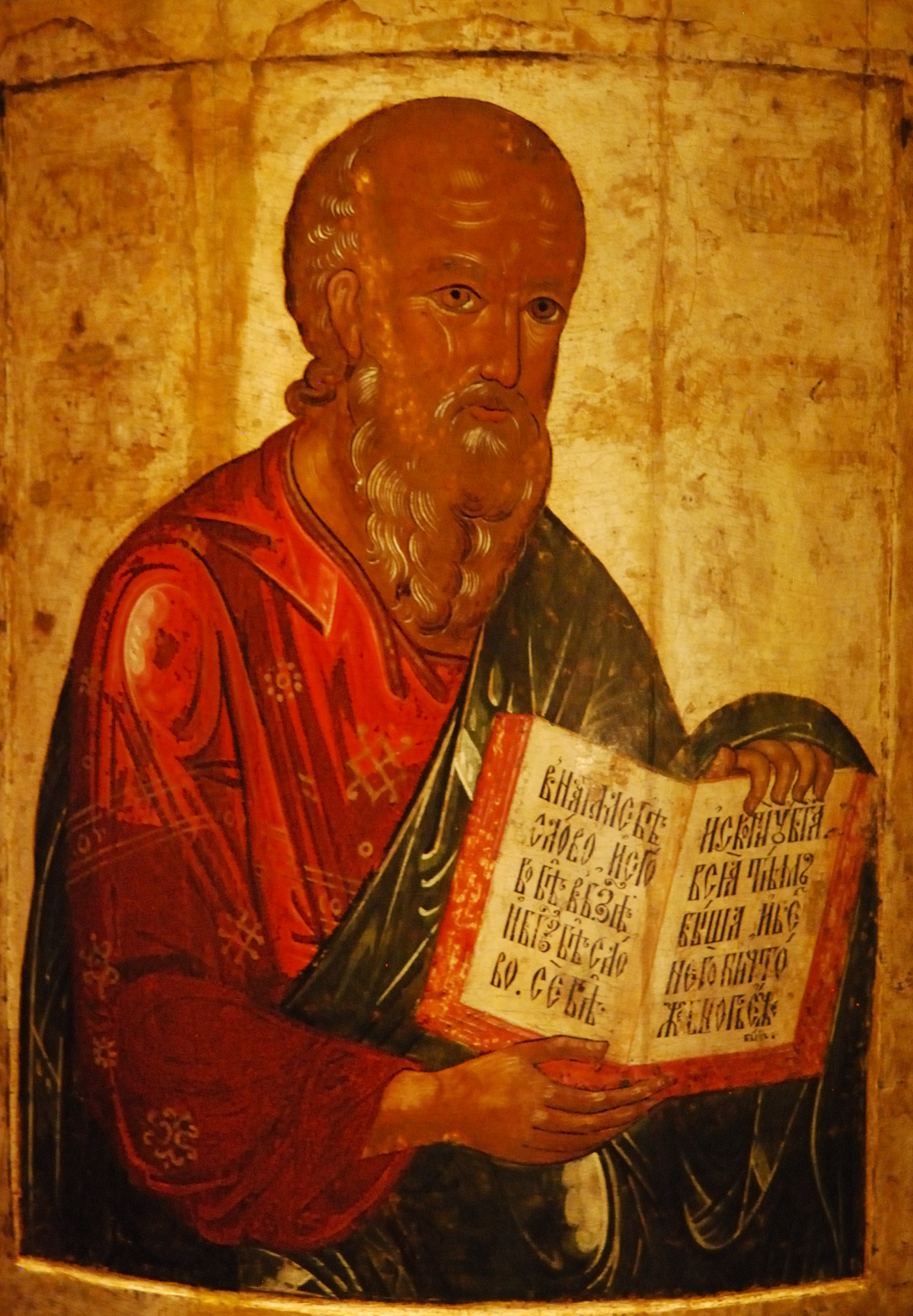
Russian icon from the collection at Hillwood Museum.
Such wisdom would serve well current Church leaders who continue to bury their heads in the sand, choosing to remain blind to the incontrovertible evidence about what it means to be gay. As the US Catholic Bishops have their fall meeting in Baltimore this week and discuss (as no doubt they will) what to do in response to last week’s election, the wisdom of those words deserves repeating. The bishops (both in the US and around the world, including Rome) would do well to take a dose of humility for a change and simply listen. They should listen to the evidence of the lives of LGBT people, their families and friends, as demonstrated in the favorable votes in four states on same-sex marriage. They should put aside their opinions, based as they are on outdated and incorrect understandings of human sexuality, and they should listen to the evidence that tells us that:
As the US and worldwide bishops continue to look away from the clear evidence of research and most especially the evidence of the lived experience of God’s LGBT children, they run the risk of being guilty of remaining in what moral theology calls “vincible ignorance.” Unlike “invincible ignorance” which cannot be overcome due to one’s own efforts, vincible ignorance is that lack of knowledge for which one is morally responsible. As shepherds of God’s People, bishops have an obligation to know the people they are called to serve.
They have an obligation to listen to the stories of gay men and women who live lives of deep Christian faith and who live in faithful, committed relationships. They need to listen to the stories of parents whose gay children have suffered bullying and abuse at the hands of others inspired, in part, by the hateful language of “disordered” and “unnatural.” Perhaps especially they need to listen to the stories of their own lives (many bishops, no doubt, are gay themselves) as well as the stories of their family members and friends.
The lived experience of God’s People is not only a legitimate source of insight into clarifying and articulating anew the Christian message in every age; it is a required source of such insight. If we really believe that God is actively involved in the lives of His People, then it is the evidence of God’s action in human lives that deserves recognition, respect, and support.

Nov. 6, 2012 – Election Day in America: It’s not often that I have a window seat when flying, preferring as I do the easy access and extra leg room of the aisle. This morning, however, I was assigned a window on the first leg of my two-flight trip to San Francisco. Leaving DC and heading for Dallas on Election Day 2012, we ascended to our cruising altitude of thirty-eight thousand feet, as the captain announced. Others around me settled in, putting on their headsets, taking out their iPads or laptops to read a book or watch a movie. As my seatmate pulled out a pile papers and printed emails, reading over material that was clearly for work and not for pleasure, my own eyes were captivated by the beauty of the snow-capped mountains of West Virginia, the sculpted mountains of the landscape below.
Ours is indeed a beautiful country. Although I don’t consider myself a particularly patriotic person in the “gung ho-America-right-or-wrong” sort of way, I doubt there is anyone among us who is not proud in a healthy-pride sort of way of the country in which we live. The rancor and ugliness of political campaigns – which we all seem to agree is getting worse and not better – doesn’t show to ourselves and the world what is Best about America and, more importantly, what is Best about Americans. In these post-election days, wouldn’t it be nice to have respite from it all and simply be thankful for the beautiful land in which we live, the many blessings in which we share, and the graced faces of God’s people who touch our lives every day.
UPDATE: Apparently in response to a request from Archbishop William Lori of Baltimore, the video of Fr. Lawrence’s homily has been removed. A request to the parish and to the video owner for information about its removal have gone unanswered.
It is sad indeed not only that the archbishop would make such a request inhibiting the free discussion of ideas so that Catholics can make well-informed decisions when entering the voting booth, but also that those responsible for the video’s removal would succumb to such pressure. Fortunately, the audio of the homily remains available on the website of St. Vincent de Paul where Fr. Lawrence serves as pastor. Homily of Fr. Richard Lawrence, October 28, 2012 (parish website).
And, in case the audio is eventually removed, a copy of the mp3 file may also be found here: Homily of Fr. Richard Lawrence, October 28, 2012.
As any churchgoer can tell you, it’s the rare homily that is met with applause. I don’t remember one of my own homilies ever receiving an ovation, though I suspect if it ever happens in the future, it will be out of thankfulness that I’ve stopped talking!
This homily, however, is definitely worth the applause it receives. We need more Catholic priests and pastors to do what Fr. Richard Lawrence, pastor of St. Vincent de Paul Parish (his parish website “bio” is worth reading!), did this past weekend in Baltimore. With respect and balance and intellectual honesty, he does what a pastor should do when it comes to helping parishioners form their consciences in matters of public import. Unlike Archbishop Lori, whose letter he reads at the beginning, Fr. Lawrence does not tell his parishioners how to vote on Ballot Question 6: The Civil Marriage Protection Act. Rather, he encourages them to continue to form their consciences faithfully, as best they can, and to vote accordingly.
102812 Homily from Jerome Bird on Vimeo.
 Image and Likeness